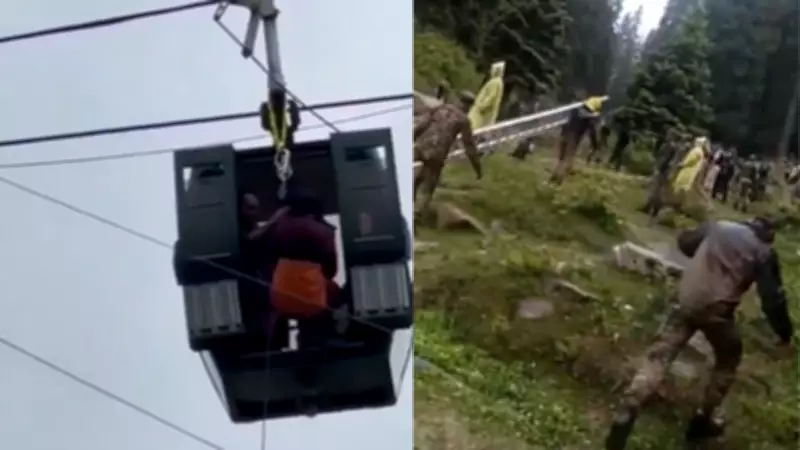
The Jammu and Kashmir government on Thursday constituted a committee to inquire into the circumstances leading to the technical malfunction of the Gulmarg Gondola on May 25, when more than 300 tourists were trapped for up to seven hours, triggering panic and a large-scale rescue operation by the police and Army. Since the incident, Gondola operations in Gulmarg have been suspended indefinitely.
Committee Composition and Mandate
The five-member committee, headed by Mahmood Ahmad Shah, Managing Director of the Jammu and Kashmir Power Development Corporation, will submit its report, along with findings and recommendations, to the Tourism Department within 10 days, according to a government order. The committee has been tasked with a comprehensive investigation.
Technical Examination
The committee will conduct a detailed technical examination of the malfunction, investigating the nature, cause, and extent of the failure. This includes examination of the mechanical, electrical, electronic, braking, communication, control, and safety systems associated with the operation of the cable car gondola system. It will also examine operational logs, fault indications, monitoring systems, alarms, inspection reports, maintenance records, and other technical documentation relevant to the incident.

Operational and Human Factors
The committee will further examine whether any operational lapse, negligence, procedural deficiency, communication gap, supervisory failure, human error, or administrative shortcoming contributed directly or indirectly to the occurrence of the incident. The government has also asked the committee to evaluate the adequacy and effectiveness of the emergency response measures undertaken during and after the incident, including emergency communication systems, evacuation procedures, passenger safety protocols, coordination among concerned agencies, and overall crisis management arrangements.
Background of the Gulmarg Gondola
The Gulmarg Gondola has two phases. The first phase has 63 cabins, each with a capacity of six passengers, and carries tourists to Kongdori at an altitude of 8,530 feet. The second phase, with 34 cabins, operates from Kongdori to Apharwat, reaching an altitude of 12,293 feet. The snag developed in the first phase, leading to the suspension of operations in both phases of the cable car system for safety reasons. The Gondola was commissioned in 1998 as a joint venture between the J&K government and French engineering firm POMA. It is among the world's highest ropeways and has not suffered any accident in its 28-year history.