Kolkata Travelers Face Chaos as Middle East Airspace Shuts Down
Flyers from Kolkata returning to the city from the United States and Europe found themselves stranded in the Gulf and Europe over the weekend. This disruption occurred after vast airspace in the Middle East was abruptly closed to traffic, a direct consequence of military strikes on Iran by the US and Israel. The situation has led to significant travel delays and cancellations, affecting hundreds of passengers.
Widespread Flight Cancellations and Diversions
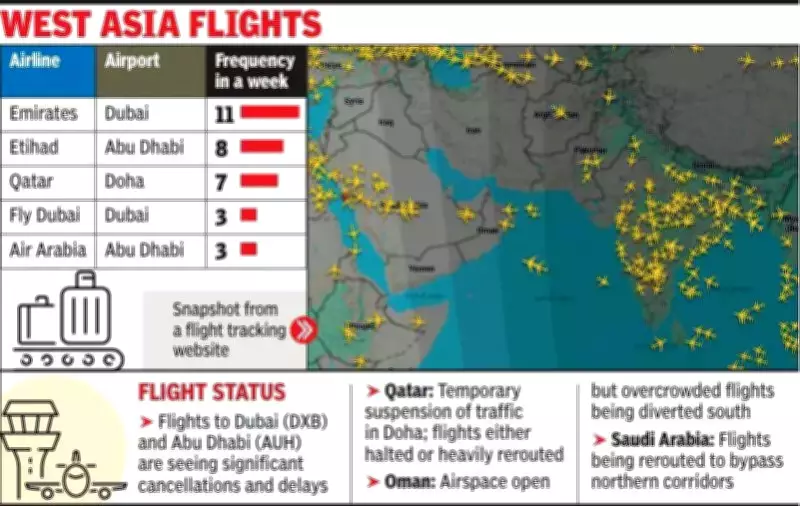
Hundreds of passengers scheduled to travel from Kolkata to destinations such as Dubai, Abu Dhabi, and Doha on Saturday were held up in the city. All west-bound flights from Kolkata were cancelled, creating a ripple effect across the region. Air traffic control officials in Kolkata reported that the scale of disruption was immense, with scores of flights over the Arabian Sea seeking diversions. This surge overwhelmed controllers at Mumbai airport, exacerbating the chaos.
A senior official from Mumbai's air traffic management explained the severity: "All flights heading west from Mumbai typically pass through Muscat. From there, they proceed to Jeddah or Emirates. Currently, Muscat is not accepting any flights destined for Emirates, nor is it allowing landings at its own airport. Additionally, Mumbai and Karachi airports are also refusing flights. We are struggling to find alternative airports for a dozen flights over the Arabian Sea."

Specific Incidents and Carrier Responses
One notable incident involved a Qatar Airways aircraft traveling from Hong Kong to Doha, which was diverted to Kolkata at 5:15 PM after the destination airport remained shut. From India, the first diversion was an Air India flight from Delhi to Tel Aviv. In response to the escalating situation, Air India later announced the suspension of all its flights to the Middle East, further complicating travel plans for many.
Travel agents in Kolkata scrambled to reroute flyers heading to the US via alternative hubs such as Singapore, Bangkok, and Kuala Lumpur. This adjustment is critical because approximately 70% of flyers traveling to the US from Kolkata typically use Gulf hubs for connections. The agents also urgently advised customers flying to Europe to postpone their travel, citing safety and logistical concerns.
Historical Context and Economic Implications
This is not the first time such disruptions have occurred. Last year, during a similar Israel-Iran conflict, hundreds of flights were cancelled, and thousands of flyers were held up at various airports for at least 48 hours. In Kolkata, travel agents worked feverishly to make alternative bookings, aiming to secure arrangements before fares escalated. Reflecting on past events, the conflict in the Gulf in 2025 led to a 20% increase in airfares, highlighting the economic impact of such geopolitical tensions.
Anjani Dhanuka, chairman of the east chapter of the Travel Agents Association of India (TAAI), commented: "A majority of people traveling from Kolkata to Europe or the US rely on Gulf carriers due to the absence of direct flights from the city. With a war now erupted, travel agents in Kolkata are strongly advising travelers to avoid hubs like Dubai, Abu Dhabi, and Doha."
Long-Term Concerns and Travel Alternatives
Anil Punjabi, chairman of the east chapter of the Travel Agents Federation of India, expressed deep concern as the conflict in the Middle East appears to be becoming protracted. He warned that if it becomes unsafe to travel through the Gulf, carriers will be forced to take long detours. This would result in increased fuel consumption by aircraft, subsequently leading to higher airfares and extended travel times.
For instance, a flyer heading to New York might now have to spend 30 to 40 hours traveling via Singapore, depending on layover times. In contrast, the same journey via Dubai would typically take between 21 and 25 hours. This significant increase underscores the broader implications of the airspace closure on global travel logistics.

The ongoing situation has left Kolkata's travel industry in a state of flux, with agents and passengers alike navigating unprecedented challenges. As the conflict unfolds, further disruptions and economic repercussions are anticipated, making it a critical issue for international travelers and the aviation sector.