Qantas Project Sunrise to Revolutionize Ultra-Long-Haul Travel with Historic Non-Stop Flights
Passengers traveling between Sydney and London or Sydney and New York will soon experience a groundbreaking aviation milestone. Australia's national carrier, Qantas, is preparing to launch what will become the longest direct commercial flights ever operated, covering distances exceeding 10,000 miles without a single stop. This ambitious initiative, known as Project Sunrise, is scheduled to commence in the first half of 2027.
Unprecedented Journey Times and Aircraft Specifications
The new routes will connect Sydney to London, spanning 10,573 miles, and Sydney to New York, covering 10,100 miles. Each journey is projected to last approximately 22 hours, effectively allowing travelers to witness the sunrise twice during a single flight as the aircraft chases daylight across the globe. By eliminating traditional refuelling stopovers, Qantas estimates that these non-stop flights could reduce travel times by up to four hours compared to current options.
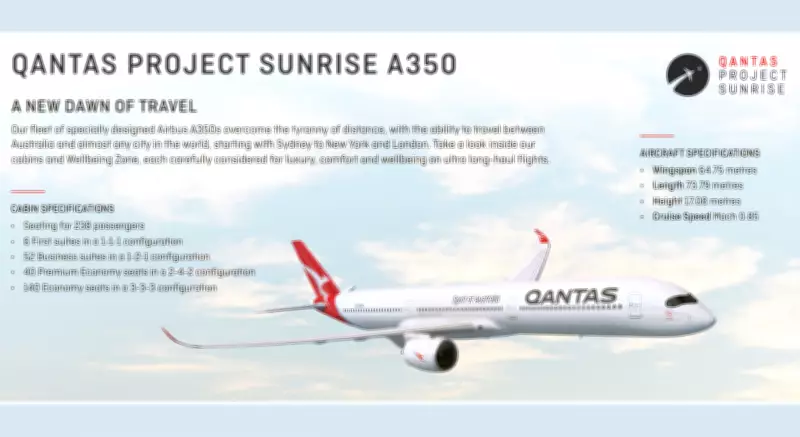
The specially configured Airbus A350-1000ULR (Ultra Long Range) aircraft will power these historic routes. Qantas placed an order for 12 of these modified planes in May 2022. Equipped with Rolls-Royce Trent engines and an additional 20,000-litre fuel tank, these aircraft can travel significantly farther than standard A350 models. The first delivery is expected by the end of 2026, with trial flights planned between Australia and New Zealand for pilot and crew familiarization.

Transforming Passenger Experience and Wellbeing
Qantas Group Chief Executive Officer Vanessa Hudson announced the project at a Los Angeles International Airport hangar event in September 2024. She emphasized that Project Sunrise aims to overcome the historic "tyranny of distance" that has long defined travel to and from Australia. Hudson stated, "These flights will cut up to four hours off the journey and transform how people experience ultra long-haul travel, through science-backed design to minimise jetlag and maximise wellbeing."
The aircraft's interior is designed with passenger comfort as a priority. Instead of the usual 300-plus seats, the Project Sunrise layout will accommodate only 238 passengers, arranged as:
- 6 First-Class suites (1-1-1 configuration)
- 52 Business suites (1-2-1 configuration)
- 40 Premium Economy seats (2-4-2 configuration)
- 140 Economy seats (3-3-3 configuration)
All cabins will include complimentary high-speed Wi-Fi, and the reduced seat count allows for more space to move during the extended journey.
Innovative Wellness Features and Jetlag Reduction
One of the most distinctive features of the aircraft is a dedicated wellness zone at 35,000 feet. Designed to help passengers manage the physical strain of nearly a full day in the air, this space offers:
- Self-serve healthy refreshments to maintain hydration
- Room for stretching and light exercise
- Large screens displaying guided stretching routines
- Exercise handles on walls to support movement
Daily Mail reporter Paudie Prendergast, who previewed the project, described the area as "effectively a yoga studio (of sorts) at 35,000ft, or simply somewhere people may wish to socialise." Interior designer David Caon, who has worked on the project since 2018, highlighted the complexity of balancing aesthetics with engineering constraints, noting that a team of six worked full-time for two years on aspects like weight, maintainability, safety, and comfort.
To address jetlag, Qantas partnered with the Charles Perkins Centre at the University of Sydney. Research from this collaboration has influenced cabin design, including lighting systems that replicate the "unique quality of light in the Australian Outback" and meal services timed to match passengers' circadian rhythms, aiding adjustment to new time zones.
Historical Context and Future Implications
The name Project Sunrise originates from a unique characteristic of these ultra-long flights: travelers will see two sunrises during a single journey. This echoes aviation history, where "Double Sunrise" flights operated between Perth and Ceylon (now Sri Lanka) during World War II, with missions so long that the sun rose twice.

Historically, the Sydney-London route, known as the "Kangaroo Route," took several days in the 1940s, with stops in cities like Darwin, Singapore, and Cairo using propeller-driven Lockheed Constellation aircraft. Today, a journey that once required four to five days could soon be completed in under a single day.
Project Sunrise will surpass the current longest non-stop passenger flight, the Singapore-New York route lasting just over 19 hours. Unlike other long routes that involve refuelling stops, such as Shanghai-Buenos Aires, the Qantas services will remain airborne for the entire journey. If successful, this project could signal a broader shift toward direct ultra-long-haul travel, potentially reshaping aircraft design and long-distance route planning in the aviation industry for years to come.