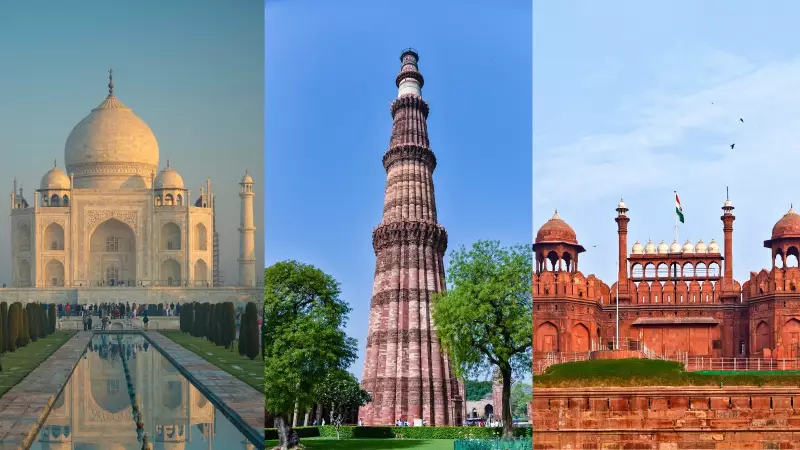
India's rich cultural heritage continues to draw millions, with the latest government data revealing a significant surge in both domestic and international tourism for the 2024-25 fiscal year. The Archaeological Survey of India (ASI) has released its compendium, highlighting the country's most popular historical sites, led once again by the iconic Taj Mahal.
Taj Mahal Reigns Supreme with Record Footfall
According to the India Tourism Data Compendium 2025 published by the Ministry of Tourism, the Taj Mahal in Agra maintained its undisputed position as the nation's most-visited monument. In 2024 alone, the marble mausoleum welcomed a staggering 6.26 million domestic tourists and 0.65 million foreign visitors, bringing its total footfall to nearly 6.9 million. This figure solidifies its status as a premier global destination, appealing equally to Indian travelers and international guests.
The Top 10 Rankings: Domestic vs. Foreign Preferences
The ASI data, which covers 145 Centrally Protected Ticketed Monuments, reveals interesting patterns in visitor preferences. While the Taj Mahal tops both lists, other monuments show varying appeal.

For domestic tourist arrivals, the Sun Temple in Konark, Odisha, secured the second spot with 3.57 million visitors, followed by Delhi's Qutub Minar in third place with 3.20 million. The top five was rounded out by the Red Fort in Delhi (2.88 million) and Bibi Ka Maqbara in Aurangabad (2.00 million).
The list for foreign tourist arrivals told a slightly different story. After the Taj Mahal, the Agra Fort was the second most popular with 225,000 foreign visitors, highlighting the strength of the Agra tourism circuit. Qutub Minar ranked third with 220,000 foreign tourists, followed by Humayun's Tomb in Delhi (158,000) and the Baori at Abhaneri in Rajasthan (116,000). Notably, four sites in the Agra circuit—Taj Mahal, Agra Fort, Fatehpur Sikri, and Itimad-ud-Daulah—collectively dominate foreign tourism interest.
Overall Tourism Growth and Pandemic Recovery
The broader context shows India welcomed approximately 56 lakh (5.6 million) foreign tourist arrivals (FTAs) and a massive 303.59 crore (3.0359 billion) domestic tourist visits (DTVs) in 2024-25. However, the growth rate for visitors to ASI monuments saw a modest year-on-year increase of 1.75 per cent in FY 2024-25.
This modest growth follows a period of explosive recovery post-pandemic. The data indicates annual visitor growth peaked at 92.8 per cent in 2021-22 and 88.6 per cent in 2022-23, rebounding from a steep 70.7 per cent decline during the pandemic year of 2020-21. The current stabilization suggests a return to more sustainable, long-term growth patterns for heritage tourism.
The top 10 most-visited monuments accounted for 47% of all domestic visitors and a substantial 74% of all foreign visitors to ASI ticketed sites, underscoring the concentrated appeal of India's flagship heritage attractions.
India, home to 44 UNESCO World Heritage Sites, continues to leverage its historical and architectural marvels as a cornerstone of its tourism economy. The latest figures not only celebrate the enduring allure of sites like the Taj Mahal but also highlight the diverse tapestry of monuments—from the caves of Ellora to the forts of Hyderabad—that together narrate the story of India's incredible past to the world.