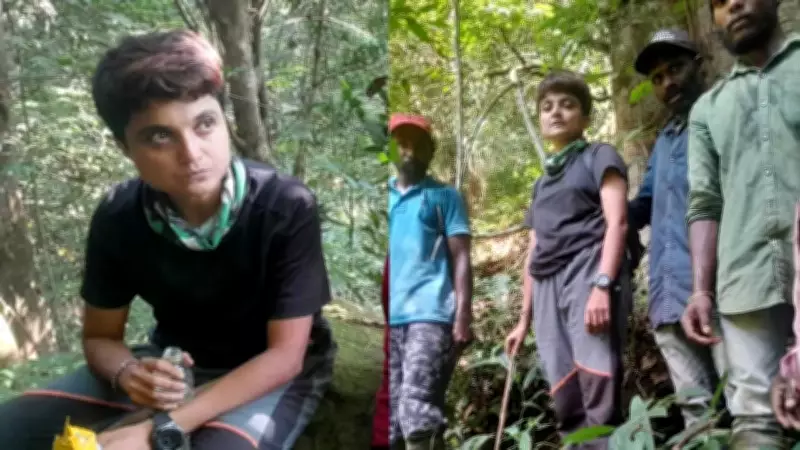
IT Professional Endures 72-Hour Forest Ordeal After Trekking Mishap in Kodagu
For four harrowing days, 36-year-old GS Sharanya experienced complete isolation—no cellular signal, no human contact, and no clear escape route from the dense, unforgiving forests of Kodagu. This region, notorious for its wild elephant populations, steep descents, and unpredictable weather patterns, became the unexpected stage for a remarkable survival story that tested both physical endurance and mental fortitude.
The Trek That Turned Into a Survival Challenge
What began as a routine one-day expedition to Tadiandamol—the highest peak in Kodagu district—quickly escalated into a life-threatening situation. Sharanya, an IT professional traveling from Kozhikode, had checked into a homestay near Kakkabe and joined a group of fellow trekkers on April 2. The journey proceeded normally until the evening descent, when she inadvertently became separated from her companions.
By the time the rest of the group returned safely to their base, Sharanya was officially reported missing. Her mobile phone, with rapidly diminishing battery life, offered little assistance in the patchy network conditions that characterize these remote forest areas. Within hours, she found herself completely cut off from civilization, facing the wilderness alone with minimal supplies.

Strategic Decisions During Critical Hours
On that first disorienting day, Sharanya attempted to retrace her steps, walking persistently until evening approached. As the forest canopy thickened and daylight faded, she made a crucial decision to stop near a rocky stream rather than risk further movement in darkness. With only a 500ml water bottle and no food provisions, she spent her first night exposed to the elements.
The subsequent two days presented a severe test of both restraint and survival instincts. A leg injury limited her mobility, prompting Sharanya to avoid venturing deeper into unfamiliar territory. Instead, she strategically positioned herself in areas with better visibility, including one relatively open patch where she hoped search teams using aerial drones might spot her.
"I maintained composure despite having no food and minimal sleep for three consecutive days," Sharanya later recounted. "I kept walking with the expectation of eventually encountering someone. Remarkably, I never experienced overwhelming fear—I cannot explain why."
Massive Multi-Agency Rescue Operation
Meanwhile, outside the forest perimeter, authorities had launched a comprehensive search operation of impressive scale and coordination. Police departments, forest officials, Anti-Naxal Force personnel, and local tribal communities formed nine specialized teams that fanned across the challenging terrain.
These rescuers combed through dense vegetation while contending with adverse weather conditions including rain, fog, and diminishing daylight. Authorities deployed thermal drone cameras for aerial surveillance and stationed additional teams along the Karnataka-Kerala border as a precautionary measure.
On the third day of her ordeal, Sharanya contemplated climbing to higher ground to improve her visibility to potential rescuers, but heavy rainfall forced her to abandon this plan. She instead practiced energy conservation—drying her clothes when possible and calling out intermittently while waiting for assistance.
Dramatic Rescue by Tribal Experts
The breakthrough came on the fourth day as search efforts intensified under directives from senior officials. Members of the Kudiya tribal community—whose intimate knowledge of the local terrain proved invaluable—detected faint calls emanating from a remote section of the Pattighat reserve forest, an area described by officials as "where nobody usually goes."
Following these auditory clues, the tribal rescuers successfully located Sharanya around 4 PM on Sunday, more than 72 hours after her initial disappearance. She was found conscious, medically stable, and displaying remarkable composure despite her prolonged ordeal.
After being escorted from the forest, Sharanya underwent thorough medical evaluation before returning to her homestay. Authorities confirmed she sustained no major injuries during her four-day wilderness experience.

Lessons in Survival and Resilience
Officials analyzing the incident highlighted how Sharanya's survival resulted not merely from endurance, but from a series of prudent decisions: remaining stationary when necessary, avoiding risky movements in darkness or unfamiliar areas, and maintaining hope until rescue arrived.
What began as a simple one-day trek had transformed into a four-day test of human resilience against nature's challenges. Yet when she finally emerged from the forest's embrace, GS Sharanya did so with a smile—a testament to both her personal fortitude and the coordinated efforts of her rescuers.
This incident underscores the importance of preparation when venturing into wilderness areas, while simultaneously highlighting the effectiveness of coordinated rescue operations involving local expertise and modern technology. Sharanya's calm demeanor throughout the ordeal likely contributed significantly to her positive outcome, providing valuable insights into human psychology during extreme survival situations.