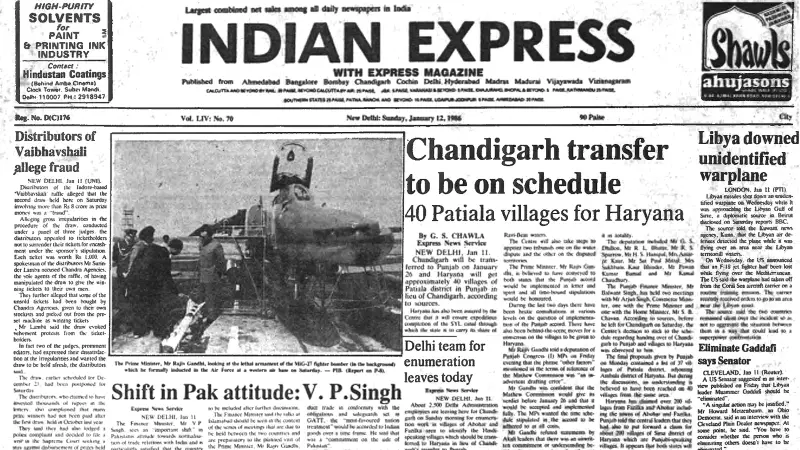
January 12, 1986, marked a day of significant diplomatic and geopolitical developments, as reflected on the front page of The Indian Express. The day's news wove together threads of promising bilateral engagement in South Asia and escalating international tension in North Africa.
A Promising Shift in India-Pakistan Trade Relations
In a development that hinted at a potential thaw, India's Finance Minister, Vishwanath Pratap Singh, identified an "important shift" in Pakistan's attitude towards normalising trade relations with India. The minister expressed particular satisfaction over Pakistan's agreement to grant non-discriminatory terms to Indian goods, aligning with the rules and obligations of the General Agreement on Tariffs and Trade (GATT).
This move was seen as a constructive step away from the historically strained economic ties between the two neighbours. Furthermore, the report indicated that Pakistan was willing to engage in discussions for a long-term trade agreement, suggesting a forward-looking approach to bilateral economic cooperation.

Libya Downs US Aircraft, Appeals to India
Simultaneously, a major international incident unfolded in the Mediterranean. According to a diplomatic source in Beirut, Libyan missiles shot down an unidentified warplane as it approached the Gulf of Sirte. The Libyan air defences had detected the aircraft near their territorial waters.
The United States later announced that it had lost an F-18 jet fighter over the Mediterranean, which had taken off from the Coral Sea aircraft carrier. In the wake of this confrontation, Libya actively sought international backing.
Libya formally requested India's support during what it described as an hour of crisis. The Libyan envoy conveyed that his government believed India's support, given its moral stature, would be of great value as Libya faced a perceived threat of aggression from the United States. At the time, India, holding the chairmanship of the Non-Aligned Movement (NAM), had not yet issued an official comment on the escalating situation in North Africa.
Domestic Political Stability in Uttar Pradesh
On the domestic front, Uttar Pradesh Chief Minister V. B. Singh firmly dismissed rumours about his removal from office. Reacting to media speculation, Singh stated that there was no move to remove him from the chief ministership. He clarified that he had recently met with Prime Minister Rajiv Gandhi to discuss the law and order situation in the state, implying full confidence and communication with the central leadership.
This snapshot from January 12, 1986, captures India navigating a complex global landscape—engaging with a traditional rival on trade, being courted for support in a distant conflict, and managing its own internal political dynamics.