

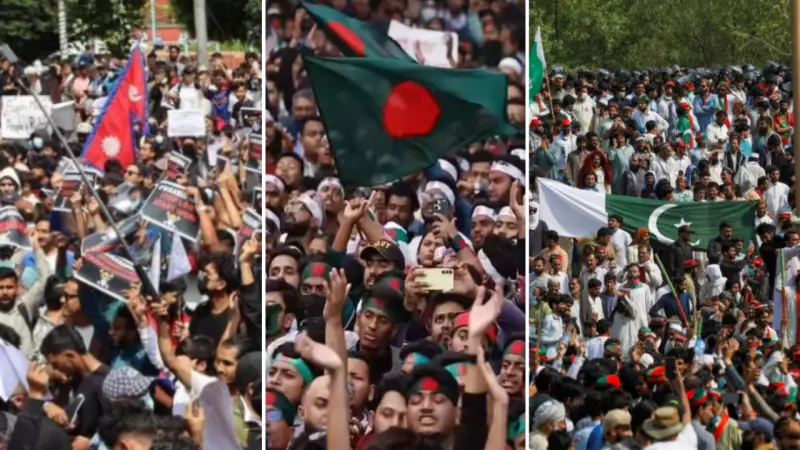
The dawn of 2026 presents a critical juncture for South Asia, with India's immediate neighbours—Bangladesh, Pakistan, and Nepal—grappling with profound political and social upheavals. These cascading crises of legitimacy threaten regional stability, posing both significant risks and a potential strategic opening for New Delhi. India's 'Neighbourhood First' policy is about to face its most severe examination, demanding a masterful balance between influence and interference.
Bangladesh at a Crossroads: Election Could Forge a 'Second Republic'
Bangladesh enters the new year under the shadow of a supercharged February 2026 general election. The political landscape has been radically altered since the ouster of Sheikh Hasina and the Awami League, now banned from the polls. An interim government led by Nobel laureate Muhammad Yunus is steering the nation through a period of anti-India protests, economic contraction, and a dangerous power vacuum.
The election has unleashed a fierce three-way contest. First, the National Citizens' Party (NCP), born from the Gen-Z protests that toppled Hasina, represents a secular, anti-corruption youth surge but lacks organisational depth. Second, the revitalised Jamaat-e-Islami, leveraging street power and madrasa networks, eyes a kingmaker role, threatening to erode the secular constitution and push for Sharia-inflected policies—a potential "Second Republic." Third, the Bangladesh Nationalist Party (BNP), led by the returned exile Tarique Rahman, merges dynastic appeal with anti-establishment fury.

At stake is the identity of a nation with a $50 billion garment export economy and rebounding reserves. The outcome will decide between liberalising progress and Islamist regression, with direct implications for youth unemployment and geopolitical alignment. A failed election risks creating jihadist enclaves, refugee waves into India, or a new hybrid authoritarianism.
Pakistan's Deep State Consolidates Amid Rising Discontent
In Pakistan, 2026 is defined by a skewed power structure where the military's shadow dominates a delegitimised political order. Army Chief General Asim Munir, now elevated to Field Marshal and the country's first Chief of Defence Forces (CDF), has orchestrated a bloodless coup. Through the 27th Constitutional Amendment, he has unified military command, including nuclear oversight, and gained presidential immunity.
Munir has sidelined Imran Khan's PTI, jailed its leadership, and built a pivotal alliance with the US. However, his grip is not absolute. Imran Khan, even from prison, retains a potent base, branding Munir a dictator and threatening protests. The economic backdrop remains brittle, stuck in an IMF-dependent, high-debt trap with severe inflation. Security challenges from the TTP, border tensions with Iran and Afghanistan, and a volatile Line of Control with India create a multi-front crisis.
For India, this means a neighbour simultaneously too weak to guarantee predictability and too securitised to rethink its fundamental strategic hostility.
Nepal's Gen Z Awakening Ahead of March Polls
Nepal approaches its March 2026 general elections galvanised by a Gen Z uprising that toppled Prime Minister KP Oli's government in late 2025. This digitally savvy generation, comprising over 40% of voters, demands a radical overhaul. Their agenda is powered by fierce anti-India sentiment, framed as a battle for true independence, alongside calls for job creation, anti-corruption drives, and climate action.
Projections indicate an unprecedented 60% youth turnout, potentially disrupting the traditional duopoly of the Nepali Congress and CPN-UML. Economic vulnerabilities sharpen the stakes: fragmented agriculture, shallow manufacturing, and tourism sensitivity. Nepal's delicate balancing act between India and China grows more complex as domestic nationalism weaponises bilateral disputes. Failure to address youth anxiety could fuel outsider populists or constitutional revisionism, impacting India's Himalayan security.

India's Strategic Dilemma and Opportunity
For New Delhi, the neighbourhood's fragility presents a high-risk, high-reward scenario. The dilemma is threefold: preventing security externalities like militancy or refugee flows; managing strategic competition from China's expanding footprint; and calibrating its tools of influence without visibly picking sides.
The opportunity lies in shifting from crisis firefighting to an integrated regional strategy. This could involve fast-tracking cross-border connectivity and energy projects, offering conditional assistance linked to governance, and using forums like BIMSTEC to promote a narrative of economic interdependence. Quiet back-channel engagement with all political forces in Dhaka, Islamabad, and Kathmandu will be crucial to hedge against sudden transitions.
The risk of perceived interference is real. Too close an embrace of incumbents could backfire, fuelling anti-India nationalism. Conversely, overt pressure on democracy could push regimes closer to China. In 2026, India will need the precision of a chess grandmaster, trading short-term comfort for long-term leverage in a neighbourhood where stability is a constantly renegotiated balance.





