External Affairs Minister S Jaishankar provided a detailed account in the Rajya Sabha on the deportation of Indian nationals from the United States, revealing that 3,258 individuals have been sent back since January 2025. This period coincides with Donald Trump's return to the presidency and his administration's renewed crackdown on illegal migration.
Scale of Deportations and Government's Response
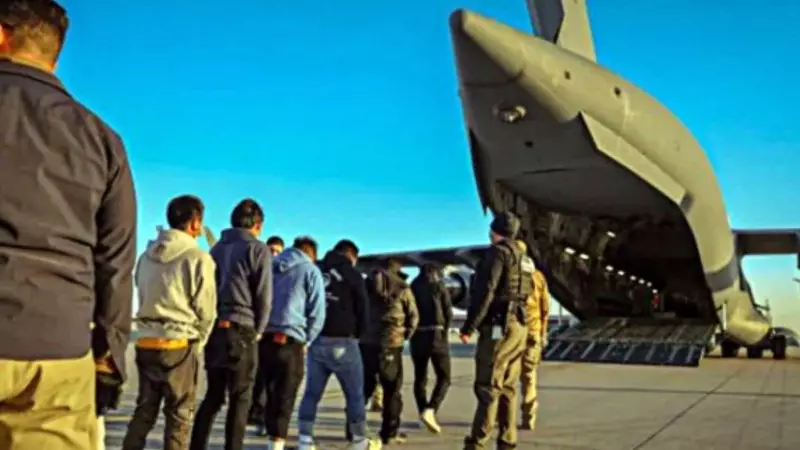
In a written reply, Jaishankar stated that the total number of Indian nationals deported from the US since 2009 now stands at 18,822. Of the 3,258 deported this year, approximately 62.3% (2,032 individuals) were sent on regular commercial flights. The remaining 1,226 (37.6%) arrived on charter flights operated by US Immigration and Customs Enforcement (ICE) or US Customs and Border Protection (CBP).
The minister addressed the controversy surrounding videos showing deportees being shackled and handcuffed, which had sparked criticism from opposition leaders, including Rahul Gandhi, and led to protests in Parliament. Jaishankar emphasized that the Ministry of External Affairs (MEA) has strongly registered its concerns with US authorities, particularly regarding the treatment of women and children during deportation operations.

He clarified that the US authorities have a Restraining Policy for deportation flights, in place since November 2012, which they claim is for the safety of all passengers. However, Jaishankar assured the house that the MEA remains engaged with the US to ensure humane treatment. He noted that no instance of shackling women and children has been reported since a specific flight on February 5.
The Case of Harjit Kaur and Action Against Traffickers
Jaishankar specifically addressed the case of Harjit Kaur, a 73-year-old Punjabi woman deported in September. While he denied reports that she was handcuffed, based on interviews by Indian immigration officials, he confirmed she was mistreated during her detention before the flight. "While Harjit Kaur was not handcuffed, she was maltreated," Jaishankar stated, adding that India officially took up the matter with the American Embassy on September 26, expressing strong concern.
According to her lawyer, Deepak Ahluwalia, Kaur, who had lived in the US since 1991, faced prolonged shackling, confinement in bare concrete cells, and denial of basic amenities during her deportation process, without being allowed to bid farewell to her family.
The minister also highlighted that the deportation process has helped bring back wanted criminals to India. He named absconding criminals like Lakhwinder Singh and Anmol Bishnoi, who were returned on such flights, as they faced charges including terrorism and murder.
Jaishankar detailed the government's crackdown on illegal immigration networks, stating that investigations are ongoing against agents and human trafficking syndicates. He revealed that Punjab has reported the highest number of trafficking cases. The Punjab government has formed a Special Investigation Team (SIT) and registered 25 FIRs against 58 illegal travel agents, arresting 16. In Haryana, 44 FIRs have been filed with 27 arrests, and a significant trafficker was arrested in Gujarat.
Furthermore, the National Investigation Agency (NIA) has registered and investigated 27 human trafficking cases, resulting in 169 arrests and chargesheets against 132 individuals, with key arrests made in Haryana, Punjab, and Himachal Pradesh.
Ongoing Diplomatic Engagement and Policy Implications
The revelations in Parliament underscore the complex dynamics of migration, deportation, and bilateral relations. The Indian government's stance balances raising legitimate concerns about the treatment of its citizens with acknowledging the US's sovereign right to enforce its immigration laws. The data presented indicates a significant increase in deportation actions under the current US administration, directly impacting thousands of Indian nationals.

The focus on cases like Harjit Kaur's demonstrates the MEA's efforts to address individual grievances while the broader statistics reveal the scale of the issue. The simultaneous action against trafficking rackets within India points to a two-pronged approach: diplomatic engagement abroad and law enforcement at home.
As the US continues its immigration crackdown, the Indian government's ongoing dialogue with US authorities will be crucial in safeguarding the dignity and rights of Indian nationals during the deportation process, even as it works to dismantle the illegal networks that facilitate such migration.