Arab Nations Issue Strong Condemnation of US Ambassador's Remarks on Israel
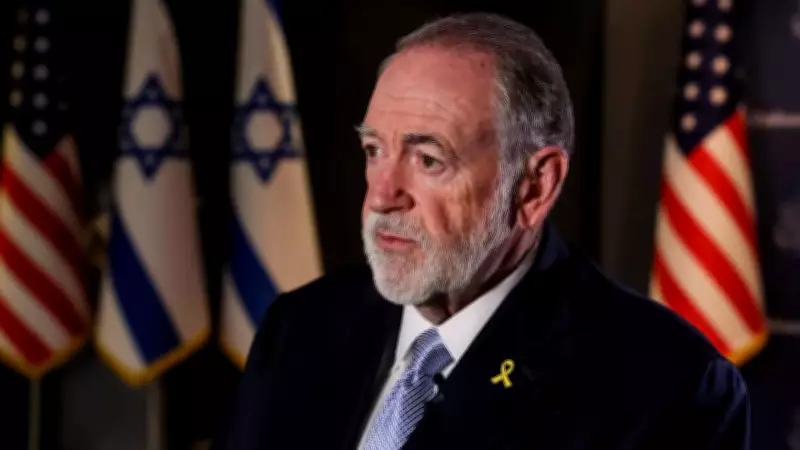
In a significant diplomatic development, fourteen Arab nations have issued a joint statement condemning remarks made by US Ambassador to Israel Mike Huckabee regarding Israel's biblical claims to Arab territories. The controversy erupted after an interview on Friday with former Fox News host Tucker Carlson, where Huckabee appeared to endorse a contentious historical perspective.
Controversial Interview Sparks Outrage
During the interview, Tucker Carlson referenced a biblical verse that describes Israel's region as extending from the Euphrates River in Iraq to the Nile River in Egypt. When Carlson raised the idea of Israel controlling this entire area, Ambassador Huckabee responded, "It would be fine if they (Israel) took it all." This statement immediately drew sharp criticism from across the Arab world.
Joint Arab Statement Expresses "Profound Concern"
The foreign ministries of Qatar, Egypt, Jordan, the United Arab Emirates, Indonesia, Pakistan, Turkiye, Saudi Arabia, Kuwait, Oman, Bahrain, Lebanon, Syria, and the State of Palestine issued a joint statement from Doha on Saturday night. They described Huckabee's comments as "dangerous and inflammatory" and expressed "profound concern" and "strong condemnation."

The signatories stated that the remarks suggested "it would be acceptable for Israel to exercise control over territories belonging to Arab states, including the occupied West Bank." They categorically rejected these statements and affirmed that "Israel has no sovereignty whatsoever over the Occupied Palestinian Territory or any other occupied Arab lands."
Legal and Security Implications Highlighted
The Arab nations emphasized that such remarks represent a "flagrant violation of the principles of international law and the Charter of the United Nations." They warned that these comments "pose a grave threat to the security and stability of the region" by potentially legitimizing expansionist policies.
The statement further explained that the territory referenced in the biblical verse would encompass modern-day Lebanon, Syria, Jordan, and parts of Saudi Arabia. The ministries cautioned that "the continuation of Israel's expansionist policies and unlawful measures will only inflame violence and conflict in the region" and "undermine the prospects for peace."
Huckabee's Subsequent Clarification
Following the backlash, Ambassador Huckabee attempted to moderate his stance, calling his earlier remark "somewhat of a hyperbolic statement." He clarified that Israel was "not asking to take all of that" and emphasized that Israel is not seeking to enlarge its current territory. Huckabee added that Israel has a right to security within the land it currently holds.
Arab Nations Maintain Firm Position
Despite Huckabee's clarification, the Arab ministries maintained their firm position, calling for "an end to these incendiary statements." They warned that remarks seeking to "legitimise control over the lands of others" fuel tensions rather than advancing peace efforts in the region.
The joint statement also noted that these comments "directly contradict the vision put forward by US President Donald Trump, as well as the US Comprehensive Plan to End the Gaza Conflict." According to the Arab nations, these US initiatives aim to contain escalation and create a political horizon for an independent Palestinian state.
The diplomatic fallout highlights the ongoing sensitivity surrounding territorial claims in the Middle East and the importance of measured language in international diplomacy. The incident underscores how historical and religious narratives continue to influence contemporary geopolitical tensions in the region.