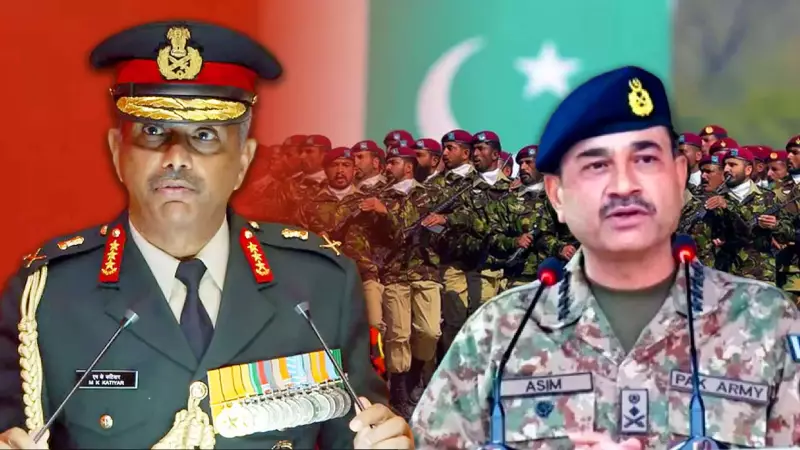
In a powerful address, a senior Indian Army commander has delivered a stark assessment of Pakistan's military capabilities and its persistent strategy of using terrorism and internal division against India.
Pakistan's Military Weakness Exposed
Speaking at the Western Command Investiture Ceremony on January 10, 2026, Lt General Manoj Katiyar stated that Pakistan possesses neither the courage nor the capability to engage India in a conventional war. He identified state-sponsored terrorism as Islamabad's primary remaining instrument of conflict.
The General, who heads the crucial Western Command responsible for the Pakistan frontier, emphasized that the western border continues to experience war-like conditions. He attributed this sustained tension to the Pakistani military establishment, which he said thrives on and benefits from a perpetual state of hostility.

A Warning on Internal Divisive Tactics
Beyond cross-border terrorism, Lt Gen Katiyar flagged a more insidious threat. He warned of active attempts to create religious and social divisions within Indian society, stating that undermining India's internal unity is a key target for adversarial forces.
He countered this narrative by highlighting the Indian Army's own composition. The General pointed out that the army, with soldiers from every faith, region, and community, stands as living proof that unity defeats divisive strategies. This diverse yet unified force, he suggested, is the bedrock of the nation's security.
The Path Forward: Vigilance and Strength
The commander's message culminated in a clear directive for the nation. He asserted that Pakistan's designs can only be neutralized through a trinity of constant vigilance, unwavering internal unity, and demonstrated military strength.
His remarks underscore the Indian military's view of the persistent threat from the western border, not as a challenge to its conventional might, but as a protracted campaign involving asymmetric warfare and psychological operations aimed at India's social fabric.
The speech serves as both an exposure of a neighbor's perceived weaknesses and a rallying call for national cohesion in the face of multifaceted threats.