

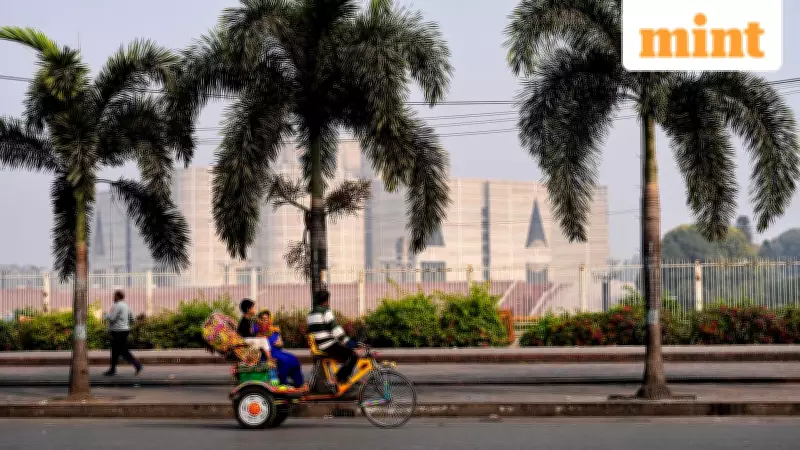
Bangladesh's Historic Election: 12.7 Crore Voters Decide Future Amid Transition
Nearly 12.7 crore Bangladeshi citizens are eligible to cast their votes today in the high-stakes 13th Parliamentary election, a pivotal moment expected to mark the country's political transition following the 2024 student-led uprising that ended Sheikh Hasina's 15-year rule. This election represents a critical juncture for one of South Asia's most populous democracies.
Two-Way Contest in 299 Seats
Voting will be conducted across all 299 parliamentary seats today in what has emerged as a two-way contest between the mainstream Bangladesh Nationalist Party (BNP) and an alliance of student leaders and Islamist groups led by Jamat-e-Islami. The polling process commences at 7:30 am under exceptionally tight security arrangements and will conclude at 4:30 pm, with results anticipated by Friday.
The BNP, which governed Bangladesh before Hasina's tenure, is widely projected to secure the most seats, though political analysts remain uncertain whether the party can achieve an outright majority. The Awami League, of which Sheikh Hasina serves as President, is currently suspended and prohibited from contesting these elections.

Testing the "Gen-Z" Political Movement
This electoral process will fundamentally test whether one of the first "Gen-Z" political movements can translate street activism into electoral success, or whether voters will ultimately return power to established political forces. Joseph Parkes, senior analyst at risk intelligence company Verisk Maplecroft, told Bloomberg that "the BNP's status as one of the two dynastic forces that have defined Bangladesh's troubled post-independence politics underlines how precarious the reform momentum could prove."
Economic and Security Challenges Await New Government
The incoming administration will inherit an economy besieged by persistently high inflation and global trade upheavals that particularly threaten the garment industry, which accounts for more than 80% of Bangladesh's exports. According to Bloomberg reports, the new government will also confront mounting law-and-order risks that could potentially derail its legislative agenda.
Polling will occur across 42,766 designated centers throughout the country. While the BNP is broadly perceived as the front-runner, it faces formidable competition from the alliance between Jamaat-e-Islami—the nation's largest Islamist party—and the student-led National Citizen Party. Overall, 51 political parties and approximately 2,000 candidates are competing in this historic election.
India's Strategic Concerns
New Delhi is monitoring the election with heightened concern, not merely as a neighboring nation but due to deteriorating bilateral relations over recent months. Hasina's ouster in August 2024—and the exclusion of the Awami League from the current election—is expected to significantly impact India-Bangladesh ties, which were considered friendly during Hasina's 15-year tenure. Notably, Hasina currently resides in exile in New Delhi.
The potential rise of the BNP and Jamaat-e-Islami, both historically more critical of India, introduces substantial uncertainty into bilateral relations. Dhaka–New Delhi ties deteriorated rapidly following the removal of the Hasina-led Awami League regime on August 5, 2024, and subsequent violence against minority communities, particularly the Hindu population.
In recent weeks, India has implemented restrictions on tourist visas for Bangladeshi citizens and withdrawn families of Indian diplomats from Bangladesh, citing security concerns ahead of the national elections. Experts on South Asia politics indicate that New Delhi fears Hasina's removal from power has created political space for groups hostile toward India, amid escalating anti-India rhetoric and violence within Bangladesh.
Security and Minority Concerns
One of the predominant factors influencing voters in this post-Hasina era is the escalation of political violence, attacks on Hindu minorities, and a concerning collapse of law and order on the streets, as reported by the Associated Press. Attacks on minorities—including Bangladesh's 13 million-strong Hindu population—have significantly exacerbated social tensions.

Dr. Chietigj Bajpayee, senior research fellow for South Asia in the Asia Pacific Programme at Chatham House, recently wrote about these escalating tensions and their implications for regional stability.
Unprecedented Security Deployment
The Election Commission has implemented elaborate security arrangements, deploying nearly one million security personnel—the largest deployment in the country's electoral history. The interim government led by Chief Adviser Muhammad Yunus has mobilized approximately 1 million police personnel, including about 100,000 from the army, to ensure peaceful polling.
In a message delivered on Wednesday, Yunus urged citizens: "All of you should exercise your respective voting rights consciously..." The Nobel laureate, who has committed to swiftly transferring power to the elected government, appealed to political parties, candidates, and other concerned stakeholders to maintain restraint, tolerance, and democratic behavior on polling day.
Yunus emphasized that "the countrymen, through this national election, will elect people's representatives, who are competent, responsible and respectful of the people's aspirations." He further stated that "a free, fair, impartial and acceptable election is the foundation of a democratic state," affirming that the present interim government remains fully committed to achieving this fundamental goal.
Historical Context and Legal Proceedings
Sheikh Hasina fled Bangladesh in August 2024 after a wave of student protests against her administration turned violent, with a subsequent security crackdown resulting in approximately 1,400 fatalities according to United Nations estimates. A tribunal in Bangladesh sentenced Hasina to death in absentia in November of last year for crimes against humanity.
The 13th Parliamentary elections are being conducted simultaneously with a referendum on a complex 84-point reform package, adding another layer of significance to this democratic exercise. The winner will succeed the interim government led by Muhammad Yunus, marking a new chapter in Bangladesh's political evolution.





