

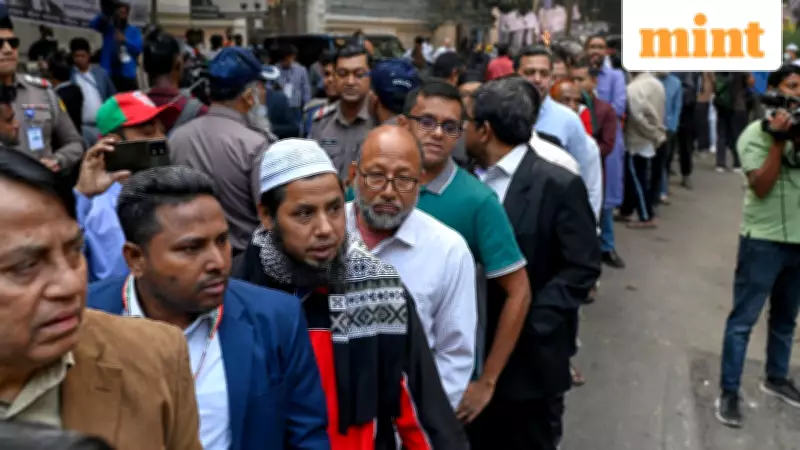
Bangladesh Votes in Landmark Election Following Hasina's Removal
Voting commenced on Thursday morning across Bangladesh in a pivotal general election, marking the nation's first parliamentary polls since the dramatic fall of Prime Minister Sheikh Hasina in August 2024. Hasina, currently residing in exile in India, saw her political party, the Awami League, disbanded and prohibited from participating in this electoral contest by the interim government led by Chief Adviser Muhammad Yunus.
Polling Details and Electoral Process
The electoral process began at 7:30 AM local time in 299 out of 300 parliamentary constituencies nationwide, with voting scheduled to continue until 4:30 PM. One constituency's voting was cancelled following the unfortunate death of a candidate. The counting of votes is anticipated to start shortly after polling concludes, with official results expected to be announced on Friday.
These 13th parliamentary elections are being conducted concurrently with a referendum on a comprehensive 84-point reform package. In a significant development, nearly 800,000 expatriate Bangladeshis registered with the election commission are exercising their franchise for the first time through an innovative IT-based postal ballot system.

Political Landscape: BNP vs Jamaat Contest
With the Awami League absent from the electoral arena, the political contest has transformed into a primarily bipolar competition between the Bangladesh Nationalist Party (BNP) and its former ally, Jamaat-e-Islami. Chief Adviser Muhammad Yunus, who has committed to a swift transfer of power to the elected government, has appealed to all political parties, candidates, and stakeholders to demonstrate restraint, tolerance, and democratic conduct throughout the polling day.
India-Bangladesh Relations Under Scrutiny
New Delhi is observing the Bangladeshi electoral process with heightened attention for multiple strategic reasons. Throughout Sheikh Hasina's fifteen-year tenure as prime minister (from 1996 to 2001 and again from 2009 to 2024), India maintained exceptionally friendly relations with Dhaka, treating Bangladesh as a crucial strategic partner in South Asian security architecture.
This period witnessed several landmark bilateral achievements, most notably the 2015 Land Boundary Agreement that facilitated the exchange of approximately 17,160 acres from India to Bangladesh and 7,110 acres from Bangladesh to India, resolving a decades-old territorial issue. Economically, India emerged as Bangladesh's largest trading partner in Asia, with bilateral trade reaching $11.1 billion in exports from India and $1.8 billion in imports from Bangladesh during the fiscal year preceding Hasina's removal.
Deterioration of Bilateral Ties
The previously cordial relations between New Delhi and Dhaka began deteriorating rapidly following Hasina's ouster on August 5, 2024, and the subsequent outbreak of violence targeting minority communities, particularly Bangladesh's Hindu population. As violence escalated across the country, Hasina sought refuge in India, where she remains in exile.
Back in Bangladesh, the International Crimes Tribunal convicted Hasina for ordering lethal force against protesters, while a special court recently sentenced her to ten years imprisonment in two separate corruption cases. The interim government has repeatedly requested India to extradite Hasina, especially after a Dhaka court sentenced her to death for her alleged role in the deadly crackdown during the 2024 uprising against her administration.
Security Concerns and Minority Safety
The political transition has raised serious concerns about the safety of Bangladesh's Hindu community, which constitutes over 13 million people and traditionally formed the support base for Hasina's Awami League. Community leaders report approximately 2,700 incidents of targeted violence against Hindus during the eighteen months of Yunus-led interim governance.
India has responded to the deteriorating security situation by restricting tourist visas for Bangladeshi citizens and withdrawing diplomatic families from Bangladesh ahead of the national elections. The diplomatic tensions have even affected sports relations, with Bangladesh withdrawing from the men's T20 World Cup after the International Cricket Council declined to relocate their matches from India to Sri Lanka.

Future of Bilateral Relations
Experts on South Asian politics note that both main contenders in today's election – the BNP led by Tarique Rahman and Jamaat-e-Islami – have historically maintained less friendly relations with India compared to the Hasina era. The BNP's foreign affairs adviser, Humaiun Kobir, stated that many Bangladeshis perceive India as complicit in Hasina's alleged crimes, while BNP Secretary General Mirza Fakhrul Islam Alamgir emphasized the need to resolve bilateral issues including water-sharing, border killings, and trade disputes.
Bangladesh shares a 4,000-kilometer border with India, touching five northeastern states, making stability in Dhaka crucial for India's border security, insurgency management, and migration control. During Hasina's rule, Dhaka cooperated effectively against anti-India militant groups, but the future of this security cooperation remains uncertain under a new government.
Opportunity for Renewal
According to Praveen Donthi of the International Crisis Group, the formation of a new government in Dhaka presents both nations with an opportunity to reverse the deterioration in relations and initiate a fresh beginning. Indian Foreign Minister S. Jaishankar's visit to attend former Prime Minister Khaleda Zia's funeral, carrying Prime Minister Narendra Modi's letter referencing a "new beginning," signals New Delhi's willingness to normalize relations if reciprocated by Dhaka.
The ultimate trajectory of India-Bangladesh relations will depend significantly on how both governments navigate domestic political pressures while addressing bilateral concerns. As Bangladesh votes today, the outcome will not only determine the nation's political future but also reshape its strategic relationship with its powerful neighbor to the west.





