

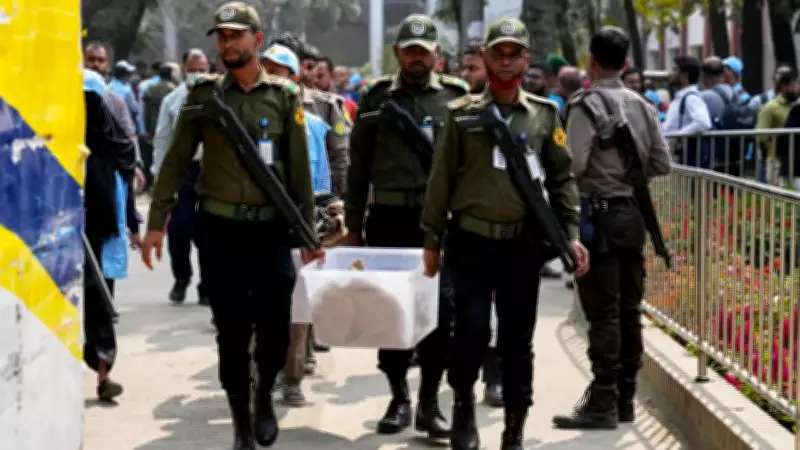
Bangladesh's Landmark Election: Unprecedented Security for Post-Hasina Vote
Bangladesh is poised to conduct parliamentary elections on Thursday, marking the first national vote since the removal of former Prime Minister Sheikh Hasina in August 2024 following mass protests. Authorities have implemented extraordinary security protocols, with over half of the country's polling centers designated as "risk-prone."
High-Risk Polling Centers and Security Assessments
According to police evaluations, nearly 24,000 out of approximately 43,000 polling stations nationwide have been classified as "high" or "moderate" risk. In the capital city of Dhaka, 1,614 out of 2,131 polling centers have been flagged as risk-prone. However, the army has provided a contrasting assessment, identifying only two centers in Dhaka as "risky."
The Election Commission (EC) has emphasized that its security strategy is tailored to local conditions. Election Commissioner Abul Fazal Mohammad Sanaullah stated at a media briefing, "Security deployment is being made based on local sensitivity assessments."

Record-Breaking Security and Technological Deployment
Officials have described the upcoming polls as witnessing the largest-ever mobilization of law enforcement personnel in Bangladesh's electoral history. A staggering 9.58 lakh security personnel have been deployed across the nation.
Inspector General of Police Baharul Alam detailed that over 1.57 lakh police personnel will be directly involved in election duties, bolstered by nearly 30,000 additional police staff from stations throughout the country. In a historic move, authorities are utilizing unmanned aerial vehicles (UAVs), drones, and body-worn cameras to monitor the electoral process.
Sanaullah highlighted, "Additionally, for the first time, UAVs (Unmanned Aerial Vehicles), drones, and body-worn cameras are being used for election security." Approximately 25,000 body-worn cameras will be employed in the field, while CCTV cameras have been installed in more than 90 percent of polling centers to ensure continuous surveillance.
Voting Details and Electoral Process
Voting is scheduled from 7:30 am to 4:30 pm across 299 constituencies, with polling in Sherpur-3 postponed due to the death of a candidate. A total of 42,659 polling centers have been established.
More than 12.77 crore voters are eligible to cast their ballots, including about 3.58 percent first-time voters. In addition to the parliamentary elections, citizens will participate in a referendum on an 84-point reform package.
The Election Commission has deployed 2,098 executive magistrates and 657 judicial magistrates to oversee the proceedings. Sanaullah expressed satisfaction with the law-and-order situation, expressing hope that law enforcement agencies will ensure a peaceful environment during and after voting.
Political Backdrop and Contesting Parties
The elections occur 18 months after Hasina's Awami League government was ousted following a student-led uprising on August 5, 2024. The interim administration, led by Chief Adviser Muhammad Yunus, subsequently disbanded the Awami League and barred it from contesting.
The primary contest is between the Bangladesh Nationalist Party (BNP) and Jamaat-e-Islami. Pre-poll surveys indicate that the BNP is the frontrunner, with its chairman Tarique Rahman emerging as a leading contender for the top post.
With heightened surveillance, extensive security deployment, and advanced monitoring systems in place, Bangladesh enters a closely monitored election, viewed as a critical test of its political transition in the post-Hasina era.






