

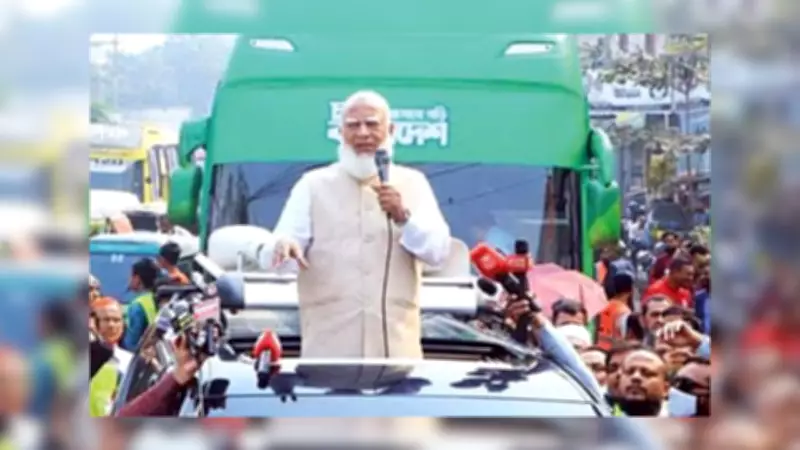
Bangladesh Election Stirs Painful Memories for 1971 Liberation War Veterans
As Jamaat-e-Islami locks horns with the Bangladesh Nationalist Party (BNP) in the high-stakes Bangladesh elections scheduled for February 12, the political battle has ignited deep-seated anxieties among former Mukti Bahini fighters. Many observers see this as Jamaat-e-Islami's best opportunity yet to secure a Dhaka seat independently, a prospect that evokes raw emotions from the nation's liberation struggle.
Historical Wounds Resurface
The Mukti Bahini, a militia of freedom fighters trained by the Indian Army, played a decisive role in the 1971 liberation war against the Pakistan Army in what was then East Pakistan. During that conflict, they directly confronted members of Jamaat-e-Islami, which had opposed Bangladesh's independence and sided with the Pakistani forces.
"How can we forget that this is the same organisation that was against the very idea of Bangladesh and never wanted freedom from Pakistan, while siding with their army during the 1971 liberation war? It is extremely difficult for us to come to terms with that," said 74-year-old Shekhar Goswami, a Dhaka resident and former Mukti Bahini fighter who fought alongside the Indian Army.

Recalling a recent campaign incident, Goswami described how a Jamaat-e-Islami worker visited his neighborhood, urging residents to vote for the party. "I immediately countered him, saying, 'How dare you come to us? I am a freedom fighter and I have seen with my own eyes what Jamaat people did while collaborating with the Pakistan Army in 1971,'" Goswami recounted. "After my strong response, he quietly left. It only proved my point. Even today, they cannot hold their heads high in this country because of their past."
Party Denials and Veteran Skepticism
In response, Jamaat-e-Islami media and publicity secretary, Matiur Rahman Akanda, termed the allegations 'baseless'. "The people of Bangladesh are well aware of the blame game initiated against us. They have rejected it outright and are welcoming us with open arms. The election results will prove how much the people love us," he asserted.
However, former Mukti Bahini members remain unconvinced. An octogenarian ex-fighter from Mymensingh argued that his opposition extends beyond wartime actions. "Their politics goes against the very ethos of Bangladesh," he alleged. "During the freedom struggle, people of all religions fought together for independence. Bangladesh belongs to everyone, not to followers of a single religion. Jamaat's ideology stands against this idea and threatens our motherland. Every sane citizen should oppose them, especially since they have still not officially apologised to the nation they now seek to govern."
Incidentally, Jamaat-e-Islami's ameer (chief) Shafiqur Rahman recently stated that the party is willing to apologise "if our mistakes are proven beyond doubt."
Haunting Memories and Broader Implications
Another former Mukti Bahini fighter, 76-year-old Mudassar Ali, emphasized that liberation war memories continue to haunt veterans. "We witnessed unspeakable horrors. The worst was the violation of our women by the Pakistan Army, aided by Jamaat-e-Islami collaborators known as Razakars. Those images still flash before our eyes," he said.
The party also faces sharp criticism from its main competitor, the BNP. BNP chairperson Tarique Rahman questioned, "Those who are now asking for people's support - the people of this country have already seen them in 1971. They not only killed lakhs of people, but their collaborators violated countless mothers and sisters..."
Bangladesh-watchers note the electoral dynamics will be closely monitored. Sanjay K Bhardwaj, a professor at Jawaharlal Nehru University's School of International Studies in Delhi, commented, "Voters are aware of past incidents. It is not as if Jamaat is hiding its history. That said, the party seems to be working to bring back the forces that sided with the Pakistan army in 1971. How they fare in the polls will have implications for not just Bangladesh, but also India."

Corroborating this view, Mohammed Saiful Alam Chowdhury, an associate professor in the Department of Mass Communication and Journalism at Dhaka University, stated that despite Jamaat-e-Islami's evolution as a political force, the "stigma related to 1971 liberation war will remain intact." He explained, "Their role as collaborators with the Pakistani army during the freedom struggle is well known. They helped them identify intellectuals and other important figures only to be later eliminated. Otherwise, how could the Pakistani army be in a position to go into alleys and streets to identify their homes? These were the people who helped them in doing that."
Chowdhury added, "Even if they win these elections, their past blot won't be washed away. Till date they have not formally apologised for their crime, rather offered a vague apology while calling their role a 'mistake'. They forget that crime and mistakes are never equal."





