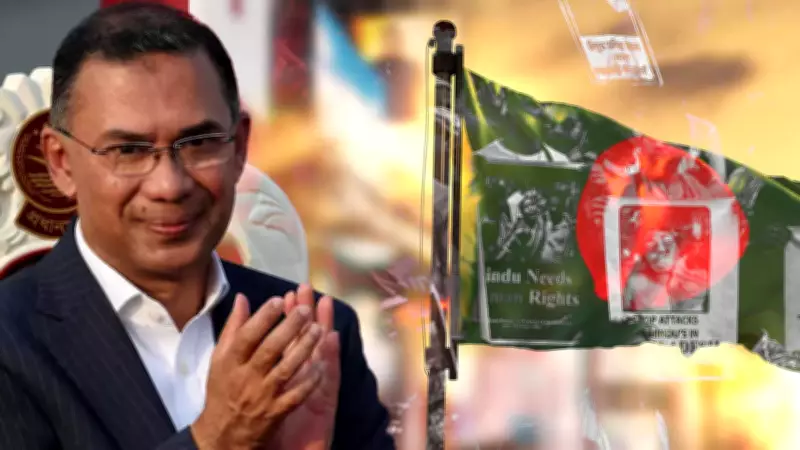
Bangladesh's New Leader Pledges Inclusive Governance Amid Heightened Minority Concerns
In his maiden public address as Prime Minister, Tarique Rahman has made a significant commitment to transform Bangladesh into a secure and inclusive nation where every citizen enjoys equal rights and protections under the law. This bold promise arrives at a critical juncture, as the country grapples with persistent concerns over attacks on minority communities, particularly Hindus, following the political upheaval of August 2024.
Rahman's Immediate Priorities: Law, Order, and Corruption Crackdown
Rahman emphasized that restoring robust law and order and tackling systemic corruption stand as his government's most urgent priorities. He articulated a vision of a Bangladesh where safety and justice are not privileges but fundamental rights accessible to all, regardless of religious or ethnic background. This focus on governance and security is seen as a direct response to the instability that has marked the nation's recent political landscape.
Parallel Development: India Detains and Deports Accused in High-Profile Killing
Simultaneously, in a move that has sharpened the international focus on justice and accountability, Indian authorities detained a Bangladeshi student leader at Delhi's Indira Gandhi International Airport. The individual was accused in the brutal killing of Hindu police officer Santosh Chowdhury, who was lynched during violent protests on the very day former Prime Minister Sheikh Hasina fled the country. The suspect was swiftly deported back to Bangladesh, underscoring the cross-border implications of such cases.

The timing of this arrest and deportation has not gone unnoticed, adding a layer of geopolitical significance to Rahman's domestic pledges. For New Delhi, stability and the protection of minority rights in Bangladesh remain paramount strategic interests as the new administration in Dhaka begins its term. India has repeatedly raised the issue of minority safety with Bangladeshi authorities, making this a persistent diplomatic concern.
Broader Context: Minority Safety and Bilateral Relations
The confluence of Rahman's inclusive pledge and India's decisive action highlights the ongoing challenges surrounding minority protection in Bangladesh. The political turmoil of 2024 exacerbated vulnerabilities for Hindu communities, leading to international scrutiny. Rahman's address can be interpreted as an effort to reassure both domestic minorities and international partners, like India, of his government's commitment to safeguarding all citizens.
As Bangladesh embarks on this new political chapter, the world watches closely. The effectiveness of Rahman's promised reforms in law enforcement and anti-corruption, coupled with tangible improvements in minority security, will be critical benchmarks for his administration's success. The deportation from India serves as a stark reminder that justice for victims like Santosh Chowdhury is a matter of regional importance, demanding accountability and robust bilateral cooperation to prevent future tragedies.