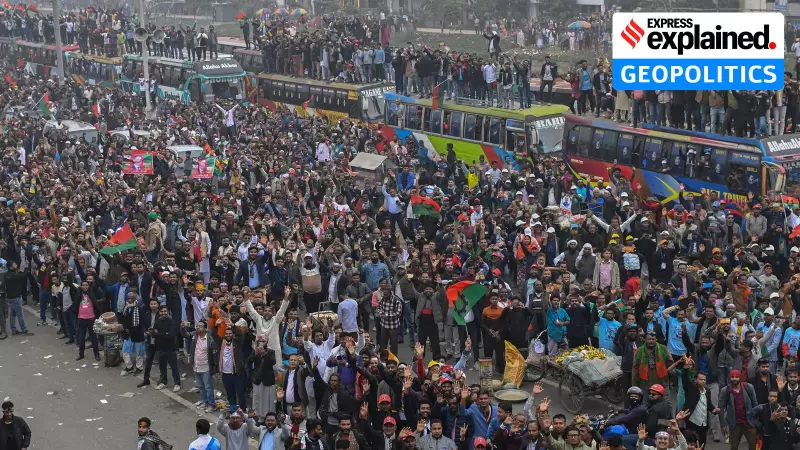
Bangladesh is witnessing a period of intense political turmoil and violence, marked by the dramatic return of Bangladesh Nationalist Party (BNP) acting chairman Tarique Rahman after 17 years in exile. The chaos has been accompanied by a sharp rise in anti-India rhetoric, prompting concerns in New Delhi. To understand the complex forces at play, we turn to the analysis of Veena Sikri, former High Commissioner of India to Bangladesh.
The Roots of the Current Unrest: A Planned Regime Change?
According to Sikri, the genesis of the current crisis lies in the events of July-August 2024. While described as a spontaneous student uprising, she asserts it was a planned operation with the goal of regime change. This claim is supported by Bangladesh's chief adviser, Muhammad Yunus, who reportedly introduced his special assistant as the "brain behind the whole operation" at a New York event in September 2024.
The hardline Jamaat-e-Islami, historically aligned with Pakistan, is identified as a major driving force. Sikri outlines three critical consequences of Jamaat's prevailing influence over the Yunus administration.

First, there is a systematic campaign to dismantle not just the Awami League but the entire post-1971 Liberation War order. Since August 5, 2024, symbols and institutions linked to Bangladesh's independence have been targeted.
Second, there is a visible push to Islamize the nation and clamp down on minorities. Hindus, Buddhists, Christians, and Ahmadiyyas have faced attacks, including killings, rape, and property destruction. The recent lynching of Dipu Chandra Das drew international condemnation.
Third, the mutually beneficial economic cooperation with India, built over decades, has been shaken. The Bangladesh economy, which grew at 6.5-7% annually for 15 years, is now sliding backward. Growth has halved, unemployment is rampant, and inflation is high due to factory closures and a lack of investment.
Mobocracy, Media Control, and Tarique Rahman's Uncertain Role
Sikri emphasizes that Jamaat's activities are inherently violent, using mobocracy and media control to establish dominance. Government offices, officials, and judges are surrounded until mob demands are met. Media houses like Prothom Alo and Daily Star have been attacked, and journalists jailed without trial.
In this climate, Tarique Rahman's return on December 25 is significant. However, Sikri cautions that if elections are held with the Awami League banned, they will be neither free nor fair. While Rahman may see initial support, his victory is not guaranteed.
The relationship between BNP and Jamaat is fraught. Although they shared power in 2003-06, Jamaat now desires pole position and may prefer an alliance of smaller Islamist parties to rival BNP. More than half of BNP is strongly pro-Jamaat, and the liberal, pro-1971 faction has been sidelined. Rahman's return, therefore, does not materially alter the fundamental power dynamics favoring Jamaat.
India's Strategic Imperatives: Restraint, Engagement, and Democratic Principles
The rising anti-India rhetoric stems from a segment that has always opposed the 1971 Liberation War. India's response, Sikri suggests, must be two-fold.
First, India must continue projecting goodwill towards the people of Bangladesh. New Delhi has shown strategic restraint, maintaining aid, trade, and open communication channels, including recently agreeing to export an additional 50,000 metric tonnes of rice.
Second, India must insist on free, fair, and inclusive elections where all parties, including the Awami League, can participate. Without this, instability and violence will persist.
The bilateral relationship is paramount. For Bangladesh, Indian cooperation was crucial to its economic success. For India, Bangladesh is vital for security, given the over 4,000-km porous border. The Hasina government had helped curb terror havens, but since August 2024, Pakistan has sought to re-establish its pre-1971 influence, even embedding with the Bangladesh army near the Indian border.

Any restricted election will worsen this adverse situation. India's priority must be to engage all actors while firmly advocating for a democratic process that reflects the true will of the Bangladeshi people.