

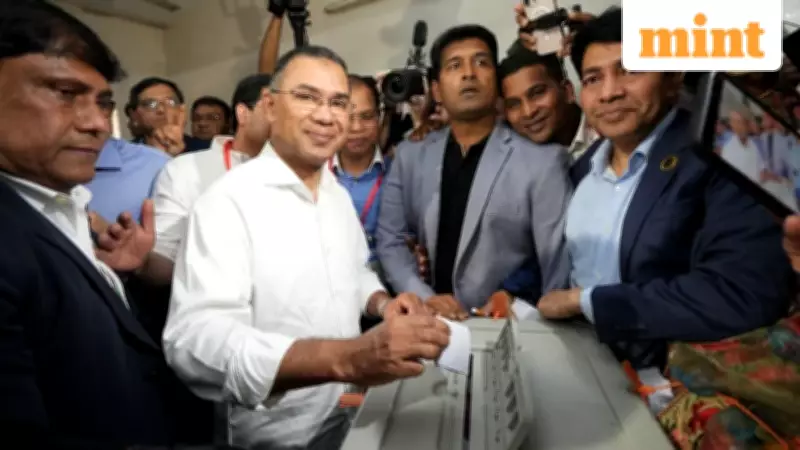
Bangladesh Votes in Historic Post-Hasina Election Amid High Security and Disinformation Warnings
Bangladesh is casting ballots today in a landmark parliamentary election, the first since a deadly 2024 uprising that ended Sheikh Hasina's fifteen-year rule. Long queues formed outside polling stations in the capital, Dhaka, as voting commenced in this South Asian nation of 170 million people, according to ground reports from news agencies.
Massive Security Deployment and UN Concerns Over Disinformation
More than 300,000 soldiers and police have been deployed nationwide to oversee the electoral process. Ahead of the vote, United Nations experts issued stark warnings about "growing intolerance, threats and attacks" and a "tsunami of disinformation" targeting millions of young, first-time voters, as reported by AFP.
Key Contenders: BNP vs. Jamaat-e-Islami in a Tight Race
The election features a fierce contest between two major political forces. Leading prime ministerial hopeful Tarique Rahman, 60, of the Bangladesh Nationalist Party (BNP), expresses confidence in regaining power. However, he faces a formidable challenge from Jamaat-e-Islami, the country's largest Islamist party.

Jamaat chief Shafiqur Rahman, 67, has run a disciplined grassroots campaign. If victorious, this former political prisoner could lead the first Islamist-led government in Bangladesh, a constitutionally secular state. Opinion polls show varied results, with most giving the BNP a slight lead, though some indicate a knife-edge race.
Interim Leadership and Hasina's Legacy
Interim leader Muhammad Yunus, the 85-year-old Nobel Peace Prize winner who has governed since Hasina's ouster, addressed the nation before the vote, stating, "The significance of this day is far-reaching." He will step down once the new government assumes power.
Sheikh Hasina, 78, was sentenced to death in absentia for crimes against humanity related to a bloody crackdown on protesters during her final months in office. She remains in hiding in neighboring India after fleeing Bangladesh following the student-led August 2024 uprising. Her Awami League party has been banned from contesting by Yunus's interim administration.
Political Violence and Calls for Fairness
Police records indicate that five people were killed and over 600 injured in political clashes during the campaign period. Analyst Thomas Kean of the International Crisis Group emphasized to AFP, "The crucial test for Bangladesh now will be to ensure the election is conducted fairly and impartially, and for all parties to then accept the result."
Main Players and Electoral Dynamics
The primary electoral battle pits the BNP, led by Tarique Rahman, against a newly formed 11-party alliance known as the 'Like-minded 11 Parties,' led by Jamaat-e-Islami and the National Citizen Party (NCP). Tarique Rahman, son of former Prime Minister Khaleda Zia, who passed away in December 2025, returned from exile in London to assume the BNP chairperson role. All criminal cases against him from Hasina's era have been dropped.
The BNP is a coalition of 10 parties, while the Jamaat-led alliance includes the NCP, headed by students prominent in the 2024 anti-Hasina protests. Jamaat's Shafiqur Rahman has pledged to protect democratic rights if elected.
Stance on India and Regional Implications
Historical tensions with India add another layer to the election. According to the Institute of South Asian Studies in Singapore, the BNP has had "prickly engagement" with India, with late leader Khaleda Zia often framing Indian initiatives as hegemonic and opposing transit arrangements and disputes.
Jamaat-e-Islami is known for its anti-India stance, with chief Shafiqur Rahman recently stating, "On 12 February, the people will show a red card to the slaves of hegemony..."—a remark many interpret as indirect messaging toward India. The NCP has also shown anti-India sentiments during the 2024 uprising.
Electoral Mechanics and Government Formation
Voters will elect 299 lawmakers directly, with 50 women chosen later from party lists; one seat's election was cancelled due to a candidate's death. The Bangladesh Parliament, or Jatiya Sangsad, has 350 seats: 300 directly elected and 50 reserved for women.

To form a government, a party or coalition needs a simple majority of at least 151 out of the 300 directly elected seats. The 50 women's reserved seats are allocated post-election based on party shares and do not affect the initial threshold for government formation. Members of Parliament serve five-year terms.





