

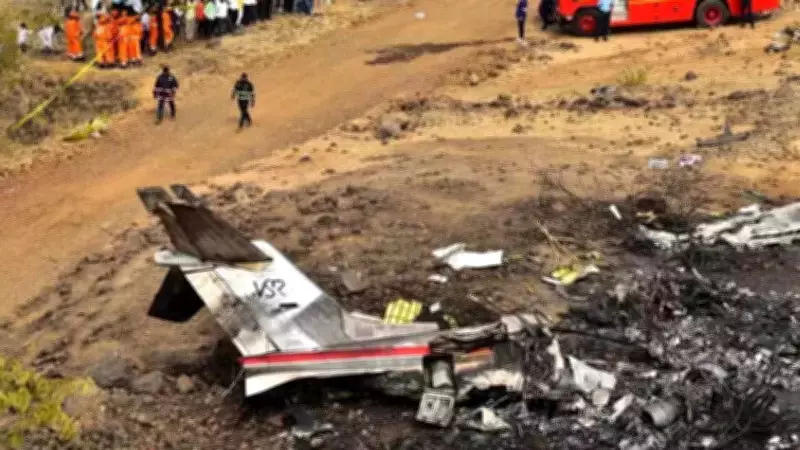
Baramati Plane Crash: Eyewitnesses Describe Terrifying Spiral Descent
As the ill-fated aircraft carrying prominent politician Ajit Pawar approached Baramati airport for landing, local residents reported witnessing a harrowing sequence of events that culminated in tragedy. Multiple eyewitness accounts from villages near the airstrip describe seeing the plane enter a dangerous spiral before crashing, with CCTV footage partially corroborating these observations by showing the aircraft's wings tilting to an unstable degree during descent.
Eyewitness Accounts of the Final Moments
Anita Atole, a resident of Gojubavi village located approximately 12 kilometers from the Pawar family's hometown, provided a detailed account of the crash. "The aircraft was flying very low and completed one circle around the airport before suddenly beginning to spiral downward," she recalled. "There was an enormous fireball in the air followed by thick, billowing smoke. We immediately ran toward the crash site. Fire brigade vehicles arrived on the runway within minutes but faced significant challenges reaching the actual crash location due to the absence of a proper metallic road, forcing them to take alternative routes."
Atole added that the intense smell of gasoline permeated the area well into the afternoon, and local residents only learned about Ajit Pawar's presence on the aircraft after recovery operations had begun.

Another eyewitness, Raghu Maruti Atole (65), described his experience while feeding cattle amid morning fog conditions. "I observed a small aircraft heading toward the airstrip, and within minutes, it returned from the railway gates side toward the landing area," he stated. "The plane appeared to be swaying unsteadily before a loud blast-like noise echoed through the area. When I reached the airstrip, flames were towering approximately 50 feet high, with metal aircraft components scattered across the terrain. Before I could take any action, fire brigade sirens were already approaching."
Aviation Experts Analyze Potential Causes
Air Vice-Marshal Manmohan Bahadur (retired) suggested multiple factors could have contributed to the tragedy, including low visibility conditions, sudden technical malfunctions, or operational challenges. Aviation sources examining the CCTV footage noted that if the footage showing the aircraft banking sharply to the left is authentic, the incident may extend beyond simple visibility issues.
"The aircraft appears to have experienced a significant technical problem," one source explained. "It was attempting to execute a landing but apparently could not complete the maneuver due to this issue."
Baramati Airport's Operational Limitations
Early speculation had focused primarily on low visibility as the primary cause, particularly before the CCTV footage surfaced on social media platforms. However, aviation experts highlighted that Baramati operates as an uncontrolled airfield, meaning visibility assessments occur visually rather than through sophisticated meteorological equipment.
"Unlike major airports such as Mumbai, where the meteorology department measures visibility precisely and authorities can close runways when minimum visibility thresholds aren't met, Baramati lacks these systems," an aviation source noted. The runway's elevated position adds another layer of complexity, making low-visibility landings particularly hazardous.
Challenges of Business Jet Operations
Civil aviation specialists emphasized that operating mid-sized business jets like the Learjet 45 presents distinct operational challenges requiring advanced pilot skills. "These aircraft are recognized for their high cruise and approach speeds," commented a senior test pilot familiar with business jet operations. "While speed reduces travel time, it dramatically compresses the decision-making window available to pilots, especially during critical landing phases."
The expert further explained that such aircraft typically require longer landing distances and precise touchdown points, where even minor approach instability or delayed corrections can rapidly escalate into runway overruns or hard landings.

Final Communication and Timeline
The aircraft's crew initially contacted Baramati Air Traffic Control at 8:18 AM, inquiring about wind conditions and visibility. Controllers reported calm winds and approximately 3,000 meters of visibility. During their final approach to Runway-11, however, pilots reported inability to see the runway and initiated a go-around procedure.
Following the go-around, ATC requested position updates, with the crew confirming they were on final approach. When asked to report runway visibility, pilots responded that the runway remained out of sight but they would notify controllers when it became visible. Moments later, at 8:43 AM, the aircraft received landing clearance after pilots reported runway visibility, though they failed to read back the clearance confirmation.
At 8:44 AM, ATC personnel observed flames near the runway threshold. The wreckage was subsequently located on the left side of the 1,770-meter-long, 30-meter-wide runway, marking the tragic conclusion to the flight.





