

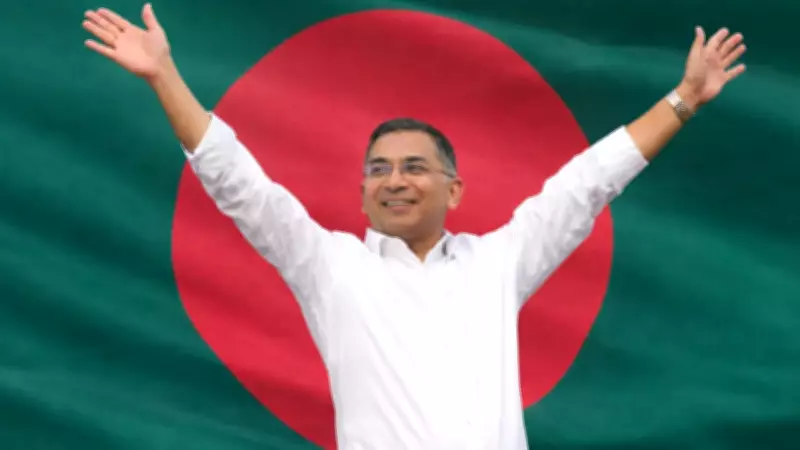
BNP Declares Victory in Historic Bangladesh Parliamentary Election
The Bangladesh Nationalist Party (BNP) has announced a decisive victory in the country's first parliamentary election following the dramatic 2024 uprising, asserting it has secured sufficient seats to establish the next government. While the Election Commission has yet to release the official final results, the BNP's declaration marks a significant political shift in South Asia's eighth-most populous nation.
Challenger Questions Election Credibility Amid Anticipated Outcome
Jamaat-e-Islami, one of the BNP's primary opponents in the electoral contest, raised serious concerns about the vote's integrity on Friday. The Islamist political organization alleged "repeated inconsistencies and fabrications" within the unofficial results, casting doubt on the electoral process despite the widely predicted outcome.
The path to this election proved extraordinary, unfolding after a student-led uprising in July 2024 that ultimately resulted in the removal of then-Prime Minister Sheikh Hasina. The protests, fueled by widespread frustration over economic stagnation and systemic corruption, intensified dramatically after Hasina ordered a severe crackdown on demonstrators. The violent clashes claimed more than 1,400 lives, leading to Hasina's subsequent flight to India for refuge.

Tarique Rahman Prepares to Assume Leadership at Critical Juncture
At 60 years old, BNP leader Tarique Rahman stands ready to assume leadership of Bangladesh, a nation of approximately 170 million people. Speaking from his office two days before the pivotal vote, Rahman articulated his vision to build upon his parents' political legacy while establishing his own distinct leadership style.
"They are them, I am me," Rahman stated in comments cited by AFP. "I will try to do better than them." His remarks underscore both the weight of familial political history and his aspirations for Bangladesh's future direction.
The Formative Years and Political Inheritance of Tarique Rahman
Born when Bangladesh remained East Pakistan, Tarique Rahman experienced early political trauma when briefly detained as a child during the 1971 independence war. Widely recognized as Tarique Zia, he has carried a political surname that has profoundly shaped both his public and private existence throughout his life.
His party officially describes him as "one of the youngest prisoners of war," highlighting how political conflict marked his childhood. Rahman's father, Ziaur Rahman, emerged as a prominent army commander following a 1975 coup that resulted in the assassination of founding leader Sheikh Mujibur Rahman—Sheikh Hasina's father.
These violent events cemented a deep-seated rivalry between the two political families that would dominate Bangladesh's political landscape for decades. The assassination of Ziaur Rahman in 1981 further intensified this enduring political feud.
Political Apprenticeship Under Maternal Guidance
Rahman matured within his mother's political sphere as Khaleda Zia made history by becoming Bangladesh's first female prime minister. For years, power alternated between Khaleda Zia and Sheikh Hasina in a prolonged and intensely adversarial political competition that defined the nation's governance.
"In her seats, I used to go and I used to campaign," Rahman recalled in statements quoted by AFP. "So this is how slowly and gradually I started getting involved in the politics." This gradual immersion laid the foundation for his eventual political ascendancy.
Controversies and Legal Challenges Mark Political Journey
Rahman's political career has been consistently shadowed by allegations of corruption and abuse of power. His arrest on corruption charges in 2007 represented a significant setback, with Rahman later claiming he endured torture while in custody. The following year, he departed Bangladesh for London, where he subsequently faced multiple legal cases tried in absentia.
Rahman has consistently denied all allegations, characterizing them as politically motivated attacks designed to undermine his legitimacy. Married to a cardiologist and father to a daughter practicing law, he maintained a relatively low-profile existence in Britain for years.

High-Profile Return and Vision for National Reconstruction
This subdued existence transformed dramatically with Rahman's high-profile return to Bangladesh in December following his mother's passing. He received an overwhelmingly large public welcome, signaling strong popular support for his political resurgence.
Reflecting on the challenges ahead, Rahman described the task as "immense," portraying the country as having been "destroyed" by the previous regime. In a conciliatory gesture, he stated, "If there are any mistakes which were unwanted, we are sorry for that," suggesting a potential shift toward political reconciliation.
The BNP's claimed victory, coupled with Rahman's anticipated leadership, represents a watershed moment in Bangladesh's turbulent political history, potentially ending decades of alternating power between two rival political dynasties while ushering in a new era of governance for the South Asian nation.





