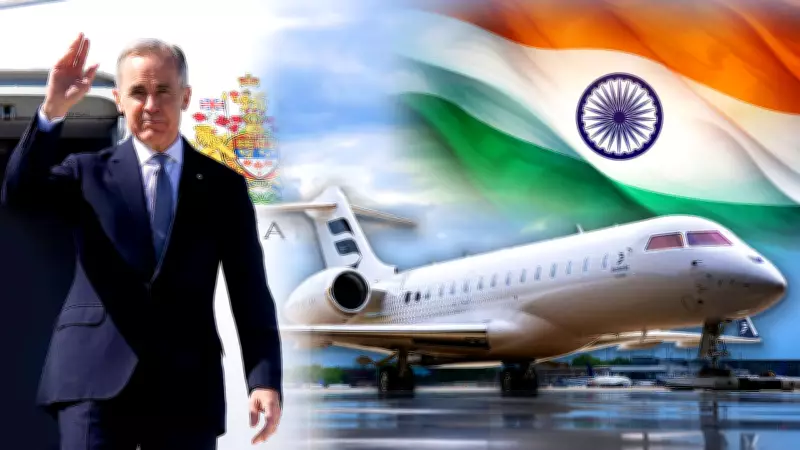
Bombardier's Strategic India Expansion Coincides with Canadian Prime Minister's Diplomatic Mission
In a significant development for international aerospace and defense cooperation, Canadian Prime Minister Mark Carney's arrival in India has been accompanied by a major strategic announcement from Bombardier, the renowned Canadian aerospace and transportation manufacturer. The company has signaled its intention to launch a substantial push into India's rapidly growing aviation and defense markets, positioning this move as a long-term commitment aligned with India's economic ascent.
Timing Aligns with Diplomatic Re-engagement Efforts
The announcement comes at a pivotal diplomatic moment, as Prime Minister Carney's visit aims to rebuild and strengthen bilateral ties between Canada and India. Bombardier's strategic interest is seen as a concrete manifestation of this renewed engagement, moving beyond political rhetoric to tangible industrial partnership. The company's leadership views India not merely as a market, but as a central growth engine for its global operations in the coming decades.
Focus on Business Aviation and Tailored Defense Solutions
Bombardier's expansion strategy is multifaceted, targeting two key segments of the Indian market. Firstly, the company plans to significantly increase its footprint in the business jet sector, aiming to connect India's major economic hubs with global destinations through its premium aircraft offerings. Secondly, and perhaps more strategically, Bombardier is preparing to offer customized defense platforms, indicating a desire to become a key partner in India's military modernization and indigenization efforts, known as 'Make in India'.

The Canadian firm's confidence is underpinned by robust market fundamentals within India. The country's aviation sector is experiencing an unprecedented surge, driven by:
- A rapidly expanding middle class with increasing disposable income
- Massive airport infrastructure development across major and secondary cities
- Growing demand for both commercial and private air travel
- Government policies encouraging foreign investment in defense manufacturing
Long-Term Potential Versus Immediate Challenges
While Bombardier's vision is ambitious, industry analysts note that translating this interest into deep industrial partnership requires navigating several challenges. These include complex regulatory environments, competition from established global players, and the need for technology transfer agreements that satisfy both Indian strategic priorities and Canadian commercial interests. The success of this initiative will depend on sustained diplomatic support and the alignment of long-term strategic objectives between the two nations.
The broader question remains whether this corporate initiative will catalyze a more comprehensive strategic alignment between Canada and India across multiple sectors beyond aerospace.As Prime Minister Carney engages in high-level discussions with Indian leadership, Bombardier's announcement serves as a powerful indicator of the economic dimension of this diplomatic re-engagement. The coming months will reveal whether this aerospace push becomes the foundation for a transformed bilateral economic relationship or remains a standalone corporate venture in a competitive market.