

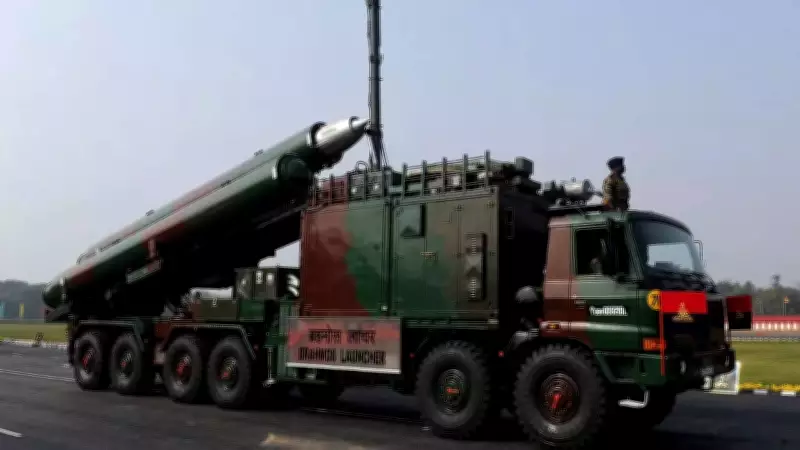
India-Russia BrahMos Missile Program Advances Toward Hypersonic Technologies
In a significant development for India's defense sector, the upgradation and modernisation of the BrahMos cruise missile system is described as a continuous and ongoing process. According to a top official from the Russian joint venture partner, both nations are now firmly focused on transitioning toward hypersonic technologies.
Continuous Enhancement of BrahMos Missile
Alexander Leonov, CEO and Chief Designer of NPO Mashinostroyeniya, emphasized that India and Russia are constantly enhancing the jointly produced BrahMos missile. This involves improving its performance characteristics and actively working on next-generation variants, including small-sized missiles and hypersonic platforms.
"We constantly modernise these missiles, improving their characteristics. That is why this is a continuous work. Under the BrahMos project, work is also underway on small-sized missiles and hypersonic technologies," Leonov stated during a conference on cosmonautics in New Delhi. His remarks were reported by Russia's state-run news agency TASS.

Strategic Context and Regional Security
These comments emerge at a critical juncture as India accelerates its push to develop advanced missile systems. This drive is in response to rapidly evolving regional security challenges, with hypersonic weapons emerging as a key focus area for future warfare scenarios.
The BrahMos missile, a supersonic cruise missile equipped with advanced guidance and control systems, offers remarkable versatility. It can be launched from multiple platforms including:
- Submarines
- Surface ships
- Aircraft
- Land-based platforms
Developed jointly by India and Russia, this missile has become one of the most versatile and reliable strike weapons in India's arsenal.
Historical Background and Evolution
The BrahMos project traces its origins back to 1998, with serial production commencing in 2004. Widely regarded as the brainchild of former president APJ Abdul Kalam, the missile derives its name from the Brahmaputra and Moskva rivers, symbolizing their combined speed and power.
Originally derived from the Russian anti-ship Yakhont supersonic cruise missile, BrahMos has steadily evolved into a symbol of cutting-edge Indo-Russian defence collaboration. Over the years, the project has moved decisively toward indigenous production, with more than 70 percent of its components now manufactured in India under the 'Atmanirbhar Bharat' initiative.
Operational Validation and Future Direction
The missile system's combat capability was convincingly demonstrated during Operation Sindoor in May 2025. During this operation, BrahMos carried out pinpoint strikes on crucial enemy targets, reinforcing its role as a precision strike weapon in high-intensity conflict scenarios.
The current emphasis on hypersonic technologies marks the next strategic phase of the programme. Both nations seek to stay ahead of emerging missile defence systems and develop weapons capable of travelling at speeds far beyond existing supersonic platforms.
Technical Specifications and Capabilities
BrahMos stands as a supersonic cruise missile jointly developed by India and Russia, ranking among the fastest operational cruise missiles currently deployed worldwide. Its technical features include:
- A two-stage propulsion system combining a solid-propellant booster and a liquid-fuelled ramjet engine
- Sustained speeds approaching Mach 3 throughout its flight
- Advanced guidance, navigation and control systems enabling high-precision strikes against both land and sea-based targets
A key operational advantage lies in its exceptional versatility across multiple launch platforms, providing the Indian armed forces with a credible multi-domain strike capability designed to penetrate modern air defence systems.

Program Evolution and Strategic Significance
Since its initiation in 1998 as a joint venture, the BrahMos program has evolved through multiple upgrades including extended-range variants and air-launched versions tailored for platforms such as the Su-30MKI. With indigenous manufacturing exceeding 70 percent, BrahMos has become a flagship of India's self-reliance push while maintaining its status as a symbol of advanced Indo-Russian defence cooperation.
Leonov's remarks underscore that BrahMos is no longer a static weapons programme but a constantly evolving system. This reflects the long-term strategic partnership between New Delhi and Moscow and their shared commitment to developing next-generation missile technologies that will shape future defence landscapes.





