

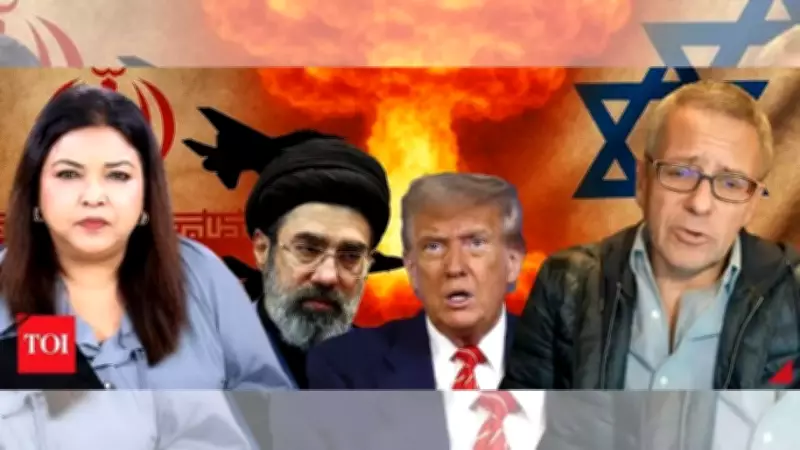
Geopolitical Expert Warns US-Iran Conflict Has Taken Dangerous Turn
In a comprehensive analysis of the ongoing Middle East conflict, Ian Bremmer, president of the prominent political risk consultancy Eurasia Group, has delivered a sobering assessment of the United States' military campaign against Iran. Bremmer asserts that a significant divergence has emerged between battlefield developments and political realities, with Washington's military actions inflicting substantial damage on Iran while failing to produce the political outcomes President Donald Trump anticipated.
Tactical Successes Versus Strategic Failures
Speaking in an exclusive interview, Bremmer detailed how American forces have successfully degraded key Iranian military capabilities, including ballistic missile systems and naval assets. However, he emphasized that these tactical achievements have not translated into the broader political objectives the Trump administration sought.
"It's not gone the way that Trump hoped or expected," Bremmer stated bluntly, highlighting what he described as a core miscalculation in Washington's approach.

The geopolitical analyst explained that US strategists operated under the assumption that Iran's leadership could be either decapitated or pressured into producing a more compliant successor government. This assumption, Bremmer suggested, has been thoroughly disproven by recent developments.
The Succession That Changed Everything
Bremmer pointed to the elevation of Mojtaba Khamenei following the death of Supreme Leader Ali Khamenei in US-Israeli strikes as a pivotal moment that shattered Washington's political calculations. Rather than signaling moderation, compromise, or internal fragmentation within Tehran's power structure, this succession has demonstrated continuity and defiance.
"It shows that the Iranian leadership is in an intransigent mode," Bremmer observed, contrasting the symbolism of Iran's formal presidency with the harder realities of the clerical system that truly wields power.
The selection of Mojtaba Khamenei, according to Bremmer's analysis, amounts to a clear declaration that the Islamic Republic intends to maintain its position rather than seek compromise on terms dictated by Washington.
Mounting Strategic Costs
While Iran's conventional military forces have sustained visible damage, Bremmer outlined how the broader strategic costs have escalated rapidly. These include:
- Drone and missile attacks targeting Gulf states
- American military casualties
- Severe disruption in the Strait of Hormuz
- Significant increases in global oil, gas, and fertilizer prices
This combination of military progress and political failure, Bremmer argued, has created a far more dangerous and expensive conflict than the Trump administration initially anticipated.
A Fundamental Misunderstanding of Iranian Politics
Bremmer was particularly direct in dismissing comparisons between Iran and other nations where the United States believed it could exploit internal fractures to achieve regime change. The fundamental problem in Iran, he explained, is not merely operational difficulty but the absence of any internal faction willing to trade ideology for survival in the manner Washington hoped.
"Trump assumes that all political leaders are like him - that everyone has a price," Bremmer said. "In the case of Iran he is negotiating with people who do not have a price."
This reality, according to Bremmer's analysis, means any serious attempt at regime change would require tools the United States currently lacks: either American ground forces, a coordinated domestic opposition movement, or most likely both. Neither currently exists in a usable form, he noted.
The Changing Nature of the Threat
Bremmer described how Iran's military strategy has evolved in response to American pressure. While Iran is clearly losing in conventional military terms, with its missile arsenal steadily reduced and proxy forces like Hezbollah and Hamas diminished, the nature of the threat has transformed.
Iran's remaining tools increasingly focus on low-cost, dispersed violence rather than massed conventional retaliation. These include:

- Drone attacks that are cheap and difficult to eliminate completely
- Opportunistic strikes against various targets
- Potential terrorist operations abroad
Bremmer warned that drones represent a particularly concerning threat category because of their affordability, decentralization, and persistence. Iran may sustain this kind of pressure for months even as its heavier capabilities diminish.
Triggers for Wider Conflict
The geopolitical analyst outlined three specific triggers that could transform the current conflict into a much broader Middle East war:
- A major attack causing large-scale American casualties
- An oil shock severe enough to send crude prices above $100-$120 per barrel while damaging energy infrastructure
- A significant strike on a Gulf state that convinces countries like the UAE that their economic models face direct threat
Bremmer placed particular emphasis on the global economic consequences of prolonged instability in the Gulf region. The disruption in the Strait of Hormuz is already historic, he noted, and any deeper shock would affect energy markets, trade flows, and domestic politics in countries far from the battlefield, including the United States and India.
Narrowing Options and Political Pressures
According to Bremmer's analysis, President Trump now faces a narrowing set of choices: accept a leader he does not want, retreat from his earlier rhetoric, or continue a war whose costs are likely to keep rising. The conflict has already become unpopular in the United States and could grow more so as expenses mount, especially at a time when Trump faces domestic pressure over immigration and economic affordability issues.
"This war did not need to be about killing the Supreme Leader, killing all military leaders, or disrupting the Strait of Hormuz," Bremmer argued, suggesting that a narrower campaign focused on missile and nuclear facilities might have left the US and its allies in a stronger diplomatic position.
Instead, the broader campaign has pushed Iran toward a more desperate and decentralized strategy in which local commanders strike a wider array of targets with fewer constraints, making the conflict harder to contain.
The Path Forward
Bremmer suggested that the best-case scenario at this point is not decisive victory but a quick declaration of one. A limited ceasefire, or a unilateral US decision to halt operations after inflicting damage, could still reduce casualties and create space for renewed negotiations from a position of strength.
However, he expressed concern about the alternative: a war that deepens because Trump finds it politically difficult to acknowledge limitations.
"Trump will never admit failure," Bremmer noted. "But when he feels constrained he also tends to double down."
This psychological dynamic, Bremmer suggested, represents the primary danger now hanging over the conflict: a war in which the military situation appears manageable, but political logic keeps pulling the United States toward a larger and more punishing confrontation. Even without dramatic escalation, Bremmer views the conflict as likely to become the defining foreign-policy error of Trump's presidency.





