

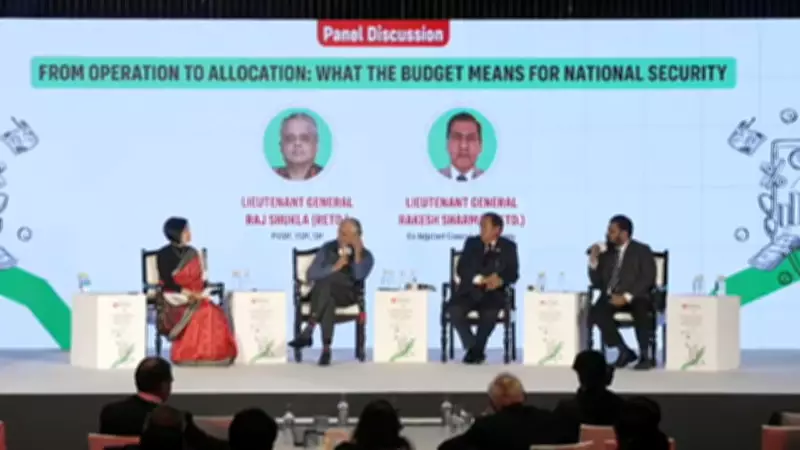
TOI Budget Dialogues 2026 Examines National Security Implications of Union Budget
The TOI Budget Dialogues 2026, held in New Delhi under the overarching theme "March Towards Viksit Bharat", featured comprehensive discussions analyzing the Union Budget's impact across critical sectors. The event convened policymakers, former government officials, and domain specialists to dissect how Budget 2026 aligns with India's long-term national objectives and developmental vision.
Focus Shifts to Defence and Strategic Challenges
During the fourth panel discussion, attention turned decisively toward national security concerns. Titled "From Operation to Allocation: What the Budget Means for National Security", this session was moderated by Anisha Dhawan and featured distinguished military experts: Lt Gen Raj Shukla (Retd.), PVSM, YSM, SM, and Lt Gen Rakesh Sharma (Retd.), former Adjutant General of the Indian Army. The dialogue critically assessed whether Budget 2026 possesses the necessary structural framework to address India's evolving defence and strategic challenges effectively.
Analyzing Defence Allocations and Capital Expenditure
The conversation commenced with a detailed examination of defence allocations within Budget 2026. Panelists scrutinized the government's announced 22% increase in capital expenditure and the pronounced emphasis on domestic procurement, noting that 75% of the capital outlay is designated for Indian industry. However, both speakers issued a caution against interpreting these figures in isolation, emphasizing the need for contextual understanding.

Lt Gen Raj Shukla articulated that the true measure of the budget's effectiveness lies in tangible outcomes rather than mere allocation figures. "Budgets don't fight wars, capabilities do. The question is not how much money is allocated, but how intelligently and quickly it is converted into operational capability," he stated, highlighting the critical gap between financial provisions and actual military readiness.
Future Warfare: Technology Over Traditional Platforms
Drawing insightful parallels from recent global conflicts, including the ongoing war in Ukraine, Shukla underscored that future battles will be predominantly shaped by advanced technology rather than reliance on sheer manpower or legacy platforms. "If we prepare for the last war, we will lose the next one," he warned, identifying several decisive factors:
- Unmanned aerial vehicles and drone technology
- Artificial intelligence and machine learning applications
- Space-based assets and satellite systems
- Precision-guided weapons and smart munitions
Shukla further highlighted structural deficiencies within India's defence procurement processes. He argued that the prevailing focus on the L1 (lowest cost) model frequently compromises quality and stifles innovation. "We are still optimising for cost when we should be optimising for lethality, speed and survivability," he remarked, adding that bureaucratic delays in decision-making can effectively neutralize even the most well-intentioned budgetary provisions.
Committed Liabilities and Budgetary Constraints
Lt Gen Rakesh Sharma provided a more measured assessment of the defence outlay, drawing attention to the substantial pressure exerted by committed liabilities. "A large part of the capital budget goes into payments for contracts signed in earlier years. What looks like a big jump on paper often leaves limited headroom for new capability creation," he explained, revealing the often-overlooked financial constraints within defence budgeting.
Sharma also pinpointed significant gaps in intelligence, surveillance, and reconnaissance (ISR) capabilities, particularly concerning space-based assets. "Without real-time situational awareness, even the most advanced platforms are fighting blind," he noted, emphasizing the foundational importance of comprehensive battlefield awareness for modern military operations.

Private Sector Participation and Defence Innovation
Both military experts concurred that robust private sector participation and the growth of defence start-ups will prove indispensable for India to achieve its long-term security objectives. Shukla emphasized that industry requires predictability and consistent governmental trust to thrive. "If we want Indian companies to take risks and innovate, we must give them long-term assurance, not stop-start policies," he asserted, calling for stable policy frameworks to foster indigenous defence manufacturing.
Holistic Security and Integrated Defence Systems
The panel discussion also encompassed critical areas such as air defence mechanisms, missile systems, and homeland security requirements. Sharma stressed the imperative need to rebalance defence spending toward more integrated approaches. "We are still investing heavily in legacy systems. The future lies in integration—air, land, sea, cyber and space working as one," he advocated, promoting a multidimensional and interconnected defence strategy.
Consensus on Reform and Strategic Mindset
The dialogue concluded with a shared understanding that Budget 2026 presents a significant window of opportunity to fundamentally reshape India's national security architecture. However, as Shukla succinctly summarized, "Money is necessary, but mindset and reform are decisive." This sentiment encapsulated the panel's collective view that beyond financial allocations, strategic vision, procedural reforms, and technological adaptation will ultimately determine India's security preparedness in an increasingly complex global landscape.
The TOI Budget Dialogues 2026 successfully facilitated this crucial exchange, bringing together expert perspectives to decode the broader implications of the Union Budget for India's journey toward becoming a developed nation.





