

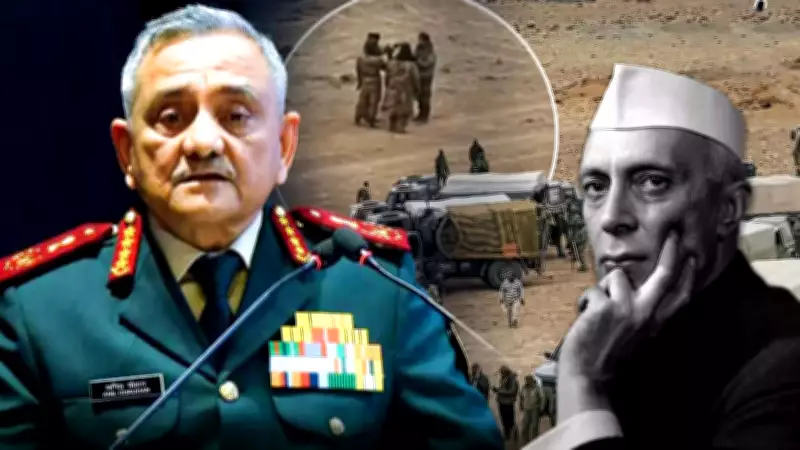
CDS General Anil Chauhan Connects Historical Context to Ongoing Border Disputes With China
As the debate over India's map intensifies, Chief of Defence Staff General Anil Chauhan has provided a strategic perspective on borders and legitimacy, linking current tensions with China to historical events and diplomatic decisions from the post-Independence era. Addressing the Bharat Himalayan Strategy Forum, he emphasized that understanding sovereignty requires more than just cartography—it involves legal agreements, political will, and ground defence.
Borders vs. Frontiers: A Strategic Distinction
General Chauhan explained the critical difference between borders and frontiers in shaping national identity and security. He stated that borders are formal separations between nation-states, defined by documented agreements and politically guarded to assert sovereignty. In contrast, frontiers represent civilisational contact zones, influenced by terrain, history, and cultural interactions, which can lead to ambiguities and disputes.
Referring specifically to the Line of Control (LOC) with Pakistan and the Line of Actual Control (LAC) with China, he outlined how India's boundary realities were shaped by diplomatic efforts after Independence. This historical context, he argued, is essential for comprehending the current standoffs and territorial claims.

Recalling Nehru's Role and the Panchsheel Era
In his remarks, General Chauhan recalled that India's first Prime Minister, Jawaharlal Nehru, was aware of the border issues with China from the early days. He referenced the Panchsheel era—the five principles of peaceful coexistence signed between India and China in 1954—and the recognition of Tibet, which played a pivotal role in shaping bilateral relations.
By placing present tensions in this broader historical framework, he highlighted how past diplomatic engagements and decisions continue to influence contemporary border dynamics. This perspective underscores the complexity of sovereignty, which he described as a combination of legal documentation, political resolve, and military preparedness.
Implications for Current India-China Relations
General Chauhan's insights come at a time of heightened border disputes between India and China, with recent clashes and diplomatic spats drawing global attention. His emphasis on history and legitimacy suggests that resolving these issues requires not only military strategy but also a deep understanding of historical agreements and territorial claims.
The CDS's remarks serve as a reminder that border disputes are not merely about lines on a map but involve layered historical, political, and civilisational factors. As India navigates these challenges, his call for a holistic approach to sovereignty—integrating legal, political, and defensive elements—could inform future policy and diplomatic efforts.






