

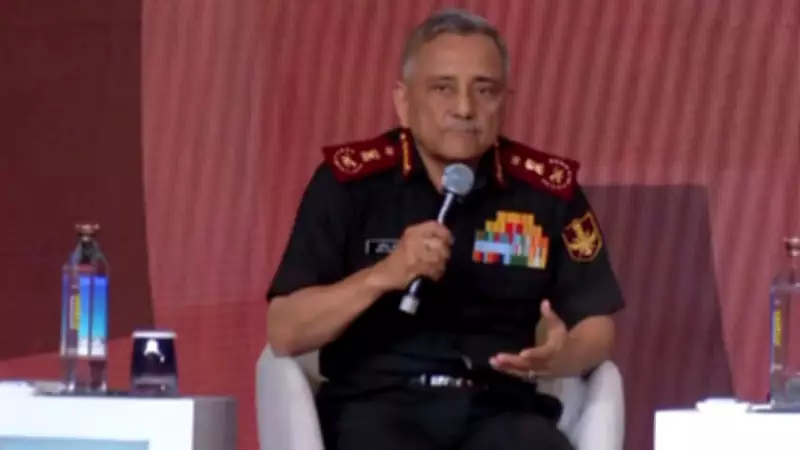
CDS General Anil Chauhan Announces Consensus on Theatre Commands, Details Still Evolving
In a significant development for India's military modernization, Chief of Defence Staff General Anil Chauhan has declared that the three armed services have reached a consensus in principle on the establishment of integrated theatre commands. Speaking at Ran Samvad 2026 in Bengaluru, General Chauhan described this alignment as a major step forward, though he emphasized that specific structural and organizational aspects are still being refined and will evolve during implementation.
Core Agreement on Force Separation
General Chauhan highlighted that the Army, Navy, and Air Force are fully aligned on the fundamental concept of separating force generation from force application. "There is total consensus on the concept," he stated, adding that operational details such as command locations, sequencing, and exact structures are not fixed and can be resolved as the reform progresses. This consensus marks a critical breakthrough after years of deliberation, overcoming one of the most substantial hurdles in India's defence reorganization efforts.
Voluntary Concessions by Service Chiefs
Acknowledging the sensitive nature of the reform, General Chauhan noted that it involves a voluntary dilution of the traditional authority held by service chiefs. He characterized this concession as highly significant, stating, "The service chiefs are willing to do it for the larger good of India." In his view, this willingness to prioritize national security over individual service interests represents a more meaningful development than the mere structural details of the theatre commands themselves.

Structure and Integration of New Commands
The proposed joint headquarters will integrate operations, intelligence, and logistics under a unified structure. Existing regional commands will continue to function under the theatre commands for operational purposes while maintaining administrative links with their respective service headquarters. General Chauhan clarified that the Army's planned Integrated Battle Groups (IBGs) are entirely separate initiatives aimed at enhancing the agility of ground combat units and are not directly related to the theatre command framework.
Expansive View on Modern Warfare
Addressing the theme of Ran Samvad 2026, multi-domain operations, General Chauhan offered a broader perspective than current doctrine reflects. He argued that contemporary warfare has expanded beyond physical domains into synthetic and cognitive realms, where shaping public perception can achieve political objectives without direct military engagement. He pointed to ongoing global conflicts where battlefield dominance has not necessarily led to clear political outcomes, underscoring the complexity of modern strategic environments.
Innovative Reformulation of Military Theory
General Chauhan presented an original reinterpretation of US Air Force Strategist Colonel John Boyd's renowned OODA (Observe, Orient, Decide, Act) loop. He suggested that advancements in predictive artificial intelligence and data analytics could potentially invert the traditional sequence, allowing military forces to orient and decide before they observe, thereby compressing the decision cycle beyond Boyd's original vision. This insight highlights the transformative impact of technology on military strategy and operational tempo.
Time as the Fourth Dimension of Warfare
The CDS also identified time as an emerging fourth dimension in warfare, noting that modern battlefields now host systems operating at vastly different speeds simultaneously. From slow-moving underwater platforms to near-instantaneous cyber intrusions, this disparity demands new frameworks for comprehension and command to effectively manage the tempo of operations across diverse domains.

Deliberate Non-Committal on Capability Choices
On debates regarding specific military capabilities, such as aircraft carriers versus submarines or the future role of tanks, General Chauhan was deliberately non-committal. He argued that warfare is evolving too rapidly to provide firm long-term answers, emphasizing the need for flexibility and adaptability in defence planning. He firmly ruled out any shift toward expeditionary ambitions, reaffirming that securing India's borders remains the primary focus, with overseas roles strictly limited to humanitarian assistance and United Nations missions.
Ran Samvad as a Diagnostic Tool
General Chauhan described Ran Samvad 2026 as a deliberate reversal of convention, centering on serving officers rather than veterans or think tanks. He noted that the seminar served as a valuable diagnostic tool, providing him with a ground-level assessment of how deeply the culture of jointness has penetrated across the three services. This feedback is crucial for gauging the practical implementation of integrated theatre commands and fostering a cohesive military ethos.





