

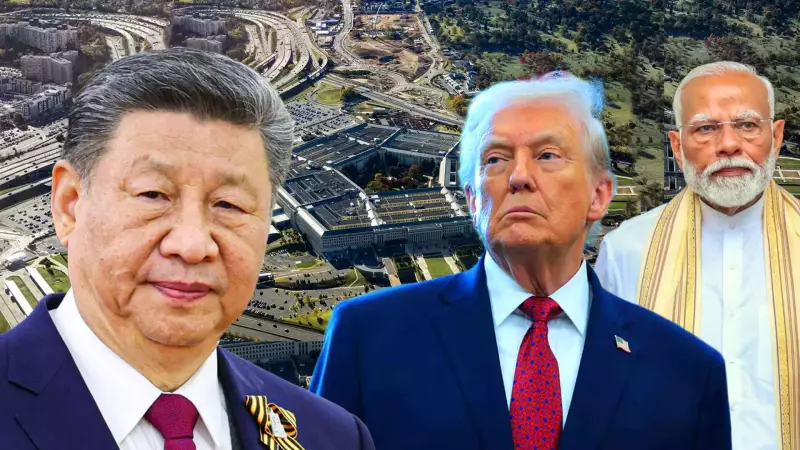
In a significant diplomatic statement, China has strongly rejected a recent United States Pentagon report while simultaneously reaching out to India for enhanced cooperation and stability. The development highlights Beijing's nuanced approach, balancing its fury towards Washington with a cautious but open stance towards New Delhi.
Beijing's Dual Response: Anger at US, Outreach to India
On Thursday, December 26, 2025, Chinese Foreign Ministry spokesperson Lin Jian launched a sharp critique of the Pentagon document. He labelled the report as "irresponsible" and "misleading," accusing it of attempting to justify continued US military dominance in the region. The core of Beijing's objection revolves around the report's expansion of China's stated "core interests" to include the Indian state of Arunachal Pradesh.
However, in the very same briefing, Lin Jian pivoted to India with a notably different tone. He emphasised that China is prepared to strengthen communication and build trust with its southern neighbour. Stressing a long-term strategic view of the bilateral relationship, the spokesperson confirmed that border communication channels remain operational and the situation is largely stable.

The Contentious Pentagon Report
The document that sparked this reaction from Beijing presents a starkly confrontational view of China's ambitions. The US Department of Defense report intricately links China's territorial claims, its rapid military expansion, and the Communist Party's overarching control to a broader national strategy. This strategy, as outlined by the Pentagon, aims at achieving "national rejuvenation" by the year 2049.
By explicitly mentioning Arunachal Pradesh—a region China refers to as Zangnan and claims as part of South Tibet—the report directly touches upon one of the most sensitive friction points in Sino-Indian relations. This move by the US has evidently placed China in a position where it must publicly clarify its stance to both international observers and India.
Implications for Regional Stability
China's dual-track response reveals a careful diplomatic calculus. While it cannot let the US allegations go unchallenged, it also appears keen to prevent the Pentagon's assessment from derailing its managed relationship with India. The offer to maintain stable relations and build trust indicates a desire to compartmentalise issues and avoid unnecessary escalation on the border front.
This episode underscores the complex geopolitical triangle involving the US, China, and India. Beijing's message is clear: it views Washington's actions as provocative and designed to sow discord, but it seeks to assure New Delhi of its commitment to dialogue and border management. The coming months will show whether this verbal outreach translates into tangible progress on the ground, particularly in resolving longstanding border disputes.






