

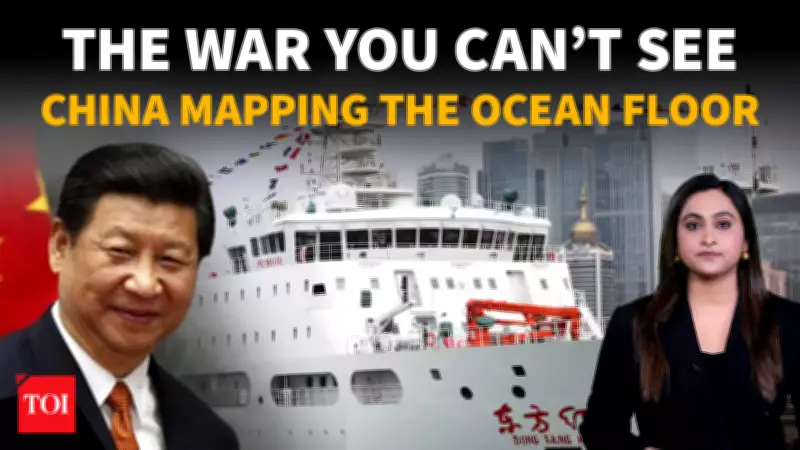
China's Ocean War: Deep-Sea Mapping Across Pacific and Indian Oceans Raises Global Alarm
Beneath the surface of the world's vast oceans, a silent and profound transformation is currently unfolding—one that possesses the potential to fundamentally redefine the future of global warfare and strategic competition. While most contemporary conflicts remain visible in the skies or on contested land, military analysts and intelligence agencies increasingly warn that the next major geopolitical battlefield may lie deep underwater, hidden from conventional view and notoriously difficult to track with standard surveillance methods.
Scientific Research or Strategic Preparation?
The People's Republic of China is rapidly and systematically expanding its sophisticated undersea mapping and comprehensive surveillance operations across critical maritime domains, including the vast Pacific Ocean, the strategically vital Indian Ocean, and even the increasingly accessible Arctic Ocean. On official documentation and in public statements, these extensive maritime missions are consistently described and promoted as purely scientific research endeavors, ostensibly focused on critical climate change studies and the exploration of underwater natural resources.
However, a growing body of recent intelligence reports, satellite imagery analysis, and expert geopolitical assessments strongly suggest there exists a much deeper, more calculated strategic purpose behind these activities. The precise nature and repeated patterns of these mapping exercises align closely with methods used for military reconnaissance and preparation of the battlespace.

Advanced Vessels in Sensitive Waters
China has deployed advanced, state-of-the-art oceanographic research vessels, including notable ships such as the Dong Fang Hong 3, to conduct highly detailed and systematic seabed surveys in some of the world's most sensitive and strategically important maritime regions. These areas include international waters perilously close to Taiwan, around the major U.S. military hub of Guam, and across key chokepoints and sea lanes within the Indian Ocean that are crucial for global trade and energy transport.
Observations confirm these specialized vessels frequently move in precise, grid-like, and repeated navigational patterns—a well-established and recognized methodological signature used specifically for creating high-resolution, three-dimensional maps of the ocean floor. Such detailed bathymetric data is essential not only for scientific understanding but also, critically, for naval operations, including submarine navigation, mine placement, and the deployment of underwater sensors or communication cables.
Global Security Implications and Rising Tensions
The scale and scope of China's deep-sea mapping initiative have triggered significant alarm within defense and intelligence circles worldwide. The ability to chart the seabed with extreme accuracy provides a formidable advantage in potential underwater conflict scenarios, enabling the effective hiding of submarines, the strategic placement of undersea infrastructure, and the potential disruption of adversary communications. This activity occurs against a backdrop of heightened tensions in the Indo-Pacific region and represents a new frontier in the great power competition for maritime dominance.
While China maintains its activities are peaceful and compliant with international law, the dual-use nature of the technology and the secrecy surrounding certain operations continue to fuel international concern. The strategic mapping of these ocean floors is increasingly viewed not merely as an academic pursuit, but as a critical component of preparing the underwater domain for future geopolitical confrontations, effectively turning the deep sea into a potential theater of silent warfare.






