

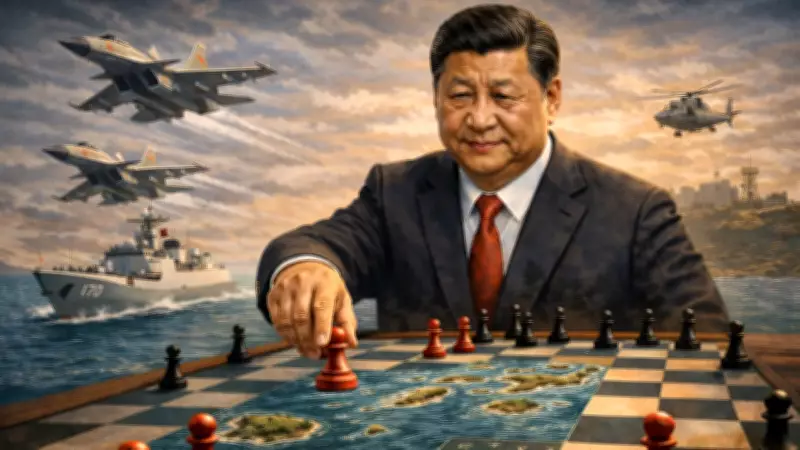
From Strategic Patience to Calculated Ambiguity: China's Evolving Foreign Policy
"Hide your strength and bide your time" – this famous maxim from Deng Xiaoping, China's transformative premier, once defined Beijing's post-Cold War foreign policy approach. For decades, this philosophy of taoguang yanghui emphasized patience, strategic restraint, and quiet accumulation of national power while avoiding confrontations that could derail domestic development. However, under President Xi Jinping's leadership, this traditional restraint has gradually eroded, giving way to a more assertive dual posture: overt where possible, ambiguous where necessary.
The Gray Zone: Between Peace and War
The shift in China's external posture manifests not merely in rhetoric but through a pattern of calibrated actions across military, economic, legal, and technological domains. These actions collectively alter realities on the ground – or on water – without triggering open conflict. This strategy operates in what analysts term the "gray zone": the ambiguous space between peace and war where states pursue coercive objectives without crossing thresholds that would trigger direct military retaliation.
At the heart of China's gray zone behavior lies a method strategists describe as salami slicing. This concept, originating in Cold War Europe, refers to achieving strategic objectives through a series of small, calibrated steps, each designed to fall below the threshold that would provoke military retaliation or unified international response. No single move appears decisive, but collectively they transform the strategic landscape.

International Law Meets Strategic Reality
International law, on paper, provides clear frameworks for resolving disputes. Yet Beijing's response to adverse rulings has been consistently dismissive. When the International Court of Justice under the United Nations Convention on the Law of the Sea (UNCLOS) ruled in July 2016 that China's sweeping claims in the South China Sea lacked legal basis, Beijing declared the verdict "null and void" and continued its activities unabated. This episode highlighted a recurring dilemma: rules exist, but enforcement against a determined major power remains elusive.
The South China Sea: Laboratory of Gray Zone Tactics
Nowhere has China's salami slicing approach been more systematically applied than in the South China Sea – one of the world's most economically and strategically consequential maritime corridors. According to the China Power Project at the Center for Strategic and International Studies, approximately one-third of global maritime trade passes through these waters annually. For China specifically, over 64% of its maritime trade – valued at approximately $874 billion in 2016 – transits this region.
Incremental Occupation and Militarization
China claims "historic rights" over most of the South China Sea based on the controversial nine-dash line, which overlaps with exclusive economic zones of several Southeast Asian nations. Rather than enforcing these claims through direct confrontation, Beijing has pursued control through incremental occupation and sustained presence.
The strategy became unmistakable during the 2012 Scarborough Shoal standoff, when Chinese coast guard vessels established de facto control without formal declarations or shots fired. This was followed by a massive land-reclamation program from 2013 to 2016 that transformed submerged reefs into artificial islands capable of hosting airstrips, deep-water ports, and military installations. By the mid-2010s, China had established 27 outposts across disputed areas, significantly expanding its power projection capabilities.
Maritime Militias and Cabbage Tactics
China's maritime posture increasingly relies on a layered force structure that blurs civilian and military roles. The country's maritime militia – ostensibly civilian fishing fleets organized and directed by state authorities – routinely shadow foreign vessels, block access to contested features, and engage in aggressive maneuvers. This blending of roles allows China to apply pressure while maintaining plausible deniability.

At contested locations like Second Thomas Shoal, Chinese coast guard vessels have repeatedly obstructed Philippine resupply missions, reflecting what Chinese strategists term "cabbage tactics" – surrounding disputed features with multiple layers of vessels to isolate them gradually.
Beyond Maritime Disputes: Expanding Gray Zone Operations
While the South China Sea offers the clearest illustration, China's salami slicing extends across multiple domains:
- Military Signalling: The People's Liberation Army Air Force conducted thousands of incursions into Taiwan's air defence identification zone in 2024, averaging nearly three per day – a sustained pressure campaign short of invasion.
- Cyber Operations: Taiwan's National Security Bureau reported an average of 2.4 million cyberattacks per day against government networks in 2024, with most attributed to Chinese cyber forces.
- Economic Coercion: Beijing has timed trade investigations and regulatory actions around political events, restricted critical mineral exports, and selectively adjusted tariffs to reward diplomatic alignment.
- Legal Instruments: China has expanded its coast guard's authority to detain vessels in contested waters and launched antimonopoly investigations into foreign firms during broader trade disputes.
The Undersea Cable Frontier
One of the least visible yet most consequential arenas of gray zone competition lies beneath the ocean surface. Undersea cables carry approximately 95% of global internet traffic, and Chinese research institutions affiliated with the PLA have studied cable-cutting techniques for over a decade. Multiple incidents involving Chinese-owned vessels have damaged undersea cables near Taiwan and in the Baltic Sea since 2023.
China has also delayed repairs by requiring permits for cable repair ships operating in waters it claims, prolonging outages and creating economic disruption. US officials have warned that Chinese repair vessels could be used for espionage, exploiting a shortage of alternative repair capacity in the Asia-Pacific region.
The Cumulative Impact and International Challenge
Each individual gray zone action – whether a patrol, regulation, cyber intrusion, or reef transformation – may appear manageable in isolation. None constitutes war, and none demands immediate escalation. This is precisely the strategic advantage of salami slicing: incremental steps that avoid red lines, exploit hesitation, and create new facts on the ground. By the time international responses coalesce, the baseline has already shifted.
As the 2016 UNCLOS ruling demonstrated, international law can clarify rights but cannot by itself reverse realities established through years of calibrated action. China's gray zone strategy operates on this premise – that influence can be accumulated without war, and that the patience once urged by Deng Xiaoping can be replaced by persistence under ambiguity.
For the international system, the challenge remains unresolved: how to respond to change that is slow, deliberate, and legally contested – yet strategically decisive in reshaping global power dynamics.





