

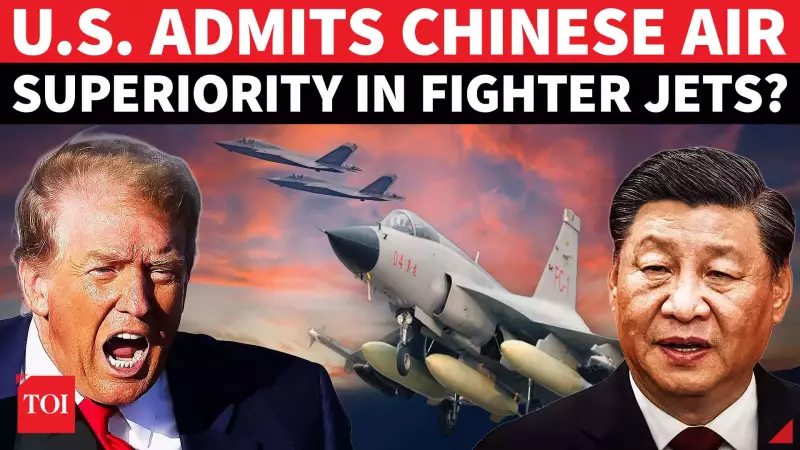
A new report from the Pentagon to the U.S. Congress has sounded a stark alarm, indicating that China is on the verge of dramatically altering the global military balance. The assessment warns that Beijing is preparing to saturate international defence markets with its advanced fighter aircraft, a move that could erode American influence and challenge decades of U.S. air superiority.
China's Ambitious Fighter Jet Export Push
The report, submitted to Congress, highlights a focused strategy by China to promote its most capable combat aircraft abroad. At the forefront of this push is the J-35, a fifth-generation stealth fighter designed to rival American F-35 jets. Alongside the J-35, China is aggressively marketing the J-10C Vigorous Dragon, a potent multi-role fighter, and the JF-17 Thunder, developed jointly with Pakistan.
More concerning for U.S. strategists are the identified potential buyers. The Pentagon report specifically names Egypt, Saudi Arabia, and the United Arab Emirates (UAE) as nations showing interest. These countries have traditionally been significant security partners for the United States, making their potential shift towards Chinese hardware a major geopolitical concern.

Closing the Capability Gap with the U.S.
The Pentagon's analysis goes beyond mere arms sales. It delivers a sobering evaluation of China's rapidly advancing domestic air combat capabilities. U.S. assessments conclude that the technological and operational gap between Chinese and American air forces is narrowing at an alarming rate. The report states that in certain combat scenarios and mission areas, Chinese capabilities are not just catching up but are beginning to surpass those that have underpinned American air superiority for generations.
This rapid advancement is no longer confined within China's borders. The potential export of such advanced technology means that the balance of air power in volatile regions like the Middle East could be reshaped not by the U.S., but by its primary strategic competitor.
Global Strategic Repercussions
The implications of this shift are profound. If successful, China's fighter jet export campaign would achieve several strategic objectives simultaneously. Firstly, it would deepen military and strategic ties between Beijing and key Middle Eastern powers, potentially drawing them into China's sphere of influence. Secondly, it would generate substantial revenue for China's defence industry, fuelling further research and development.
Most significantly, it would intensify the global strategic competition between the United States and China, extending it into new theatres and alliances. The prospect of U.S. allies operating advanced Chinese stealth fighters presents unprecedented challenges for interoperability, intelligence sharing, and regional security dynamics. The Pentagon's warning makes it clear that the battle for influence is increasingly taking to the skies, with the future of air power hanging in the balance.






