

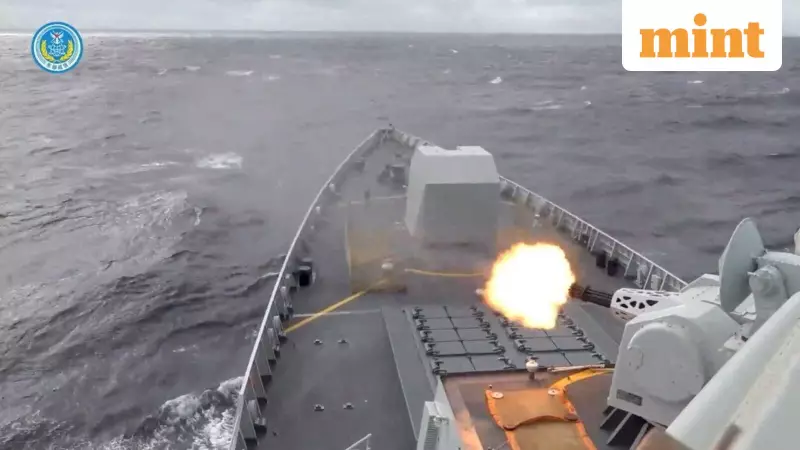
China has initiated significant military exercises in the airspace and waters surrounding Taiwan, delivering what it terms a 'stern warning' against foreign interference. This major display of force comes amidst heightened tensions with the United States and Japan concerning the island's security.
Drills a Direct Response to US Arms Package
The large-scale drills, which began on Monday, follow the Trump administration's mid-December approval of a substantial US arms sale to Taiwan, valued at over $11 billion. In retaliation, Beijing imposed sanctions last Friday, targeting 20 US defense companies and 10 of their executives.
China's Eastern Theatre Command stated that its naval and air forces would conduct operations 'approaching the island in close proximity' and performing 'blockade and control' maneuvers. These actions simulate the kind of military moves required to isolate or seize Taiwan. The exercises included live-fire drills on Tuesday across seven designated zones encircling the island.

Targeting 'Separatists' and Blocking External Aid
Beijing clarified that the drills also serve as a warning to what it labels 'Taiwan separatist forces'. China asserts sovereignty over Taiwan, viewing it as an internal matter and reserving the right to use force for reunification. A commentator on state broadcaster CCTV emphasized the strategic intent, pointing to a no-fly zone east of Taiwan.
'On one hand, we ensure Taiwan independence forces have nowhere to escape. On the other hand, we make sure external aid can't get in,' said Meng Xiangqing, a professor at the PLA National Defense University.
Analysts note the drills focus on an Anti-Access/Area Denial (A2/AD) strategy, aimed at preventing the defence of the island. The exercise zones, particularly north of Taiwan, suggest a plan to sever sea and air links between Taiwan and Japan, where US forces are stationed.
Regional Reactions and Escalating Tensions
Taiwan's military responded by deploying forces and conducting rapid-response drills, vowing to defend the island. The civil-aviation authority anticipated flight disruptions and explored alternative routes after Beijing declared a 'temporary danger area'.
The situation is further complicated by a weekslong pressure campaign by China against Japan. This began after Japanese Prime Minister Sanae Takaichi suggested in November that Japan's military could be involved if China attempted to seize Taiwan by force. In a related development, Japan's cabinet on Friday approved a record defence budget of $58 billion for the year starting April 2026, citing the need to protect islands near Taiwan.
China's Foreign Ministry criticised Japan's budget, accusing 'Japanese right-wing forces' of seeking remilitarisation. Meanwhile, Russia's Foreign Minister Sergei Lavrov affirmed over the weekend that Moscow would support China in a Taiwan conflict, citing a treaty pledge for 'mutual support in defending national unity and territorial integrity'.
The US, while committed to supplying Taiwan with defensive weapons, maintains a policy of strategic ambiguity regarding direct military intervention. The recent exercises underscore the fragile and increasingly volatile security landscape in the Taiwan Strait, with major global powers being drawn into the escalating standoff.






