

Unusual Chinese Fishing Boat Formations Spark Military Concerns Near Taiwan
An extensive analysis of satellite imagery, ship-tracking data, and expert interviews has revealed startling patterns of Chinese maritime activity, with thousands of fishing vessels forming precise geometric formations in waters near Taiwan. The findings, documented by AFP, have prompted serious questions about whether Beijing is testing its ability to mobilize civilian vessels for potential military or strategic operations in the region.
Geometric Patterns Detected in East China Sea
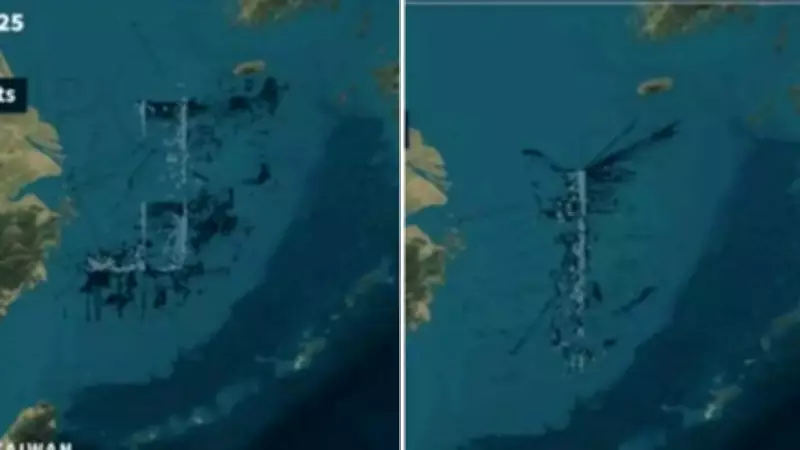
According to the comprehensive AFP investigation, the first major incident occurred on December 25, when approximately 2,000 Chinese fishing boats assembled in two large parallel inverted L-shaped formations in the East China Sea. These formations were positioned about 300 kilometers northeast of Taiwan, a location of significant strategic importance.
The vessels maintained their positions for roughly 30 hours despite challenging weather conditions, including near gale-force winds. Analysis of Automatic Identification System (AIS) signals, which commercial vessels use to broadcast their locations, confirmed the unusual patterns. Satellite imagery further verified that the boats were positioned as close as 500 meters apart, forming lines stretching nearly 400 kilometers before suddenly dispersing.

Jason Wang, chief operating officer of maritime data firm ingeniSPACE, emphasized the abnormality of these patterns. "Thousands of vessels forming straight lines across hundreds of kilometers is extremely rare in normal maritime behavior," he explained. While fishing vessels often gather where fish stocks are abundant, the geometric precision observed suggested activities beyond traditional fishing operations.
Multiple Incidents Point to Coordinated Operations
The December event was not isolated. In early January, approximately 1,000 Chinese fishing vessels gathered again in the same general area, forming what analysts described as a large uneven rectangle stretching around 400 kilometers. Many of these vessels had participated in the earlier December formation.
A third incident occurred weeks later, when about 1,200 vessels formed two long parallel lines further east in the East China Sea. Similar to previous incidents, these vessels maintained formation for approximately 30 hours before dispersing.
Experts reviewing the data concluded that the vessels were real and not spoofed, meaning the AIS signals were not artificially manipulated. Mark Douglas, a maritime analyst at Starboard and former New Zealand naval officer, compared the recent patterns with vessel behavior in the same region over the previous two years and found nothing similar.
Experts Confirm Vessels Were "Clearly Not Fishing"
Several maritime and security analysts cited in the AFP analysis stated unequivocally that the formations did not resemble normal fishing patterns. Gregory Poling, director of the Asia Maritime Transparency Initiative at the Center for Strategic and International Studies (CSIS) in Washington, noted he had never seen Chinese fishing boats mass in such numbers outside a port.
Jennifer Parker, a former Australian naval warfare officer now with the Australian National University's National Security College, emphasized that the proximity and density of the vessels strongly suggested they were not engaged in fishing. "Fishing fleets typically spread out to maximize their catch. Boats packed closely together in precise lines across hundreds of kilometers would not be operating efficiently as a fishing operation," she explained.
Evidence Points to State-Directed Coordination
The scale of these operations suggests organization at a national level. Thomas Shugart, a former US Navy submarine warfare officer and defense analyst, told AFP that coordinating thousands of vessels would be difficult for a commercial fishing entity alone. The sheer number of boats involved indicates the possibility of a state-directed mobilization exercise, potentially testing how quickly large numbers of vessels can be assembled.

China operates one of the world's largest fishing fleets, with tens of thousands of vessels active across the Yellow Sea, East China Sea, and South China Sea. Many of the vessels involved in the East China Sea formations appeared to originate from Zhejiang province, which hosts several ports associated with maritime militia units.
Potential Connection to China's Maritime Militia
One key explanation discussed in the AFP analysis involves China's maritime militia, a network of fishing vessels trained to support military and coastguard operations. These civilian boats are often used in "grey zone" tactics—actions that fall short of open military conflict but allow Beijing to assert territorial claims or apply pressure in disputed waters.
The militia has previously been deployed in the South China Sea, where large numbers of Chinese fishing boats have surrounded disputed reefs or blocked other countries' vessels. The recent formations in the East China Sea may represent similar tactics being tested in a different strategic theater.
Strategic Implications for Taiwan and Regional Security
According to experts cited in the AFP report, civilian vessels could play a crucial role in any potential Chinese military operation around Taiwan. While China's navy is the largest in the world by number of ships, analysts note it still lacks enough specialized landing vessels to transport the large number of troops and equipment required for a full-scale amphibious invasion.
Civilian ships such as ferries, cargo vessels, and fishing boats could therefore supplement military transport capacity. In such scenarios, fishing vessels might serve multiple roles including:
- Logistics support for military operations
- Surveillance and reconnaissance missions
- Decoys to confuse enemy detection systems
- Harassment of opposing naval vessels
The analysis places these fishing boat formations within the broader context of rising tensions around Taiwan. China claims Taiwan as part of its territory and has repeatedly stated it would use force if necessary to bring the island under its control. In recent years, Beijing has increased military pressure through regular fighter jet and warship deployments around Taiwan, along with large-scale military exercises that analysts say resemble rehearsals for a blockade or invasion.
Growing Regional Concerns and Unanswered Questions
The unusual formations of fishing vessels could represent a test of China's ability to mobilize civilian maritime assets quickly and in large numbers. While there is no direct evidence that the gatherings were linked to an imminent military operation, the patterns are consistent with preparations for scenarios involving Taiwan or other regional disputes.
Experts note that such activities fall into the category of "grey zone" operations, which are difficult for other countries to respond to because they involve civilian vessels rather than formal military deployments. China has not publicly commented on the formations detected in the East China Sea, according to the AFP report.
Regional governments have responded cautiously. Japan's coast guard declined to comment when contacted by AFP, even as tensions between Tokyo and Beijing have grown over Taiwan and maritime disputes. For analysts, these events highlight the growing complexity of maritime competition in East Asia, where civilian fleets, militias, and military forces increasingly operate in overlapping roles.
It remains unclear whether these formations were simply coordination exercises or part of broader preparations linked to China's long-term strategic goals in the region. However, the scale of the gatherings has added to concerns about how civilian maritime assets could be deployed in a future crisis, particularly given China's stated ambitions regarding Taiwan and its increasing military capabilities in the region.





