

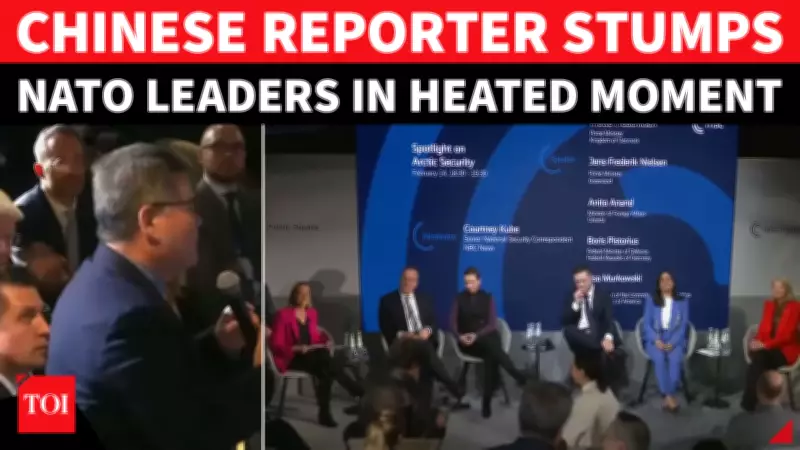
Chinese Reporter Confronts NATO Leaders Over Arctic Military Buildup at Munich Security Conference
A dramatic confrontation unfolded at the prestigious Munich Security Conference when a Chinese journalist directly challenged Arctic leaders regarding NATO's increasing military activities in the region. The exchange, which occurred on February 15, 2026, has brought the simmering geopolitical tensions in the Arctic into sharp international focus.
Heated Exchange Over Strategic Interests
The Chinese correspondent openly questioned the logic behind NATO's Arctic militarization plans, pointedly asking about Beijing's perceived role in what Western powers describe as a security strategy. The reporter's assertive line of questioning, which included characterizing certain plans as "illogical," created a palpable tension in the conference hall.
Greenland Prime Minister Jens-Frederik Nielsen and German Defence Minister Boris Pistorius responded to the challenge by defending transatlantic cooperation and Western security approaches. Both leaders emphasized the importance of their strategic posture amid what they described as rising competition with both Russia and China in the Arctic region.

Geopolitical Significance of the Arctic Region
The Arctic has emerged as a critical theater of global competition due to several factors:
- Strategic waterways that are becoming increasingly accessible due to climate change
- Vast untapped natural resources including oil, gas, and minerals
- New shipping routes that could dramatically shorten global trade pathways
- Military positioning advantages for surveillance and missile deployment
This confrontation at one of the world's premier security forums underscores how the Arctic has transformed from a relatively cooperative region into an arena of intense great power rivalry. The exchange reflects broader tensions between Western alliances and rising powers seeking to assert their influence in this strategically vital area.
Broader Context of Arctic Competition
The Munich confrontation occurs against a backdrop of increasing military activities by multiple nations in the Arctic region. Russia has significantly expanded its military infrastructure in its northern territories, while China has declared itself a "near-Arctic state" and increased its scientific and economic presence in the region through its Polar Silk Road initiative.
NATO countries have responded with their own enhanced military exercises and infrastructure development, citing the need to protect allied interests and maintain regional stability. This has created a complex security dynamic where diplomatic exchanges like the one in Munich serve as public manifestations of deeper strategic disagreements.
The public nature of this exchange between a Chinese journalist and NATO-aligned leaders suggests that Arctic competition is moving from behind-closed-doors discussions to more open diplomatic confrontations. As climate change continues to make the region more accessible, such tensions are likely to intensify rather than diminish in the coming years.






