

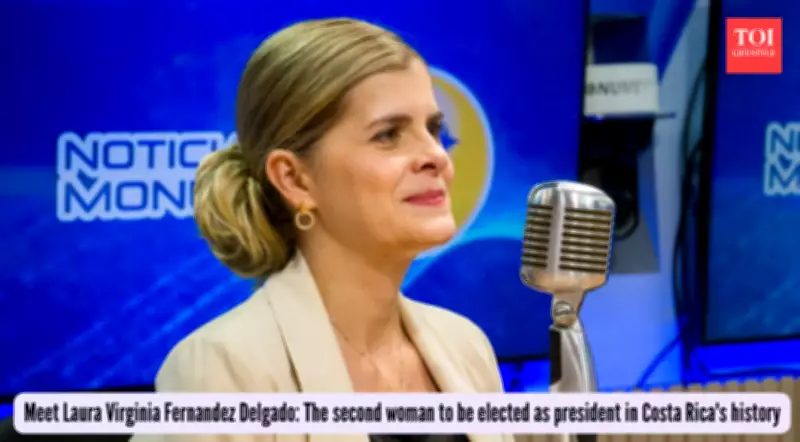
Costa Rica Makes History with Second Female President
Women continue to break barriers across global leadership positions, from corporate boardrooms to international diplomacy. Costa Rica has now joined this progressive movement by electing Laura Virginia Fernández Delgado as its new president, marking only the second time in the nation's history that a woman will assume the highest office.
A Landmark Victory in Central American Politics
This week, the 39-year-old political scientist captured international attention after securing victory in Costa Rica's presidential election. According to official results reported by The Sunday Guardian, Fernández Delgado won with 48.3% of the vote, decisively defeating centrist economist Álvaro Ramos who received 33%. Her margin was sufficient to avoid a runoff election, allowing for a clear first-round victory.
Fernández Delgado follows in the footsteps of former president Laura Chinchilla, who served from 2010 to 2014, establishing herself as the country's second female leader. The president-elect is widely regarded as a political ally of outgoing president Rodrigo Chaves and is expected to maintain much of his conservative-leaning policy agenda.

Educational Foundation and Political Ascent
Born on July 4, 1986, in the coastal city of Puntarenas, Fernández Delgado developed her political expertise through formal education and practical experience. She studied public policy and democratic governance at the University of Costa Rica, an academic background that profoundly shaped her approach to governance, public finance management, and systemic reform.
Her political journey represents more than a decade of dedicated public service before reaching the presidential spotlight. Fernández Delgado began her career as a consultant for Costa Rica's Ministry of National Planning, collaborating with the German development agency GIZ on state reform initiatives. She subsequently advised the government on modernizing public systems and served as an adviser in the Legislative Assembly, focusing on public spending and legislative reforms.
Progressive Career Trajectory
Fernández Delgado's political portfolio demonstrates consistent growth and expanding responsibility. In 2018, she ran as a vice-presidential candidate, gaining valuable electoral experience. She later led strategic planning for the Cartago municipality before joining President Chaves' administration.
Under the outgoing president, she served as Minister of National Planning from 2022 to 2025, followed by an appointment as Minister of the Presidency. She resigned from this position in 2025 to concentrate fully on her presidential campaign, which officially launched in July of that year after receiving endorsement from the term-limited President Chaves.
Vision for Costa Rica's Future
As president-elect, Fernández Delgado has outlined a governance platform centered on economic stability combined with structural government reforms. She has adopted a firm stance on addressing crime and violence, emphasizing that Costa Rica requires decisive action to restore public safety and security.
Following her electoral victory, she addressed supporters with a forward-looking message about national transformation. Referencing Costa Rica's political evolution since the 1948 civil war, Fernández Delgado declared that the country must transition beyond the "second republic" era and construct a "third republic" better equipped to meet contemporary challenges.
Personal Profile and National Context
Financial disclosures indicate Fernández Delgado possesses modest personal wealth accumulated primarily through her government service and consulting work. At 39, she becomes one of the youngest presidents in Costa Rican history, bringing generational change to the leadership of this Central American nation.
Costa Rica, with approximately five million citizens, occupies a strategic position between Nicaragua and Panama, bordered by both the Pacific Ocean and Caribbean Sea. Known for its stable democracy, peaceful political traditions, and environmental consciousness, the country now prepares for a new chapter under Fernández Delgado's leadership from the capital city of San José.

This election represents a significant milestone not only for gender representation in Costa Rican politics but also for the broader trajectory of women's leadership across Latin America and global governance institutions.





