

Cuba's Daily Life Grinds to a Halt Under US Oil Blockade
Daily life in Cuba is grinding to a complete halt under a U.S. campaign to block the island's oil imports, drawing sharp international criticism that the Trump administration is pushing the Caribbean nation toward a severe humanitarian crisis with no clear resolution in sight.
Fuel Shortages Cripple Transportation and Economy
The Communist Caribbean island is in deep crisis as airlines cancel flights, hotels close their doors, and authorities furlough workers across multiple sectors. Cuba's authorities are rationing dwindling fuel supplies, drastically curtailing public transportation, and implementing widespread worker furloughs as the situation deteriorates rapidly.
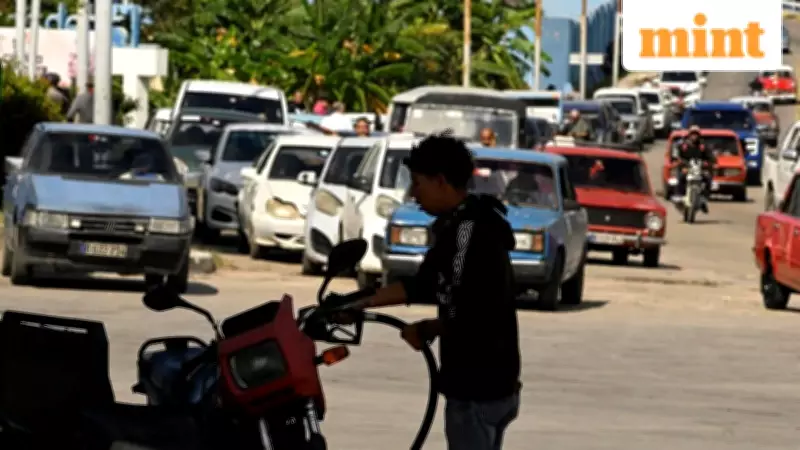
Children are being sent home from school early, basic food items like milk and chicken have become barely affordable for most citizens, and long lines have become a permanent fixture at gas stations across Havana and throughout the country.

Tourism Industry Paralyzed
Cuba's crucial tourism industry has been paralyzed by the ongoing crisis. Several popular hotels, crippled by persistent blackouts, have begun shutting down operations entirely, ferrying their remaining guests to alternative lodging facilities according to reports from Russia's tour-operator agency.
With more than 4,000 Russian tourists currently in Cuba, Moscow-backed state airline Aeroflot announced it was restricting service and would fly an empty plane specifically to pick up stranded tourists. Air Canada, which reported having approximately 3,000 customers in Cuba, suspended all service to the country due to the critical fuel shortage. Other international airlines have indicated they will refuel in neighboring islands to maintain limited service for now.
Swift Deterioration Following US Actions
The swiftly deteriorating conditions in Cuba follow the Trump administration's effective establishment of an oil blockade last month. The last oil delivery to Cuba was a January 9 shipment from Mexico, which has since halted all supplies under intense U.S. pressure.
Cuba has also lost crucial crude deliveries from Venezuela since the U.S. raid on January 3 that captured authoritarian leader Nicolás Maduro, ending all support for Cuba from its most significant international backer.
President Trump's executive order on January 29 designated Cuba as "an unusual and extraordinary threat" and warned of imposing new tariffs on any country that supplies oil to the island nation. These new measures build upon a comprehensive set of U.S. sanctions on Cuba that began in the early 1960s when the Fidel Castro-led government nationalized U.S. property.
International Condemnation and Humanitarian Concerns
The speed with which conditions on the island have deteriorated has surprised analysts and even some U.S. officials. Cuba's government has accused the Trump administration of engaging in "blackmail and coercion" through its policies.
The blocking of oil imports has drawn condemnation from the United Kingdom and Democratic lawmakers in Washington, while the United Nations has issued warnings about an impending humanitarian crisis.
"It is very unjust," stated Mexican President Claudia Sheinbaum, who has faced domestic pressure to assist Cuba. "You cannot strangle a people like this. They don't have fuel for hospitals, for schools."
Human Impact and Economic Breakdown
For ordinary Cubans, the economic breakdown has been punishing. Most citizens are living with increasingly severe and prolonged blackouts. On a recent Saturday morning, one of the main arteries in one of Havana's busiest neighborhoods stood empty save for a single vehicle.
Lizzel Jimenez, a 64-year-old Cuban citizen, can no longer travel to her primary workplace. Even if transportation were available, her job at the Department of Agriculture—which pays 4,000 pesos monthly, equivalent to less than $10—has been frozen until further notice. She expressed gratitude for having secured a second job sterilizing medical equipment at a nearby clinic for 3,000 pesos monthly, which will now serve as her only lifeline.

"Everything is paralyzed," Jimenez stated. "Almost all the jobs are paralyzed." She and other furloughed Cubans will receive their full salary for one additional month, followed by two months at only 60% of their regular pay.
"It's a pittance," said Jimenez, who is raising her four-year-old granddaughter. She noted that a liter of milk costs 1,600 pesos, while a small package of chicken drumsticks costs 2,000 pesos. With just these two essential items, her new monthly budget becomes completely overextended.
Expert Predictions and Political Stances
Jorge Piñón, an expert on Cuban energy at the University of Texas who tracks oil shipments to the island, believes a complete collapse is imminent, predicting that oil will completely run out by April at the latest.
"In Cuba, the biggest blackout you have ever seen will happen sooner than you all think," he warned. "And now what? That's the question that I have."
President Trump has stated that the U.S. is "talking to Cuba" and argued that the island's suffering is avoidable. "It doesn't have to be a humanitarian crisis," he commented last week. "I think they probably would come to us and want to make a deal."
In recent weeks, the Trump administration has reportedly been searching for Cuban government insiders who could help negotiate a deal to push out the current government by year's end, according to reports from The Wall Street Journal.
Florida Republicans and other hard-liners have cheered the Trump administration's crackdown. "Our Cuban-American community is eternally grateful for your decisive action against the regime," posted Representative Carlos Gimenez (R-Fla.) on social media platform X. "The end is near!"
Cuban Government Response and UN Concerns
Cuba's President Miguel Díaz-Canel stated that his government is willing to engage with the Trump administration as long as any dialogue comes without prior conditions and respects Cuba's sovereignty.
"To surrender isn't an option for Cuba," he declared last week. "Tough times are coming. We will overcome this together with creative resistance."
Stephane Dujarric, a spokesman for United Nations Secretary-General António Guterres, said the international body is "extremely concerned about the humanitarian situation in Cuba," warning that shortages could push essential services to complete breakdown if the country's oil needs remain unmet.
Critics in Congress have accused the Trump administration of engaging in "economic warfare" against Cuba. "The most vulnerable will suffer the most. This policy is unconscionable," stated Representative Nydia Velázquez (D-N.Y.).
The State Department recently announced that the U.S. would send $6 million in humanitarian aid to Cuba, including canned tuna, rice, beans, pasta, and solar lamps to allow recipients to charge their phones. However, Trump administration officials have denied that U.S. pressure to curb fuel shipments is responsible for the crisis.
"This idea that a short-term change in some amount of oil shipments is what's responsible for the humanitarian situation in Cuba is simply not true," stated Jeremy Lewin, a State Department official for foreign assistance and humanitarian affairs, during a briefing with reporters last week.
As conditions continue to deteriorate, there are growing concerns that without a clear plan for stabilization, the crisis could drag on for years, exacting a heavy toll on ordinary Cuban citizens who find themselves caught in the middle of geopolitical tensions.





