

Cuba Proposes Unconditional Talks with U.S. as Economic Crisis Deepens
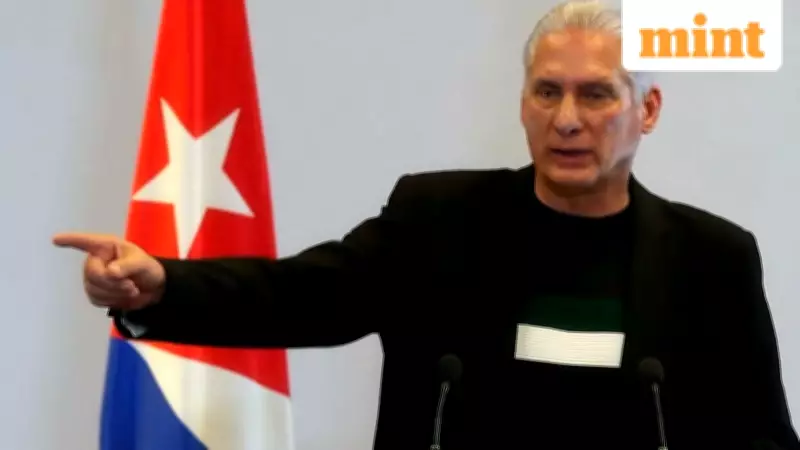
Cuban President Miguel Díaz-Canel has declared his government's readiness to engage in dialogue with the Trump administration, emphasizing that any discussions must occur "as equals" and without prior conditions. This announcement comes as the Communist island braces for severe fuel shortages, exacerbated by recent U.S. threats to impose trade sanctions on countries shipping oil to Cuba.
Escalating Tensions and a Call for Sovereignty
During a rare, two-hour press conference on Thursday, Díaz-Canel framed the situation against an image of the late revolutionary leader Fidel Castro, stating firmly, "To surrender isn't an option for Cuba." He asserted that Cuba poses no danger to the United States, which he labeled the biggest threat to global security. While noting, "We aren't in a state of war," he added that Cuba is preparing for that possibility if necessary.
The U.S. recently identified Cuba as an "unusual and extraordinary threat" due to its alliances with Russia, China, and Iran. Following last month's raid in Venezuela to capture strongman Nicolás Maduro, the Trump administration has moved to choke off Cuba's fuel lifeline, intensifying pressure on the regime.

Fuel Shortages and Economic Implosion
Cuba is experiencing its worst crisis since the Soviet Union's collapse, driven by:
- Decades of economic mismanagement
- The Covid-19 pandemic devastating tourism
- U.S. sanctions taking a significant toll
The Caribbean island has long depended on Venezuelan oil supplies, which ceased after Maduro's capture. With fuel reserves dwindling under sustained U.S. pressure, Cubans face:
- Increasingly severe blackouts
- Scarcity of basic goods, food, and medicines
- Mosquito-borne diseases overwhelming medical facilities due to unaffordable insecticides
Oil experts warn that Cuba could run out of oil in weeks, potentially halting the economy from public transport to hospitals, schools, and factories.
U.S. Strategy and Political Maneuvers
In recent weeks, the Trump administration has reportedly been searching for Cuban government insiders to help cut a deal to push out the Communist regime by year's end. President Trump has stated, "It doesn't have to be a humanitarian crisis. I think they probably would come to us and want to make a deal." However, U.S. officials have not disclosed specific details.
In Washington, lawmakers and Trump allies are seizing the opportunity to increase pressure. Representative Carlos Gimenez (R., Fla.) sent letters to major U.S. airline executives, urging them to end all commercial flights to Cuba, arguing that such flights provide the regime with hard currency against U.S. national security interests.
Cuba's Response and Future Outlook
Cuba's government has accused the Trump administration of "blackmail and coercion." Díaz-Canel announced efforts to increase oil output and fuel storage capacity, though the island currently produces only 40,000 barrels per day of low-quality crude, often used in obsolete electricity plants prone to failure.
Despite the grim outlook, Díaz-Canel struck a defiant tone, stating, "Tough times are coming. We will overcome this together with creative resistance." As the crisis deepens, the world watches to see if dialogue can bridge the gap between these long-standing adversaries.






