

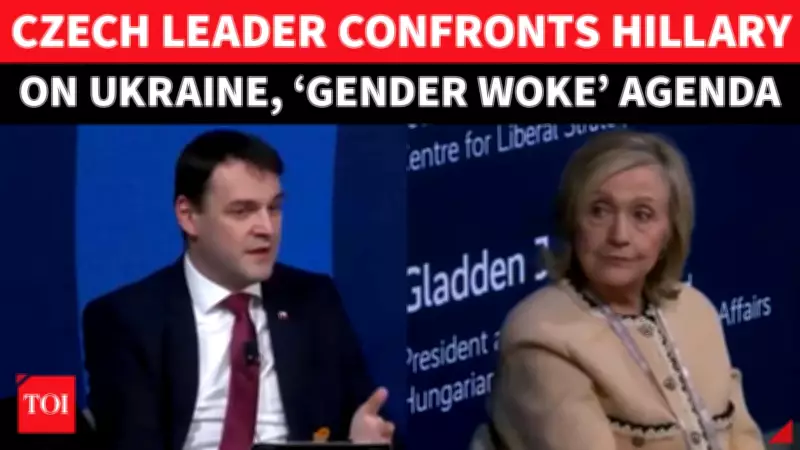
Czech Deputy PM Petr Macinka Confronts Hillary Clinton Over Ukraine Narrative at Munich Security Conference
A fiery diplomatic confrontation erupted at the prestigious Munich Security Conference, drawing global attention as Czech Deputy Prime Minister and Foreign Minister Petr Macinka directly challenged former U.S. Secretary of State Hillary Clinton on her characterization of the Ukraine conflict. The exchange, marked by sharp disagreements over geopolitical strategy and rhetoric, highlighted deepening fissures within Western alliances regarding the ongoing war in Eastern Europe.
Macinka Rejects Clinton's "Ukraine Fighting for Us" Assertion
During a panel discussion, Hillary Clinton remarked that Ukraine is essentially "fighting for us," implying that Kyiv's struggle against Russian aggression serves broader Western interests. Petr Macinka swiftly countered this narrative with a firm rebuttal. He emphasized that Ukraine is primarily fighting for its own future, freedom, sovereignty, and independence, not as a proxy for other nations. Macinka argued that framing the conflict in such terms risks undermining Ukraine's agency and the authenticity of its national struggle.
This stance reflects a growing sentiment among some European leaders who advocate for recognizing Ukraine's autonomous motives in the war, rather than subsuming them under a collective Western agenda. The Czech official's comments underscore a nuanced perspective that prioritizes Ukrainian self-determination while still supporting its defense efforts.

Controversial Claim: Only Trump Administration Can Halt Russian Destruction
In a more provocative segment of the debate, Petr Macinka made a bold assertion that has sparked considerable controversy. He contended that only the administration of former U.S. President Donald Trump possesses the capability and political will to compel Russia to cease its destructive campaign in Ukraine. This viewpoint suggests a critical assessment of current U.S. leadership under President Joe Biden, implying limitations in diplomatic or strategic leverage over Moscow.
Macinka's statement taps into ongoing discussions about the effectiveness of international pressure on Russia and the potential shifts in U.S. foreign policy depending on electoral outcomes. It also highlights the Czech Republic's pragmatic, albeit contentious, approach to geopolitical realignments and power dynamics.
Broader Implications for Western Unity and Gender Agenda
The clash extended beyond Ukraine, touching on underlying tensions about gender and political discourse. Reports indicate that Macinka, in a moment of frustration, told Clinton, "Don't be nervous and hear me out," which some observers interpreted as a dismissal of her arguments, potentially tinged with gender undertones. This aspect of the exchange raises questions about the interplay of diplomacy, gender politics, and assertive communication in high-stakes international forums.
The incident at the Munich Security Conference, a key gathering for global security dialogue, signals potential rifts in Western cohesion. As nations grapple with divergent strategies on Ukraine, such public disagreements could influence future policy coordination and alliance stability. The debate also reflects broader trends where European voices are increasingly vocal in challenging American perspectives, advocating for more localized or independent approaches to crises.
In summary, the confrontation between Czech Deputy PM Petr Macinka and Hillary Clinton underscores significant debates over narrative framing, strategic solutions for Ukraine, and the dynamics of Western alliances. As the war persists, such exchanges may shape diplomatic efforts and public perceptions, highlighting the complex interplay of sovereignty, power, and rhetoric in contemporary geopolitics.






