

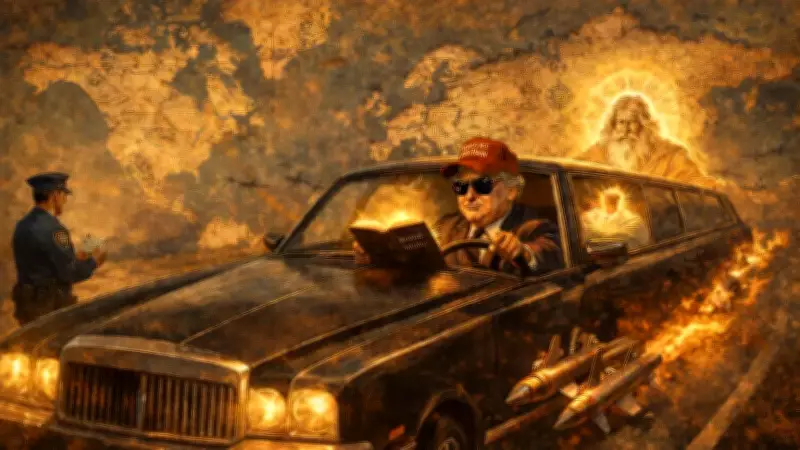
The Pope's Limousine and the Eternal Problem of Divine Drivers
There exists a classic joke about the Pope. During a visit to New York, thoroughly bored with being chauffeured everywhere, the Pontiff convinced his driver to let him take the wheel of the limousine. Unfortunately, his expertise lying more in theology than transportation, he was promptly pulled over for speeding. The police officer found himself in a dilemma and called his chief.
The conversation unfolded as follows:
Officer: "Chief, I just stopped a limo for speeding."

Chief: "So issue a ticket."
Officer: "I can't. He's extremely important."
Chief: "Even more reason to do so."
Officer: "No, chief, I mean really important."
Chief: "Is he the mayor?"
Officer: "Bigger."
Chief: "A senator?"
Officer: "Bigger."
Chief: "The President?"
Officer: "Who could possibly be bigger than the President?"
Officer: "I believe it's God."
Chief: "What makes you think that?"
Officer: "Well... his chauffeur is the Pope."
When Rulers Claim Divine Mandates
This humorous anecdote feels uncomfortably relevant because history is filled with individuals—rulers, pastors, and con artists—who have claimed to be acting on God's behalf. In some traditions, God is depicted as the charioteer himself. The fictional Dr. Gregory House once quipped, "If you talk to God, you are religious. If God talks back, you are psychotic."
Unfortunately, since ancient times, before leaders needed to campaign for votes, many asserted that God spoke directly to them. With armies at their disposal, no one dared label them insane.
- In ancient Egypt, pharaohs declared themselves living deities.
- Chinese emperors governed under the Mandate of Heaven.
- European monarchs invoked the divine right of kings.
It is hardly surprising, then, that such notions of divine intervention have permeated modern democratic systems as well.
God's Chosen Warrior in Contemporary Politics
The saying that the Lord works in mysterious ways might explain why some believe God selected a former reality television star, known for rambling speeches, to execute divine plans. Over the past decade, certain American evangelicals have proclaimed Donald Trump as God's "chosen warrior," despite his inability to quote Bible verses during the 2016 Republican primary debates. This did not prevent him from marketing Trump-themed Bibles.
The fervor intensified when Trump survived an assassination attempt. MAGA conspiracy theorist Jack Posobiec noted the shots were fired at 6:11 PM, linking it to Ephesians 6:11: "Put on the armour of God, so that you can take your stand against the devil’s schemes." Matthew D Taylor, a scholar of Christian nationalism, explained to Politico that this reaction reflects a hardline evangelical belief in the fulfillment of modern prophecy.
Consequently, it was only a matter of time before divine rhetoric entered the US-Israel confrontation with Iran.
Theology Enters the Iran Conflict
The American establishment has offered various justifications for strikes against Iran: regime change, preemptive action by Israel, feminist causes, and nuclear disarmament. Theology has now joined this list.
According to an Asia Times report, a combat-unit commander allegedly told non-commissioned officers that the Iran war was "part of God’s plans" and that Trump had been "anointed by Jesus to light the signal fire in Iran to cause Armageddon and mark his return to earth." Service members complained to the Military Religious Freedom Foundation about commanders describing the conflict as "all part of God’s divine plan," referencing the Book of Revelation's passages on Armageddon.
This rhetoric aligns with interpretations in evangelical media, prophecy forums, and street preaching in Jerusalem. The Israel-Iran war is increasingly framed through biblical eschatology.

- Commentators cite Revelation's description of Armageddon—the gathering of armies before final judgment.
- They reference the prophecy of Gog and Magog from Ezekiel, depicting hostile nations rising against Israel in the end times.
- Modern Iran is seen as ancient Persia reborn, with Israel as the stage for history's final act.
Pete Hegseth, Trump's defense secretary and former Fox News host, often discusses conflict in theological terms. In his 2020 book American Crusade, he portrays geopolitics as a civilizational struggle between Christianity and its adversaries, suggesting that those enjoying Western freedoms should "thank a crusader." Hegseth's body bears crusader imagery, including the Jerusalem Cross and the Latin phrase Deus Vult ("God wills it"), a medieval battle cry.
A Historical Pattern of Divine Warfare
It would be naive to assume America's "divine wars" began with recent figures. During the War on Terror, George W. Bush called the campaign a "crusade," a remark that echoed across the Muslim world. Although the White House later clarified, the slip revealed how holy war language can infiltrate modern geopolitics. Bush frequently framed terrorism as a battle between good and evil, echoing providential themes.
Ronald Reagan labeled the Soviet Union a "godless evil empire," transforming the Cold War into a moral contest. Earlier, the nineteenth-century doctrine of Manifest Destiny asserted that Providence chose the United States to expand across North America.
In the American psyche, the nation often views itself as inheriting both Roman power and European intellectual heritage. Within this narrative, crusades, prophecies, and apocalyptic language represent a deep-seated tradition—turning wars into moral missions and geopolitical struggles into stories of destiny. Enemies and scriptures may change, but the core message remains: God is invariably on America's side.
The Christian Zionist Perspective
Much like the Indian subcontinent, which spawned Hinduism, Buddhism, and Jainism, the Middle East is the cradle of Judaism, Christianity, and Islam. This region has long been envisioned as the Promised Land or sacred terrain.
In Christian Zionist thought, Israel is not just a country but sacred geography, rooted in Genesis where God promises Abraham that his descendants will inherit the land. Isaiah 51:3 describes Zion's restoration in Edenic terms: "The Lord will surely comfort Zion and will look with compassion on all her ruins; he will make her deserts like Eden, her wastelands like the garden of the Lord."
For those interpreting scripture alongside current events, this suggests Israel's fate transcends politics, belonging to an ancient narrative. This belief occasionally surfaces in political discourse. Former US ambassador to Israel Mike Huckabee once argued it would be "fine if they took it all," referring to the biblical land from the Nile to the Euphrates, drawing sharp reactions from Trump's Arab allies.
Huckabee's remarks stem from dispensationalism, a nineteenth-century evangelical theology dividing history into divine eras culminating in Christ's return. Here, Israel's restoration is central, making support for Israel a theological imperative rather than mere diplomacy.
The Troubling Punchline
Returning to the Pope joke, much of the world now resembles the police officer who has stopped a speeding limousine. The rules dictate issuing a ticket, but the limousine metaphorically represents the American military-industrial complex—the most formidable war machine ever assembled.
This raises a disturbing question: How does one persuade someone who believes they are executing God's will to slow down?
About the Author: Nirmalya Dutta is an editorial consultant with The Times of India, covering world news, pop culture, and philosophical memes. He writes columns and newsletters blending news, culture, and humor, and co-creates satirical cartoons on corporate absurdities.





