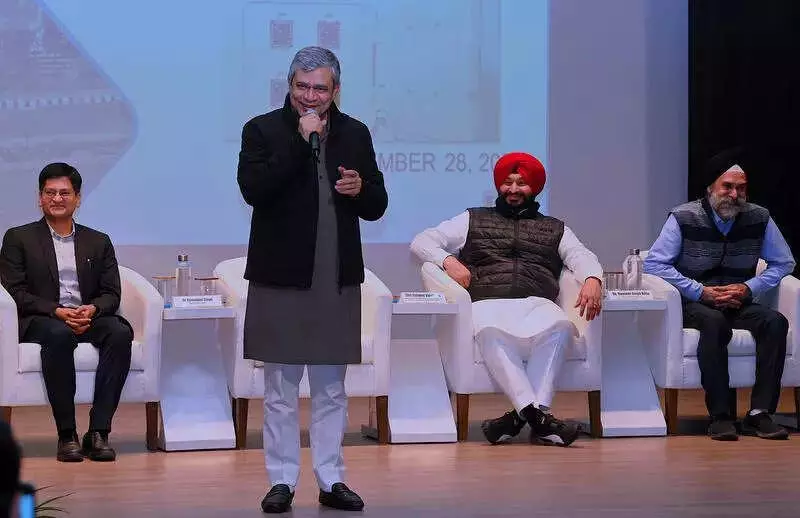
In a significant update for railway infrastructure in North India, Union Minister for Railways Ashwini Vaishnaw informed the Lok Sabha on Wednesday about the progress on two crucial projects in Himachal Pradesh and Ladakh. The minister provided detailed responses regarding the gauge conversion of a historic narrow-gauge line and the status of a monumental strategic railway line aimed at connecting Leh.
Pathankot-Jogindernagar Narrow Gauge Line to Get Broad Gauge Makeover
Responding to a question raised by Kangra Lok Sabha MP Rajeev Bhardwaj, Minister Vaishnaw disclosed that the crucial survey work for converting the iconic 200-kilometre-long Pathankot–Jogindernagar narrow-gauge railway line into a broad-gauge line has been completed. This scenic route, a heritage in itself, is now set for a major modernization push.
The minister confirmed that based on the completed survey, authorities are now actively preparing a Detailed Project Report (DPR). This DPR will outline the technical specifications, estimated costs, and the timeline for executing this transformative project, which promises to boost connectivity and tourism in the region.

However, in the same reply, the minister noted a separate assessment for an extension. A survey was also conducted for the 57-kilometre-long Jogindernagar railway line. The findings indicated that the traffic potential on this specific stretch was assessed as low, which may influence future investment decisions for this segment.
Massive Strategic Bilaspur-Manali-Leh Railway Line Detailed
In a revelation that underscores the project's national importance, Ashwini Vaishnaw highlighted the Bilaspur–Manali–Leh railway line as a project of strategic importance identified by the Ministry of Defence. This ambitious project is designed to enhance connectivity to the sensitive Ladakh region.
The minister informed the house that the survey for this colossal rail line has been completed and the Detailed Project Report (DPR) is also ready. The scale of the project is staggering. It involves the construction of a 489-kilometre-long railway line through challenging Himalayan terrain.
An extraordinary feature of this project is that 270 kilometres of the total line will pass through tunnels, making it one of the most complex railway engineering feats in the country. The minister revealed the project's monumental estimated cost at Rs 1,31,000 crore, reflecting its strategic priority and engineering magnitude.
Implications and Future Connectivity
The progress on these two projects signals a focused push by Indian Railways to enhance connectivity in the northern frontiers. The Pathankot-Jogindernagar conversion will revitalize a historic route, potentially increasing passenger comfort, freight capacity, and tourism inflow to Himachal Pradesh.
The Bilaspur-Manali-Leh line, on the other hand, represents a long-term strategic asset. Once completed, it will provide all-weather connectivity to Ladakh, reducing dependency on road transport which is often disrupted during harsh winter months. This will have significant implications for defence logistics, local economy, and tourism in the Union Territory.
The completion of surveys and DPRs is the first critical step in the long process of railway construction. Stakeholders and residents in Himachal Pradesh and Ladakh will now await further announcements regarding funding approval and the commencement of construction for these transformative infrastructure projects.