

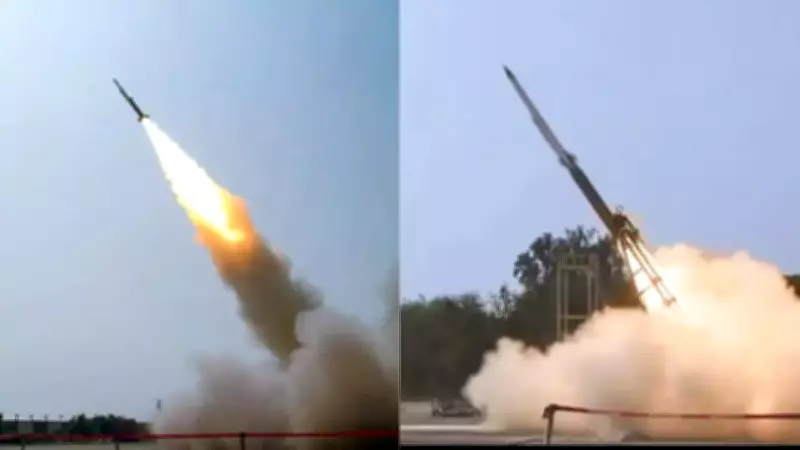
In a significant advancement for India's indigenous defence capabilities, the Defence Research and Development Organisation (DRDO) successfully conducted a crucial demonstration of Solid Fuel Ducted Ramjet (SFDR) technology on Tuesday. This sophisticated propulsion system, essential for developing long-range missiles, now places India among a select few nations possessing this cutting-edge technological capability.
Successful Test Conducted at Chandipur Test Range
The demonstration test occurred at approximately 10:45 AM from the Integrated Test Range located at Chandipur, off the coast of Odisha. According to an official defence statement released following the event, this successful test marks a pivotal moment for India's strategic defence infrastructure.
The statement emphasized, "The successful demonstration places India into an elite league of nations possessing this technology that enables developing long-range air-to-air missiles to give a tactical edge over the adversaries."

Understanding SFDR Technology
The SFDR system represents a revolutionary missile propulsion technology specifically designed for the development of extended-range air-to-air missiles currently under development by DRDO. Defence experts have noted that this versatile technology can potentially be adapted for surface-to-air missile systems as well, expanding its strategic applications.
During the comprehensive test, all major subsystems performed exceptionally according to expectations. These critical components included the innovative nozzle-less booster, the solid fuel ducted ramjet motor, and the sophisticated fuel flow controller. The system functioned precisely after the missile received initial propulsion from a ground booster motor, achieving the desired Mach number for optimal performance.
Comprehensive Monitoring and Data Collection
The performance parameters of the SFDR system were meticulously confirmed through flight data captured by numerous advanced tracking instruments strategically deployed by the Integrated Test Range at Chandipur along the Bay of Bengal coastline. Senior scientists from multiple DRDO laboratories closely monitored the entire launch sequence, including representatives from the Defence Research and Development Laboratory, High Energy Materials Research Laboratory, Research Centre Imarat, and the Integrated Test Range itself.
Leadership Recognition and Congratulations
Defence Minister Rajnath Singh extended his compliments to DRDO and the broader defence industry for achieving this successful demonstration of SFDR technology. Additionally, Secretary of the Department of Defence R&D and DRDO Chairman Samir V. Kamat personally congratulated all teams involved in the successful flight test, acknowledging their technical expertise and dedication.
Strategic Implications for India's Defence Program
This successful demonstration represents a major milestone in strengthening India's indigenous missile development programme. The advancement significantly enhances the operational reach and combat effectiveness of future air-to-air and air defence weapon systems being developed by the Defence Research and Development Organisation. This technological breakthrough provides India with greater strategic autonomy in defence manufacturing and positions the country as a significant player in advanced missile technology development.
Technical Superiority of SFDR Technology
Unlike conventional solid rocket motors that exhaust their fuel quickly after launch, SFDR-powered missiles utilize atmospheric oxygen to sustain combustion throughout their flight duration. This innovative approach allows missiles to maintain supersonic speeds for extended periods and engage targets at significantly greater ranges. The technology enables missiles to achieve sustained speeds between Mach 2 and Mach 3.8, with operational ranges extending from 50 kilometers to an impressive 340 kilometers.

The system's operational versatility includes altitude capabilities ranging from sea level up to 20 kilometers, with vertical snap-up or snap-down capability of 10 kilometers, providing pilots with enhanced tactical flexibility during aerial engagements. Furthermore, SFDR technology creates a wider no-escape zone, strengthens tail-chase capability, and enables high 'g' manoeuvring, making it considerably more challenging for adversary aircraft to evade incoming missiles.
Indigenous Subsystem Integration
The SFDR system incorporates several critical indigenously developed subsystems that work in seamless coordination. The nozzle-less booster accelerates the missile from aircraft release speed to supersonic velocities within just three seconds, utilizing specially designed propellant grains developed by DRDO's High Energy Materials Research Laboratory in Pune. Following initial acceleration, a boron-based high-energy solid fuel sustainer takes over propulsion duties.
A sophisticated hot gas valve, constructed from advanced materials including carbon-carbon composites, tungsten-copper alloys, and maraging steel, regulates combustion gas flow based on altitude and speed parameters. During flight, cheek-mounted titanium-alloy air intakes open using a pyrotechnic mechanism, compressing incoming air through a three-ramp design to ensure efficient oxygen supply for combustion within the ramjet chamber.
The missile integrates modern guidance and control systems featuring an onboard computer, inertial navigation system, radio-frequency seeker, jam-resistant data link, high-torque electro-mechanical actuators, and compact lithium thermal batteries. For maximum combat effectiveness, the missile carries a proximity fuse and a fragmentation warhead specifically engineered to optimize target destruction capabilities.





