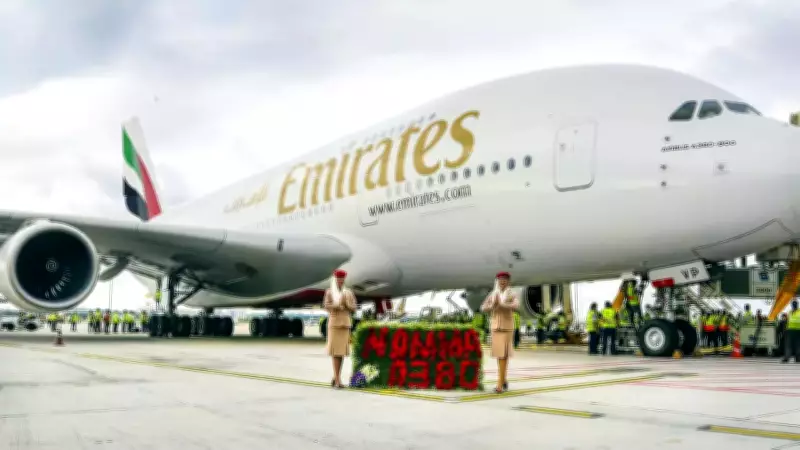
Emirates Flight Temporarily Blocked from Indian Airspace Due to Flight Plan Error
An Emirates flight en route from the United Arab Emirates to Singapore on Sunday, April 5, faced a brief but significant disruption when it was not allowed to enter Indian airspace. The issue arose because the Boeing 777's flight plan was incorrectly filed as a non-scheduled flight, for which there was no prior approval from Indian authorities.
ATC Vigilance Prevents Unauthorized Entry
According to sources, the confusion began when flight EK 9314 departed from Ras Al Khaymah. As it approached the Indian airspace over the Arabian Sea at approximately 6:25 am IST, alert air traffic controllers in Mumbai noticed that the incoming flight lacked the necessary permission. In India, the Directorate General of Civil Aviation (DGCA) issues a YA number for each approved non-scheduled flight that operates to, from, or overflies the country. The ATC staff immediately contacted the DGCA, the airline, and the pilots, but no such approval could be found.
As a result, the aircraft was forced to turn in the opposite direction and hover in the area for a period. It was only after further verification that Emirates clarified the flight was actually a scheduled service, not a non-scheduled one. The pilots confirmed this detail, leading to renewed coordination. Once the required clearance was issued, the flight was permitted to continue its journey to Singapore.

Similar Incident with IndiGo Highlights Broader Issues
This incident echoes a recent event involving an IndiGo flight from Delhi to Manchester, which was sent back to its origin over Africa due to a call sign confusion about a month earlier. The aircraft, a wet-leased Boeing 787 from Norse Atlantic, had obtained clearance but faced issues when operated under IndiGo's code "iFly" while seeking entry into Eritrea airspace. This led to confusion with local air traffic control, prompting the plane to make a U-turn and return to Delhi after a 13-hour flight.
IndiGo had all necessary enroute clearances, but the mix-up proved costly. Norse Atlantic, an EU carrier, follows European Union Aviation Safety Agency (EASA) guidelines to avoid West Asia entirely, unlike other airlines such as Air India that overfly Saudi Arabia. Consequently, Norse Atlantic resumed its Europe flights for IndiGo only after February 28, opting for routes through Africa and Eritrea to bypass no-fly zones.
These incidents underscore the critical importance of accurate flight planning and clear communication in aviation, as even minor errors can lead to significant operational disruptions and financial losses.