

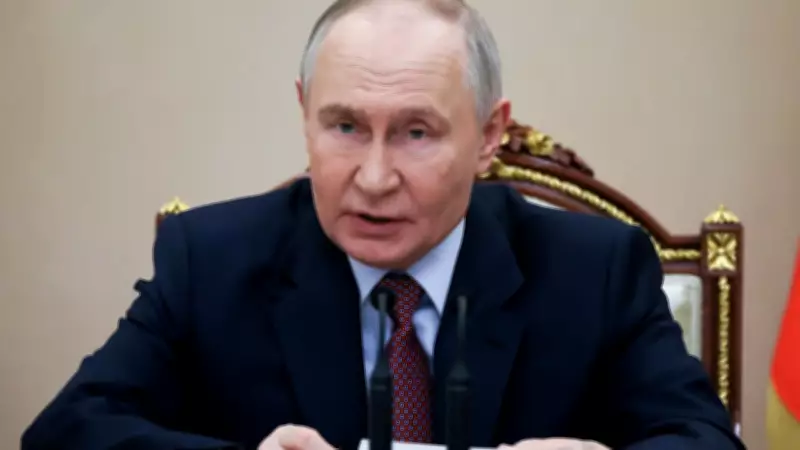
Epstein Documents Contain Over 1,000 References to Vladimir Putin
The latest release of Jeffrey Epstein files by the US Department of Justice has revealed that Russian President Vladimir Putin's name appears more than 1,000 times within the extensive documentation. This massive tranche, comprising over three million pages of documents, emails, and images, has ignited fresh scrutiny into Epstein's international network and his persistent attempts to engage with high-level Russian figures.
Years-Long Pursuit of Kremlin Access
Reports detailed in the files show that Epstein spent years actively seeking a meeting with Vladimir Putin. His correspondence indicates discussions centered around investment opportunities, digital currencies, and broader geopolitical matters with a circle of senior Russian and European contacts. It is crucial to note that there is no evidence within the documents that Epstein and Putin ever actually met. The inclusion of names in these files does not imply any wrongdoing by those mentioned.
Epstein, who was convicted in 2008 for soliciting a minor and died in a New York jail in 2019 while awaiting trial on sex trafficking charges, is portrayed in the emails as relentlessly angling for access to the Kremlin's highest levels.

Visa Requests and Repeated Overtures
According to analysis by The Independent, Epstein began exploring the possibility of obtaining a Russian visa as early as 2010. In one written query, he asked, "do i need to get visa, ? I have a friend of putin,s [sic], should i ask him?" By August 2011, he informed Emirati businessman Ahmed bin Sulayem that "putin might come to the states", expressing a preference to meet him there.
Email records show Epstein repeatedly pressing Thorbjørn Jagland, the former Norwegian prime minister and then secretary general of the Council of Europe, to assist in securing a meeting with the Russian leader. In May 2013, Jagland responded, "You have to do it. My job is to get a meeting with him."
That same year, Epstein told former Israeli prime minister Ehud Barak he hoped to meet Putin to discuss encouraging Western investment in Russia. At one point, he claimed to have cancelled a potential meeting in St. Petersburg, insisting that Putin "set aside real time and privacy."
The Washington Post reports a 2013 message from Epstein stating, "He is desperate to engage western investment in his country … I have his solution." Subsequent follow-up emails suggest that no such meeting ever materialized.
In 2014, during discussions about a possible encounter, Epstein replied to a contact, "Bad idea now after plane crash" — an apparent reference to the downing of Malaysia Airlines Flight MH17.
Kremlin-Linked Contacts and Intelligence Questions
Beyond Putin himself, the files meticulously detail Epstein's contacts with senior Russian officials and influential business figures. The Washington Post highlights correspondence with Sergey Belyakov, a graduate of Russia’s Federal Security Services (FSB) academy who was then serving as deputy economic development minister. Belyakov invited Epstein to the St. Petersburg International Economic Forum and later sought a multi-entry visa for him.
The Times reports that Epstein described Belyakov as a "very good friend" and at one juncture sought his assistance regarding a "Russian girl from Moscow" who was allegedly attempting to blackmail businessmen in New York. In a draft email, Epstein claimed he had contacted "friends in the FSB" who would deal with such threats "extremely harshly."
Epstein also maintained contact with Vitaly Churkin, Russia’s ambassador to the United Nations until his death in 2017, and suggested that Foreign Minister Sergey Lavrov could "get insight on talking to me." In a 2018 email cited by The Independent, Epstein wrote, "churkin was great . he understood trump after our conversations."

The Kyiv Post reports that an FBI memorandum cited a confidential source claiming Epstein "was President Vladimir Putin’s wealth manager", though the documents provide no supporting evidence for this assertion. Russian investigative outlet Agentstvo found that while Putin's name appears over 1,000 times, the term "Russia" is mentioned nearly 5,900 times, much of this within appended news clippings and contextual references.





