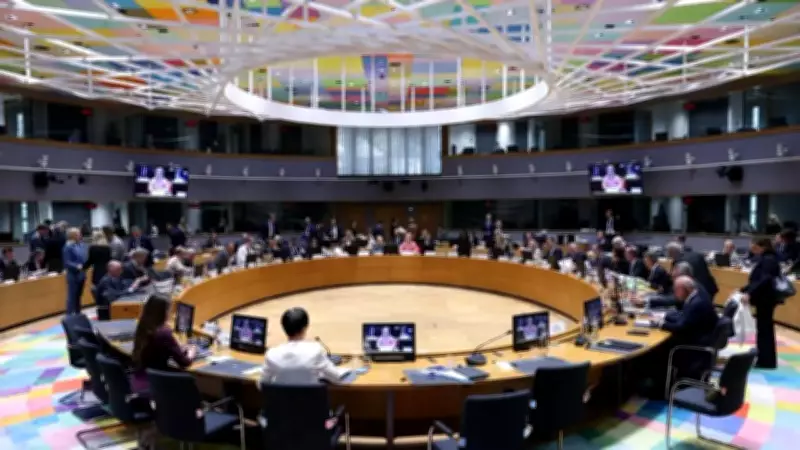
European Union foreign ministers on Monday agreed to impose new sanctions on Israeli settlers involved in violence against Palestinians, following a change of government in Hungary that ended months of blockage.
EU Top Diplomat Welcomes Decision
"It was high time we move from deadlock to delivery," EU top diplomat Kaja Kallas said in announcing the green light. "Extremisms and violence carry consequences."
French Foreign Minister Jean-Noel Barrot stated that the EU was "sanctioning the main Israeli organisations guilty of supporting the extremist and violent colonisation of the West Bank, as well as their leaders." He added on social media, "These most serious and intolerable acts must cease without delay."

End of Hungary's Veto
The move, aimed at addressing rising violence and settlement expansion in the Israeli-occupied West Bank, had been stalled by Hungary's former Prime Minister Viktor Orban. However, the ouster of the nationalist leader and Israel ally by Peter Magyar has now paved the way for the veto to be lifted.
EU officials said that seven settlers or settler organisations would be blacklisted. The bloc also agreed to sanction representatives from the Palestinian militant group Hamas.
Israel Condemns Sanctions
Israel condemned the new sanctions. Prime Minister Benjamin Netanyahu's office posted on its official X account: "As Israel and the US are 'doing Europe's dirty work' by fighting for civilisation against jihadist lunatics in Iran and elsewhere, the European Union exposed its moral bankruptcy by drawing a false symmetry between Israeli citizens and Hamas terrorists."
Israel's far-right National Security Minister Itamar Ben Gvir denounced the European Union as "antisemitic," claiming the EU was "trying to tie the hands of those who defend themselves." Foreign Minister Gideon Saar posted on X: "The European Union has chosen, in an arbitrary and political manner, to impose sanctions on Israeli citizens and entities because of their political views and without any basis."
Context of Violence
The occupied West Bank has been gripped by almost daily violence involving Israeli troops and settlers since the start of the Gaza war in October 2023. There has been a surge in deadly West Bank attacks by Israeli settlers since the start of the Iran war on February 28, according to Palestinian officials and the United Nations.
EU Divided on Further Steps
While the EU is moving ahead with sanctions on Israeli settlers, there remains no consensus among member states to take further steps against Israel, such as curbing trade ties. Foreign ministers meeting in Brussels discussed calls to ban products from Israeli settlements in the West Bank.
Italy's Antonio Tajani said that the EU's executive would now make a proposal on the move, and then the bloc would assess whether it had enough backing from member states. "This is an issue that has been discussed, but no decision has been taken, pending the proposals that will come," he said.
Settlement Expansion
Excluding east Jerusalem, more than 500,000 Israelis live in the occupied West Bank in settlements that are illegal under international law, among some three million Palestinians. In 2025, the expansion of Israeli settlements reached its highest level since at least 2017, when the United Nations began tracking data, according to a UN report.