

Trump's Unpredictability Drives Europe's Strategic Pivot to Eastern Giants
In a world increasingly defined by geopolitical volatility, the recent actions of US President Donald Trump have catalyzed a significant realignment of global partnerships. As Washington adopts a more unpredictable and tariff-heavy approach, European nations are actively seeking stability and economic opportunity by strengthening ties with major Eastern powers, particularly India and China.
The Landmark India-EU Agreement: A Tale of Two Giants
After nearly two decades of negotiations, India and the European Union have finally concluded what many are calling "the mother of all deals." This monumental free trade agreement, revived in earnest after Trump's return to the White House in January 2025, represents a strategic partnership between the world's second- and fourth-largest economies.
European Commission President Ursula von der Leyen aptly described the significance of this pact: "We are creating a market of 2 billion people. This is a tale of two giants who choose partnership in a true win-win fashion. A strong message that cooperation is the best answer to global challenges."

The negotiations had previously stalled multiple times—first in 2013 and again in 2015 following disputes over the trial of Italian marines. However, the COVID-19 pandemic exposed vulnerabilities in global supply chains, creating renewed urgency for diversified economic partnerships. The acceleration of talks in 2022 gained further momentum as Trump began implementing broad tariffs affecting both allies and adversaries alike.
Strategic Calculations Behind the Partnership
Together, India and the EU represent a combined market worth nearly $27 trillion and approximately 25% of global GDP. While neither party openly acknowledges it, Trump's policies have undoubtedly served as a catalyst for this strengthened alliance. The timing of the agreement's announcement—coming just days after Trump's public criticism of Europe at Davos and his characterization of India as a "dead economy" in August 2025—speaks volumes about the underlying geopolitical dynamics.
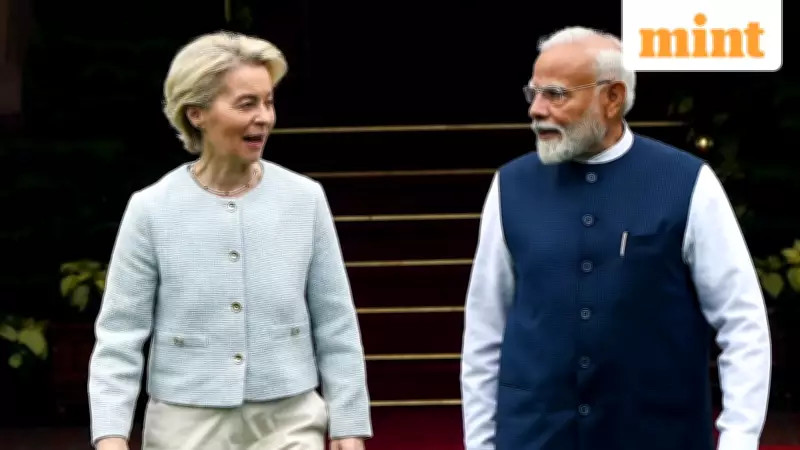
Both India and the EU are exercising diplomatic caution in their public statements, careful not to provoke Washington unnecessarily. The United States remains one of India's top five trade partners, with bilateral trade exceeding $100 billion, while Europe maintains its own complex relationship with Washington. Yet the triumphant imagery of Prime Minister Narendra Modi, von der Leyen, and European Commission President Antonio Costa celebrating their agreement tells a different story.
Washington's Reaction and Practical Implications
The India-EU agreement has drawn criticism from Washington, with US Treasury Secretary Scott Bessent expressing disappointment and suggesting Europe had prioritized trade over Ukrainian interests. Bessent noted that 25% of US tariffs on India related to New Delhi's purchase of discounted Russian crude, while Europe had been buying refined products made from sanctioned Russian oil supplies through India.
For consumers, the agreement promises tangible benefits:
- European automobiles are expected to become more affordable
- Imported wines and spirits will see reduced prices
- Enhanced technology transfer and economic spillover effects
However, the deal still requires ratification by all 27 EU member states and approval from the European Parliament, meaning implementation likely won't occur until early 2027 at the earliest.
Britain's Parallel Outreach to China
While European leaders were cementing ties with India, British Prime Minister Keir Starmer embarked on a significant four-day visit to Beijing—the first by a UK prime minister in eight years. This diplomatic outreach follows Canadian Prime Minister Mark Carney's earlier visit this month, which resulted in China lifting tariffs on Canadian canola seed imports while Canada allowed Chinese electric vehicle imports.
Starmer's delegation, accompanied by representatives of leading British firms, appears to have achieved substantial progress according to Chinese media reports. Key outcomes include:

- Agreement to develop a comprehensive strategic partnership
- Reduction of Chinese import tariffs on whisky from 10% to 5%
- Consideration of unilateral visa waivers for British citizens
- Establishment of high-level climate change partnership
- Resumption of security dialogue and signing of 12 cooperation documents
Notably, the UK had approved China's plans to build a massive 20,000-square-meter embassy in central London prior to Starmer's visit, despite security concerns about its proximity to sensitive fiber-optic cables.
Trump's Response and Broader Geopolitical Context
Unsurprisingly, Trump has reacted negatively to these European overtures toward China. While maintaining his personal relationship with Chinese President Xi Jinping, Trump warned that doing business with China was "very dangerous" for the UK—even as he prepares to meet Xi in April to negotiate his own trade deal.
Meanwhile, global tensions continue to escalate on multiple fronts. The United States has deployed a missile destroyer to Israel's Red Sea port city of Eilat, while Iran has announced the addition of 1,000 new "strategic drones" in response to perceived threats. These developments occur against a backdrop of protests in Tehran and regional instability following the fall of Syria's Bashar al-Assad government in December 2024.
The New Geopolitical Reality
Trump's tariff policies and unpredictable diplomacy have created a world where even traditionally cautious European nations are seeking alternative partnerships. For India, the EU agreement represents a significant step toward its Viksit Bharat 2047 development goals. For China, European outreach offers validation and economic opportunity amid global uncertainty.
As European leaders navigate this transformed landscape, their simultaneous engagement with both India and China reflects a pragmatic recognition that in a Trump-dominated world, diversification of partnerships has become not just desirable but essential for economic security and geopolitical stability.
The coming months will reveal whether this eastern pivot represents a temporary adjustment or a more permanent reconfiguration of global alliances. What remains clear is that Trump's policies have accelerated trends that were already underway, forcing nations to reconsider long-standing assumptions about international relations in an increasingly multipolar world.





