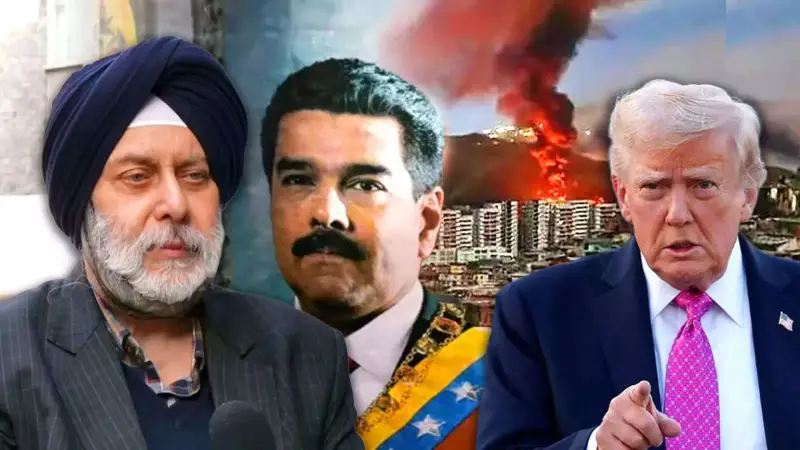
In a sharp critique of recent American military action, former senior Indian diplomat Manjeev Singh Puri has stated that the United States' strikes on Venezuela underscore a significant transformation in Washington's foreign policy under President Donald Trump. Puri's analysis, delivered on January 5, 2026, suggests the moves are driven by a clear set of presidential priorities.
Trump's Core Interests: Money, Power, and Legacy
Puri did not mince words in his assessment of the driving forces behind the US administration's strategy. He asserted that President Trump's focus appears unequivocally centered on three key elements: financial gain, the projection of power, and the shaping of his personal historical legacy. According to the ex-diplomat, this triad of motives is now visibly directing American actions on the global stage, with Latin America emerging as a surprising but crucial theatre for this agenda.
The Americas as an "Exclusive Sphere"
The former diplomat pointed directly to the US National Security Doctrine to explain the strategic rationale. He highlighted its renewed emphasis on the "western hemisphere," interpreting this as a signal that Washington now views the Americas as its exclusive sphere of influence. This explicit messaging, Puri warned, is a deliberate move that is bound to create unease and provoke reactions from other major global players who have interests in the region.

Global Repercussions and Regional Backlash
The consequences of this policy shift are already unfolding. Puri noted that the US action and its underlying doctrine have drawn sharp condemnation from regional powers like Mexico and Brazil, who view it as an overreach. Furthermore, he emphasized that such a bold assertion of hemispheric dominance is designed to, and will inevitably, unsettle both China and Russia. This dynamic raises profound concerns about escalating geopolitical tensions and presents a direct challenge to the existing frameworks of the global order, potentially leading to increased instability.
Puri's commentary paints a picture of a US foreign policy that is becoming more unilateral and interest-driven under Trump, with the Venezuela strikes serving as a potent example of this new approach. The warnings point to a period of heightened diplomatic friction as nations recalibrate their strategies in response to Washington's declared priorities.