

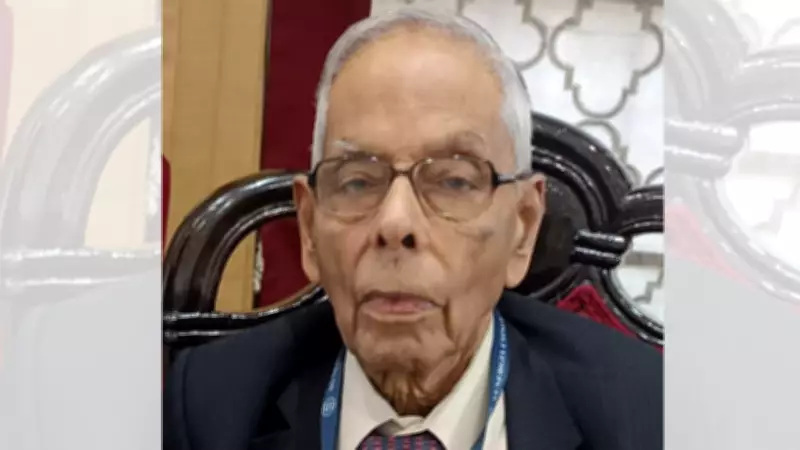
Former NSA M K Narayanan Defends India's Sovereign Right to Purchase Oil from Any Source
In a significant statement, former National Security Adviser and Intelligence Bureau chief M K Narayanan emphasized on Wednesday that India possesses every right to procure oil from wherever it is available, firmly rejecting any external conditions imposed by other nations. Speaking at the Synergia Conclave in Delhi, Narayanan articulated a robust stance on India's energy independence and geopolitical strategy.
Dismissal of Imminent Conflict with Pakistan
When questioned about the potential for another conflict with Pakistan, Narayanan provided a clear assessment. "Pakistan has enough problems to handle—with Afghanistan and Balochistan—to dare go for another conflict with India," he stated. He further elaborated that, in his view, another war with Pakistan is not imminent, especially in the aftermath of Operation Sindoor, which has bolstered India's strategic position.
Critique of US Pressure on Russian Oil Imports
Addressing the issue of US conditions on India regarding Russian oil imports, Narayanan, who served as IB chief from 2005 to 2014, highlighted India's policy of dynamic neutrality. "We have always borrowed the policy of dynamic neutrality. We have not sided with one country," he explained. He noted that Russia has been a consistent supplier of crude oil to India, and the nation will continue to buy oil based on price and availability.

However, Narayanan criticized the US for attempting to impose quotas and conditions. "Numerically, we need to make some changes. That is fine. But when it becomes a condition that is applied to you, then it affects our sovereignty," he asserted. He emphasized that India must balance its interests and not be compelled beyond a certain limit, referencing recent statements by the Indian foreign minister on handling such issues.
Response to US Attack on Iranian Warship
On the topic of a US torpedo attack on an Iranian warship in international waters off the Sri Lanka coast, Narayanan pointed to international maritime rules. He described the incident as an embarrassment for India, given that the Iranian ship was on a friendly visit to participate in Indian exercises. This underscores the complexities of maintaining diplomatic relations amidst global tensions.
Insights on Relations with Iran and China
Regarding India's interactions with Iranian leadership, Narayanan stated that there is nothing unusual, as India has always engaged with Iranian leaders and played a role in stabilizing regional situations. On the India-China face-off along the Line of Actual Control (LAC), he offered a nuanced perspective. "India and China are old civilizations. It is important for us to have peace on the border," he said.
He acknowledged that while India and China may not be on the same side, they should not be on opposite sides either. "Today, China doesn't want a conflict with India on the border as it has its own problems," he added, stressing the importance of diplomatic efforts to normalize situations when tensions arise. Narayanan also cautioned against outsourcing Indian diplomacy to the US or the West, advocating for a homegrown understanding of China.
Emphasis on Bangladesh Relations
Narayanan concluded by highlighting the importance of maintaining good relations with the new leadership in Bangladesh. "We are a bigger country. We have a vested interest in Bangladesh. So, we have to ensure good relations. Economically too, it makes sense," he remarked, underscoring the strategic and economic benefits of strong bilateral ties.






