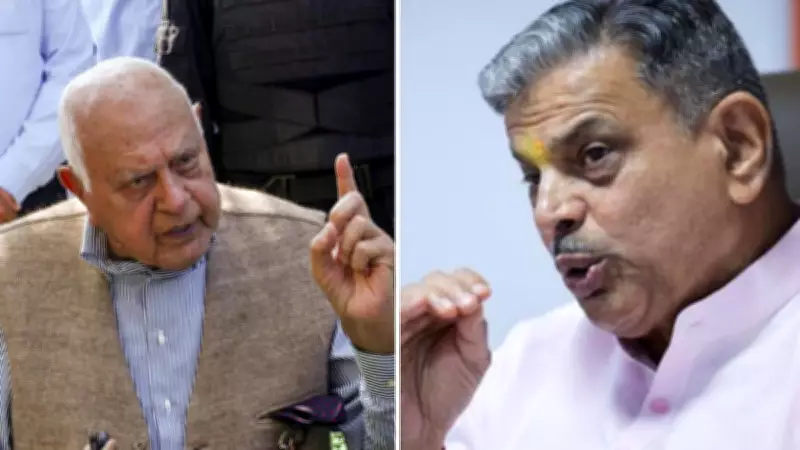
National Conference leader Farooq Abdullah has voiced support for RSS leader Dattatreya Hosabale's recent call for dialogue with Pakistan, stating that it is heartening to see that some people are finally recognizing that war is not an option. Speaking to media persons, Abdullah said, 'I am glad somebody is finally thinking that war is not an option. We have seen enough bloodshed on both sides. It is time to talk and resolve issues peacefully.'
RSS Leader's Statement on Pakistan Dialogue
Hosabale had earlier remarked that Pakistan's military and political leadership have lost India's confidence, and it is time for civil society to lead the way in fostering peace. He emphasized that people-to-people contacts and cultural exchanges could help bridge the gap between the two nations. 'The governments have failed to build trust. Now, civil society must step in to create an environment conducive to dialogue,' Hosabale had said.
Abdullah's Endorsement and Call for Action
Farooq Abdullah endorsed this view, adding that the people of both India and Pakistan desire peace. He urged the Indian government to take concrete steps towards resuming talks. 'We cannot keep living in a state of perpetual hostility. The economic and human cost is too high. Both countries need to focus on development and the welfare of their people,' he said.

The former Jammu and Kashmir chief minister also highlighted the need for addressing core issues, including the Kashmir dispute, through sustained dialogue. He stressed that any meaningful peace process must involve all stakeholders, including representatives from Kashmir.
Reactions and Political Implications
The remarks have sparked a debate within political circles. While some have welcomed the bipartisan support for dialogue, others have criticized the timing, citing recent cross-border tensions. However, Abdullah dismissed such concerns, stating that there is never a wrong time for peace. 'If we keep waiting for the perfect moment, we will never start talking. We have to take the first step,' he asserted.
The RSS, traditionally seen as a hardline organization on national security, has occasionally advocated for dialogue with Pakistan. Hosabale's statement marks a significant shift, as it comes from a top functionary of the organization. Political analysts view this as a possible indication of a broader consensus within the right-wing spectrum on the need for engagement.
Way Forward
Observers note that while civil society initiatives can help build goodwill, formal diplomatic channels remain essential for resolving bilateral issues. The Indian government has not officially responded to Hosabale's call or Abdullah's support. However, the growing chorus for dialogue from diverse quarters may put pressure on the government to reconsider its stance on resuming talks with Pakistan.
In conclusion, the unexpected alignment between Farooq Abdullah and the RSS on the issue of peace with Pakistan underscores a yearning for normalcy and cooperation in the region. Whether this translates into concrete policy changes remains to be seen, but it certainly opens a window for renewed discussions on one of the most complex bilateral relationships in the world.