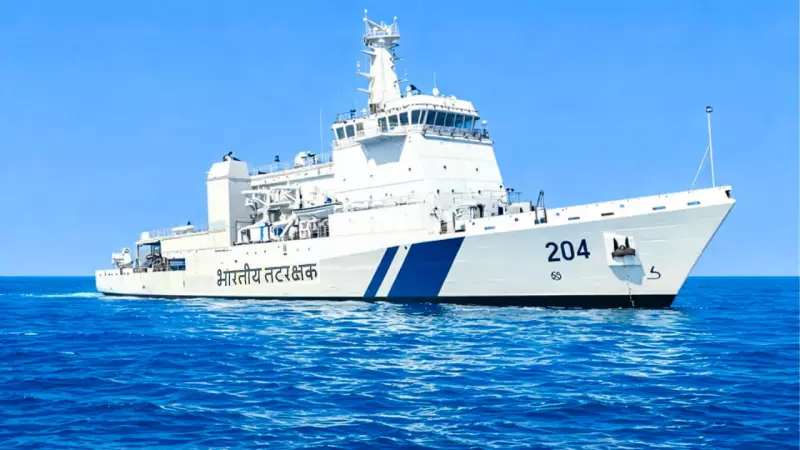
In a significant boost to India's maritime capabilities and its 'Aatmanirbhar Bharat' (self-reliant India) mission, Defence Minister Rajnath Singh commissioned the Indian Coast Guard's first indigenously designed and built pollution control vessel, 'Samudra Pratap', in Goa on Monday. The minister hailed the ship as a symbol of national resolve that will bolster the country's self-confidence.
A Milestone in Indigenous Defence Production
The commissioning ceremony marks a pivotal moment for India's domestic defence manufacturing. The 114.5-metre long vessel, constructed by the state-owned Goa Shipyard Limited (GSL), stands out with over 60% indigenous content. It is now the largest ship in the Indian Coast Guard's fleet, significantly extending its operational reach and endurance.
"Commissioning of this ship will increase our strength. This ship is the symbol of our collective resolve," stated Rajnath Singh during the event. He emphasized that as 'Samudra Pratap' advances against the waves, it will also strengthen the Coast Guard and India's self-assurance. While its primary design focus is pollution control, the minister noted its versatile capabilities in search and rescue operations, coastal patrol, and enhancing overall maritime safety.

Advanced Capabilities for Maritime Security
'Samudra Pratap' is a formidable addition, engineered to tackle modern maritime challenges. According to the Indian Coast Guard, the 4,200-tonne vessel can achieve speeds exceeding 22 knots and has an impressive endurance of 6,000 nautical miles. Its advanced systems are tailored to address oil spills, fire-fighting, and various security threats within India's Exclusive Economic Zone and beyond.
The ship's combat and operational suite is state-of-the-art, featuring:
- A 30mm CRN-91 naval gun.
- Two 12.7mm stabilised remote-controlled guns with integrated fire control.
- An indigenously developed Integrated Bridge System (IBS).
- An Integrated Platform Management System (IPMS).
- A high-capacity external firefighting system.
The vessel will be based at the ICG station in Kochi, strategically positioning it for operations.
India's Vision as a Responsible Maritime Power
Rajnath Singh connected the ship's induction to India's broader maritime vision, which views ocean resources as a shared heritage of humanity. "When a heritage is shared, the responsibility for its protection is also shared. That is why India today stands firmly on the global stage, guided by the principles of peace, stability, and environmental responsibility," he remarked.
He positioned India as a responsible maritime power committed to ensuring peace and stability across the Indo-Pacific region. The Defence Minister also issued a strong message on security, stating, "Our Coast Guard has instilled such fear in the minds of our enemies that if anyone dares to even cast an eye toward our borders, the Coast Guard will leave them in no condition to do so again."
Singh called upon the Indian Coast Guard to elevate its operational doctrines and technological innovations to set global benchmarks. He stressed the need to shape norms in maritime governance and advance cooperative frameworks, reinforcing India's leadership role in regional maritime safety and environmental stewardship.