

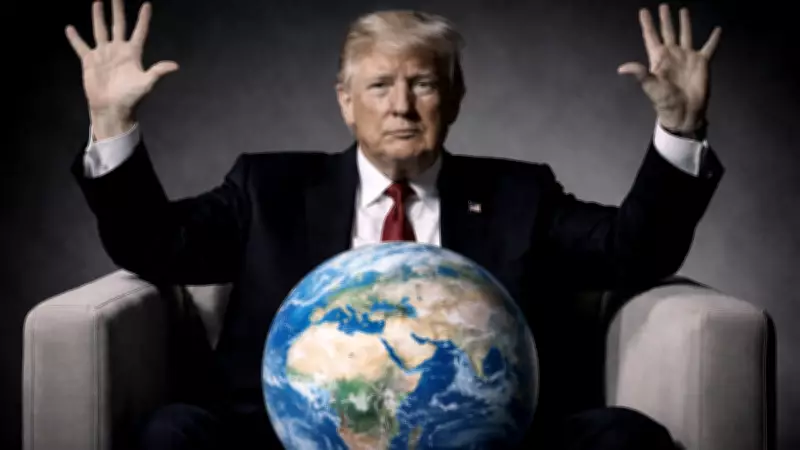
The Hollowing Center: How Trump's America First 2.0 Is Reshaping Global Order
In the political drama House of Cards, the most perilous moment arrives not during overt coups or scandals, but when characters realize the established rules no longer apply—yet institutions continue operating as if they do. This unsettling scenario now mirrors the global stage under Donald Trump's second presidency. For decades, the United States served as the anchor of the international system, often unpredictable but ultimately constrained by norms, alliances, and a sense of responsibility. Trump 2.0 has shattered this implicit contract, transforming "America First" from a disruptive subplot into the central premise of US foreign policy.
Alliances Under Unprecedented Pressure
Trump's hawkish "America First" policies are fundamentally reshaping alliance dynamics worldwide. Allies across regions are now planning for a reality where the US might withdraw support or impose punitive measures. Within NATO, for instance, member countries have agreed under US pressure to increase defense spending targets toward 5% of GDP, but this has come at the cost of eroded trust. By late 2025, US approval ratings among NATO citizens had plummeted to approximately 21%, with only Poland and Albania polling above 60% approval. In much of Northern Europe, less than 10% of citizens now approve of Washington's leadership, making the US nearly as unpopular as China among NATO publics.
Meanwhile, Trump's unilateral initiatives—such as the "Board of Peace" proposal and the raid on Venezuela—have prompted even traditionally aligned democracies to reassess their relationships. Brazilian President Lula da Silva explicitly told Trump that US actions in Venezuela "crossed an unacceptable line," even as he agreed to strengthen bilateral trade ties. Across South America, nations have demonstrated reluctance to endorse US brinkmanship in their region. This environment has created powerful incentives for friends to think twice about their dependence on Washington.

Accelerating Existing Trends Toward Multipolarity
While Trump's second presidency has exposed these shifts dramatically, it has largely accelerated trends already underway rather than creating wholly new realities. The movement toward multipolarity and regionalism predates Trump's return, but his aggressive tactics have magnified these developments exponentially. Trump's tariffs, alliance threats, and unilateral moves have made reliance on a single superpower appear riskier than ever before. Recent polling illustrates this starkly: only about 20-25% of citizens in NATO countries now approve of US world leadership—a level comparable to the lowest points of the Bush era.
This decline is directly attributable to Trump's policies. Europe's median approval of US leadership fell 14 percentage points in 2025 alone. In the same surveys, the European Union's own leadership enjoyed approximately triple the approval ratings of the US, hovering around 60%. Consequently, Trump's return has functioned less as a total paradigm shift and more as an ignition switch for contingency plans many nations were already sketching. Countries including Canada, European Union members, and Japan have quietly accelerated efforts toward "strategic autonomy"—building self-reliance and diversified international ties in anticipation of potentially unreliable US support.
Case Studies in Cautious Hedging
Canada's Strategic Recalibration exemplifies how middle powers are navigating this new reality. Prime Minister Mark Carney has been unequivocal in declaring that "the old rules-based order is over." His recent diplomacy demonstrates this pivot clearly: in January, Carney became the first Canadian premier in nearly a decade to visit Beijing, where he and President Xi Jinping agreed on a "new Canada-China strategic partnership" that eliminated crippling tariffs on agricultural staples like canola. Simultaneously, Carney has made clear that Canada will not pursue a comprehensive free-trade agreement with China if it risks triggering US retaliation.

Instead, Canada is pursuing diversification across Asia. Carney has announced new negotiations for a Comprehensive Economic Partnership with India, scheduling an early March visit to finalize agreements on nuclear energy, mining, and other strategic sectors. These moves are explicitly framed as hedges against US volatility. At Davos, Carney urged "middle powers like Canada to build coalitions to shape a fairer, more resilient world," noting that allies must work together to protect themselves from "the vagaries of the international order" now that the "natural rules-based order... is not functioning."
Australia's Cautious Adjustment follows a similar pattern, though with greater diplomatic caution. Asia-Pacific specialist Melissa Conley Tyler observes that Canberra long viewed the US as an indispensable security pillar, but today "there is a chasm" between Australian expectations and the Trump reality. Australia has contributed approximately US$3 billion under the AUKUS submarine pact to build US shipyard capacity, yet this substantial investment came without firm guarantees regarding delivery timelines—a concern mirrored in India's experience with delayed Apache helicopter deliveries from the US.
Rather than openly confronting Washington, Canberra has quietly broadened its diplomatic horizons. Foreign Minister Penny Wong has actively engaged Southeast Asian nations, advocating for a "strategic equilibrium" where "no country dominates" the region. This diplomacy aims to "reinforce rules and norms" without provoking direct US confrontation. Australia has simultaneously deepened ties with Japan, India, ASEAN states, and Pacific island nations to bolster its strategic autonomy.
Asia's Collective Response to Superpower Uncertainty
The hedging pattern extends comprehensively across US allies in Asia. Japan has found Trump's second term "far more brutal" than his first, prompting Tokyo to openly debate contingency plans. Faced with US tariff threats and defense demands, Japanese leaders are intensifying their hedging strategy through multiple approaches:
- Bolstering self-defense capabilities
- Recalibrating the US alliance framework
- Expanding security partnerships beyond Washington
Japan now looks to Europe as a partner in this endeavor, viewing initiatives like Ursula von der Leyen and Emmanuel Macron's push for "strategic autonomy" as relevant to Tokyo's own goals of greater independence. Similarly, South Korea has enhanced relations with China and Europe to offset trade friction while pursuing new multilateral frameworks—including trilateral dialogues with Japan and Australia—to supplement traditional US security guarantees.
Region-wide, Trump's return has provided added momentum to the Quad (US-Japan-Australia-India) and other Indo-Pacific forums designed to hedge against Chinese influence without relying exclusively on Washington. Across Asia-Pacific, the prevailing approach involves not alliance abandonment but strategic diversification: cultivating multiple partners, securing multilateral backing, and planning for scenarios where US leadership proves unreliable.
Europe's Defiant Recalibration
In Europe, the dilemma appears particularly acute: how to resist US pressure while maintaining reliance on American security guarantees. NATO remains central to European defense, yet Trump's behavior has sparked renewed commitment to "strategic autonomy." EU officials have lamented the fraying of traditional protective shields as NATO unanimity faces testing through Trump's threats and demands. French President Macron has declared he will not be "blackmailed" or deterred by "intimidation," while the EU has coordinated condemnation of Trump's tariff threats against Denmark and other members.
Simultaneously, Europe is pursuing economic hedging with renewed vigor. Since the onset of US tariffs, the EU has accelerated major trade agreements worldwide, concluding deals with Mercosur, Indonesia, Mexico, and Japan throughout 2025. On January 27, 2026, the EU announced a landmark comprehensive free-trade accord with India covering nearly all goods and services, accompanied by a separate mobility pact easing visas for skilled workers. EU leaders explicitly framed this agreement as part of a diversification strategy, noting it was "propelled" by US tariff threats and aimed at "boosting trade and reducing reliance on the US."
Unconventional Alignments and Transactional Diplomacy
While Trump's return has unsettled traditional alliances, it has also fostered unexpected realignments. Pakistan has emerged as an unlikely beneficiary of Trump's second presidency, repairing ties through a calculated charm offensive centered on resource diplomacy. Pakistan's army chief, Field Marshal Asim Munir, presented Trump with samples of Pakistan's untapped rare earth and critical mineral reserves during White House meetings, highlighting what Islamabad could offer a resource-hungry America seeking to diversify supply chains dominated by China.
This pitch has yielded tangible results: US and Pakistani entities have announced deals worth approximately $500 million to develop Pakistan's rare earths and critical minerals sector. Islamabad made its first symbolic shipment of rare earth minerals to the United States in late 2025—small in volume but significant in geopolitical messaging. Pakistan has further aligned with Trump-friendly economic ideas, floating plans for a strategic bitcoin reserve and dedicating surplus energy to cryptocurrency mining and data centers.
India's Strategic Multialignment
India exemplifies cautious, low-drama hedging in this volatile environment. New Delhi has largely avoided open confrontation with Washington while quietly diversifying economically and diplomatically. India recently concluded the EU-India free trade agreement, pledging to double trade between the two by 2032. Simultaneously, India has begun reducing its US dollar exposure in trade, with the Reserve Bank of India proposing to link BRICS countries' digital currencies to facilitate trade and decrease dollar reliance as "geopolitical tensions rise."
These steps reflect India's longstanding "multi-alignment" strategy: resisting formal alliances while engaging all major powers to safeguard national interests. By expanding partnerships globally, India gains alternate markets and currency options while maintaining functional ties with the United States.
Lasting Transformations in the Global Order
The critical question remains whether Trump's disruption represents a temporary shock or permanent transformation. Many diplomats believe the effects will prove enduring. Even if future US administrations adopt softer approaches, the trauma of recent years has fundamentally altered perceptions. Allies now expect less stability from Washington and have consequently baked diversification and self-reliance into their long-term strategies.
Traditional security clients like Saudi Arabia and the UAE have deepened ties with China and Russia in recent years. Following Trump's Greenland tariff controversy, European leaders moved swiftly to ratify new trade agreements demonstrating independence. In Asia, Japan and Australia openly discuss defense plans that emphasize self-reliance alongside alliance commitments. Trump 2.0 has reshaped how governments conceptualize alliance dependencies and sovereignty, with the lesson being that alliances must be carefully guarded and no ally should become a "free rider."
Countries appear to have accepted that the "high trust" era in transatlantic relations has concluded, leading them to hedge against future surprises. This suggests the disruption has semi-permanent characteristics, likely producing a more cautious world order where alliances retain importance but hedging becomes standard strategic practice.
The Emerging Global Landscape
Donald Trump's "America First 2.0" has undeniably jolted the international system, but rather than creating complete rupture, it has accelerated a multipolar realignment already underway. The true danger lies not in overnight collapse but in gradual hollowing—the system continues functioning outwardly while its center quietly erodes. Like the dramatic turning point in House of Cards, the crucial development arrives when participants realize rules have become optional and begin acting accordingly.
Trump's second presidency has forced this realization into the open. Allies still attend summits, sign communiqués, and employ the language of partnership, but behind diplomatic facades, they are drafting contingency plans, diversifying dependencies, and rehearsing for futures where Washington represents a variable rather than a constant. Middle powers including Canada and Australia, alongside numerous European and Asian nations, are quietly recalibrating through diversified trade, regional bloc formation, and strengthened rules-based ties among themselves.
What emerges is a world less anchored and more improvised, where power disperses across overlapping networks of trade, security, and influence rather than concentrating in a single capital. Middle powers are no longer content to serve as supporting characters in a Washington-led drama; they are co-producing the next season, hedging against the possibility that the lead actor might walk off set unexpectedly. This represents the new reality of global affairs—a system adapting to uncertainty through strategic diversification rather than relying on traditional anchors that may no longer hold.





