

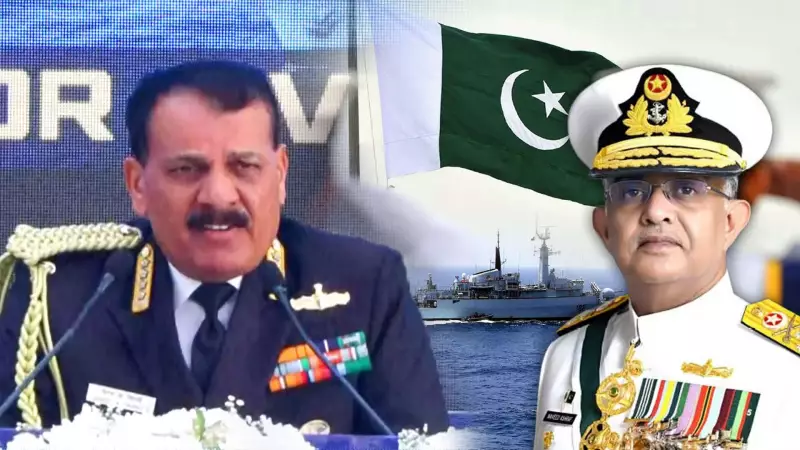
In a significant disclosure, Indian Navy Chief Admiral Dinesh K Tripathi has provided detailed insights into the maritime dynamics during the high-stakes Operation Sindoor in May 2025. The revelation confirms the Indian Navy's overwhelming dominance, which effectively neutralised Pakistan's naval capabilities and prevented any intervention from the sea.
Complete Maritime Dominance During Critical Strikes
Admiral Tripathi confirmed that India's Carrier Battle Group was deployed with an aggressive posture and rapid speed of mobilization. This decisive naval strategy ensured that Pakistan's warships never ventured beyond their coastline during the entire operation. The Indian Navy's show of force and strategic positioning created an impenetrable maritime barrier.
The context of this naval standoff was the series of precision strikes conducted by India on May 7, 2025. Indian forces targeted over 100 terrorist launch pads and camps deep inside Pakistani territory. While Islamabad attempted to escalate the situation, the Indian Navy's preemptive and dominant stance in the Arabian Sea served as a critical deterrent.

Why Pakistan's Navy Remained in Port
The Indian Navy Chief's account explains the factors that forced the Pakistan Navy to stay confined to its ports. The speed and scale of the Indian Navy's mobilization left little room for a Pakistani response. India's Carrier Battle Group, a formidable force centered on an aircraft carrier, its combat aircraft, and supporting warships, established undisputed sea control.
This control was maintained uninterrupted from the start of the strikes on May 7 until the ceasefire took effect on May 10, 2025. For those three crucial days, the Indian Navy guaranteed that the sea lanes remained under its command, securing India's maritime flank and demonstrating strategic superiority.
Strategic Implications and Regional Message
The successful execution of Operation Sindoor's maritime component sends a powerful message about India's naval prowess and readiness. The ability to completely pin down a rival's naval assets during a period of conflict is a testament to advanced planning, operational capability, and technological edge.
Analysts view this as a clear demonstration of India's capacity to conduct multi-domain operations, where actions on land, such as the cross-border strikes, are seamlessly supported and protected by dominance at sea. The episode underscores the Indian Navy's role as a key instrument of national power and deterrence in the region.
The revelations by Admiral Tripathi finally provide official clarity on a chapter that was widely discussed in strategic circles. They highlight how decisive naval power can shape the outcome of a broader military and diplomatic confrontation, ensuring that India's actions on land were carried out without the threat of a maritime counter.






