

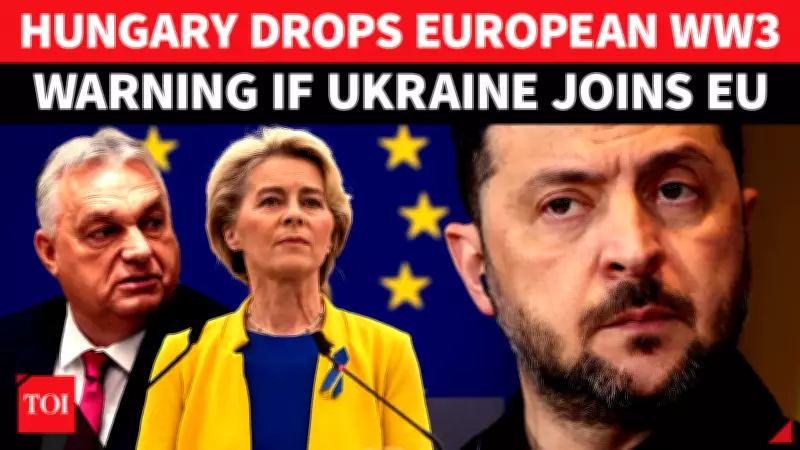
Hungary Issues Stark Warning: Ukraine's EU Accession Could Plunge Europe Into Armed Conflict
Hungary's Minister for European Union Affairs, Janos Boka, has delivered a sobering assessment that Ukraine's potential entry into the European Union could have catastrophic consequences, potentially dragging the entire bloc into direct armed conflict. In a comprehensive interview that has sent shockwaves through diplomatic circles, Boka articulated concerns that go beyond conventional political discourse, touching upon fundamental questions of European security architecture.
The Article 42 Conundrum: From Economic Bloc to Military Alliance
At the heart of Boka's warning lies Article 42 of the EU treaty, specifically the mutual military assistance clause that has existed within the framework but rarely been the subject of such urgent scrutiny. The Hungarian minister argued that what he termed "creative interpretation" of this provision could effectively transform the European Union from primarily an economic and political union into a full-fledged military alliance.
This reinterpretation, according to Boka, would create binding defense obligations that could force all member states into direct confrontation with nuclear powers. The implications are particularly concerning given the ongoing geopolitical tensions surrounding Ukraine, where external powers with significant military capabilities are already involved.

Europe's Preparation for Conflict: Defense Spending and Conscription Trends
Boka further alarmed observers by suggesting that Europe's political leadership appears to be preparing for potential conflict by 2030. He pointed to several concerning indicators that, in his view, suggest a continent moving toward military readiness rather than diplomatic resolution:
- Rising defense budgets across multiple EU member states, reversing decades of post-Cold War military spending reductions
- Renewed conscription discussions in several European countries that had previously abolished mandatory military service
- Escalating war rhetoric in political discourse that normalizes conflict as a potential policy outcome
These developments, according to the Hungarian minister, create an environment where Ukraine's EU accession could serve as a trigger mechanism for broader military engagement.
Broader Context: Energy Politics and EU Membership Tensions
The warning comes against a backdrop of multiple geopolitical tensions involving Hungary within the European Union framework. Budapest has mounted a legal challenge against the EU's proposed ban on Russian energy imports, highlighting the complex interplay between energy security, economic interests, and geopolitical alignments.
Furthermore, there are growing tensions regarding Ukraine's path toward EU membership, with Hungary expressing reservations that go beyond the technical criteria typically discussed in accession negotiations. Boka's remarks suggest these concerns are rooted in fundamental questions about the EU's future character and security commitments.
The Hungarian position raises critical questions about how the European Union balances expansion with security, particularly when prospective members are engaged in active conflicts. It also highlights divergent views within the bloc about the appropriate relationship between economic integration and military obligations.
As Europe navigates these complex challenges, Boka's warning serves as a stark reminder that decisions about enlargement carry implications far beyond economic policy and regulatory alignment, potentially reshaping the continent's security landscape for generations to come.






